Hipot & Electrical Safety Testers

Vitrek is a global leader in electrical safety testing equipment, offering a complete family of AC/DC hipot testers, insulation resistance testers, ground bond testers, and automated high-voltage test systems. Designed for manufacturing, laboratory, and compliance testing, Vitrek’s V10X, 95X, and V7X Series provide industry-leading voltage ranges, exceptional measurement accuracy, and advanced automation capabilities to support IEC, UL, CSA, and other international electrical safety standards. Whether testing medical devices, industrial equipment, aerospace systems, consumer electronics, or EV components, Vitrek delivers the performance, reliability, and flexibility required for today’s demanding production and quality assurance environments.

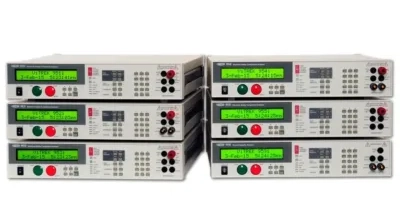
  • 95X Series: High output power, wide voltage ranges, and industry-leading leakage current measurement resolution for demanding production and compliance testing.
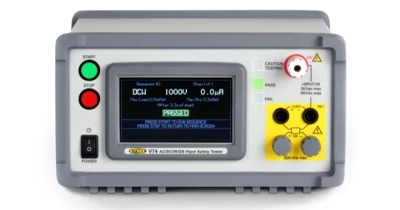
  • V7X Series: Compact, lightweight, and cost-effective hipot testers that deliver reliable performance for everyday electrical safety testing.
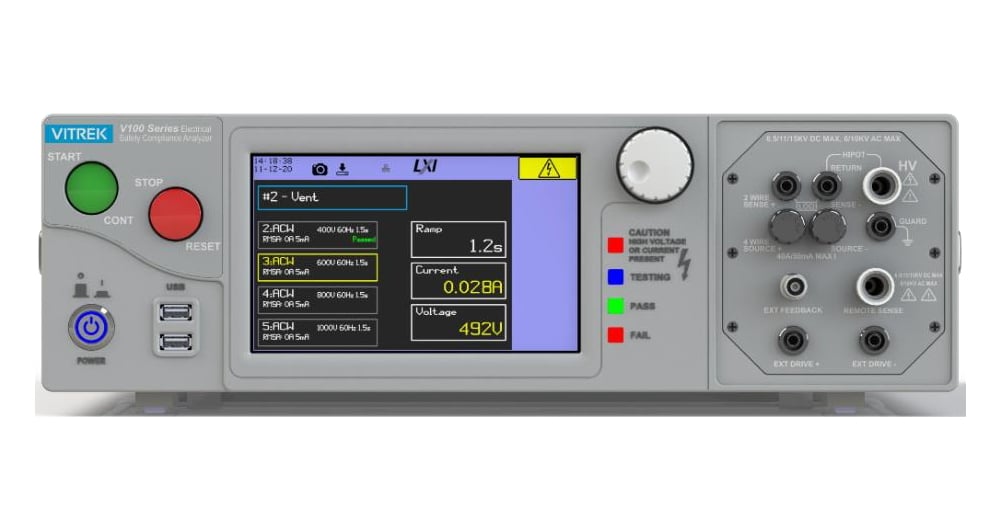
  • V10X Series: Vitrek’s most advanced platform, providing up to 30 kV output, 100 picoamp leakage current resolution, integrated insulation resistance and ground bond testing, an intuitive touchscreen interface, and powerful automation features.

All Vitrek hipot testers include built-in Ethernet, USB, and remote control interfaces for seamless integration with automated production systems and are fully compatible with QT Insite™ software. They can also be combined with Vitrek High Voltage Switching Systems to create scalable, multi-point electrical safety test solutions. Backed by expert application support, accredited calibration services, and industry-leading customer service, Vitrek helps manufacturers improve throughput, ensure compliance, and maintain the highest levels of product safety.
V10X Series

10x series hipot tester
  • Up to 30 kV AC Output
  • Industry-Leading 100 picoamp leakage resolution
  • Integrated low-ohms and ground bond capability
  • Color touchscreen enables intuitive test creation
  • Integrated barcode support

95X Series

  • High AC & DC Output
  • Low Leakage Measurement
  • 4-Wire Milli-Ohmmeter – Up to 100K ohms
  • Tera-ohm Insulation Resistance
  • Optional 40A Ground Bond

V7X Series

  • AC & DC Output up to 5KV
  • High Current Output – 20mA AC / 10mA DC
  • Insulation Resistance – Up to 90 Giga-ohms at 1000V
  • Leakage Detection – Down to 0.1 micro-amp
  • Optional 30A Ground Bond
  • 16-Channel Switching

Key Features and Benefits of Vitrek Hipot Testers

Industry-Leading Safety Features

  • Ground Fault Interrupt (GFI) & Safety Fault Interlock (SFI™): Ensures high-speed shutdown for leakage faults and interlock failures, preventing accidents during hipot electrical testing.
  • Test Lead Safety Sense (TLSS™): Verifies proper test lead connections before and during HV testing for added protection.
  • Recessed Start Switch: Prevents accidental activation for operator safety during hipot electrical safety testing.

High-Performance Voltage & Current Capabilities

  • Voltage Range Options: Choose from 5KV, 6.5KV, 15KV, or up to 30KV RMS AC for diverse hipot test applications.
  • High Power Output: Up to 50mA DC sourcing and 200mA AC drive, tackling demanding hipot tests with ease.

Accurate Testing

  • Ultra-Fast Test Execution: Ramp rates up to 50KV/sec, dwell times as low as 20ms, and test completion in just 3ms (Flash mode).
  • Multi-Dwell Functionality: Perform multiple voltage level tests without resetting, simplifying dielectric property analysis.
  • Pico-Amp Leakage Measurement: Accurately detects the lowest leakage current levels for reliable insulation testing.
  • Milli-Ohmmeter Function: 5-digit resistance measurements with 100µΩ resolution for precise low-resistance testing.

Advanced Automation & Integration

  • Expansive Test Memory: Stores up to 100 test programs with 999 steps, ensuring repeatability in production environments.
  • Multiple Connectivity Options: Standard Ethernet, USB, RS232, Digital I/O, with optional GPIB for full automation.
  • Multi-Channel Testing: Compatible with 964i HV Scanners, enabling up to 256-point switching for large-scale production testing.

Advanced Automation & Integration

  • Expansive Test Memory: Stores up to 100 test programs with 999 steps, ensuring repeatability in production environments.
  • Multiple Connectivity Options: Standard Ethernet, USB, RS232, Digital I/O, with optional GPIB for full automation.
  • Multi-Channel Testing: Compatible with 964i HV Scanners, enabling up to 256-point switching for large-scale production testing.

Compliance & Industry-Specific Testing Capabilities

  • Meets UL, CSA, IEC, and CE Safety Standards: Ensures compliance for electrical product certification.
  • 400Hz AC Testing: Provides aviation-frequency specific results for aerospace and avionics applications.
  • Capacitance Test Modes: Ideal for solar panel and high-capacitance load testing with controlled charge/discharge profiles.

Specialized Testing Applications

  • Hipot and Insulation Resistance Testing: Combined testing capabilities for comprehensive electrical safety analysis.
  • Ground Bond Testing: Integrated ground bond test equipment functionality.
  • Dielectric Withstand Testing: Complete dielectric testing machine capabilities.

User-Friendly & Cost-Effective Design

  • Intuitive 4.3″ Color Touch Display: Easy-to-use interface for quick setup and operation.
  • Lightweight & Compact: Rugged, fan-free, and easy to transport, weighing as little as 8.2 kg.
  • Extended Calibration Intervals (Up to 3 Years): Reduces maintenance costs while ensuring long-term accuracy.
Request a Free Demo

Fill out my online form.

FAQs about Hipot Testers

A hipot tester (short for high potential tester) is a specialized electrical safety testing device, and often considered a core component of an electrical safety analyzer, designed to verify the dielectric strength of insulation in electrical components, cables, and products. It applies a high-voltage AC or DC signal to ensure that the insulation can withstand the required voltage without breaking down or leaking excessive current.

A hipot tester is also known as a dielectric withstand tester, dielectric strength tester, dielectric breakdown tester and insulation resistance tester.

An electrical safety analyzer is a versatile instrument used to evaluate the electrical safety of devices and equipment. It typically combines multiple testing functions, including hipot testing (AC and DC), insulation resistance testing, ground bond testing, leakage current measurement, and others. By integrating these tests into a single instrument, an electrical safety analyzer streamlines the testing process, improves efficiency, and ensures comprehensive safety assessments. These analyzers are crucial in manufacturing, research and development, and quality control for various industries.

Ground bond tester (earth bond tester) verifies the integrity of an electrical device’s grounding connection, ensuring a low-impedance path for fault current to prevent electrical shock. A ground bond tester injects high current into the ground circuit and measures resistance—low resistance indicates a good connection. Many electrical safety analyzers combine HiPot and ground bond testing for streamlined testing.

Electrical insulation plays a vital role in preventing current leakage and ensuring safe operation. Hipot testers are used across various industries, including manufacturing, aerospace, medical devices, and consumer electronics, to:

  • Detect insulation defects before product deployment: Prevent issues before they reach the field.
  • Ensure compliance with international safety standards (IEC, UL, ANSI, etc.): Meet regulatory requirements for safety and performance.
  • Reduce the risk of electrical failures and safety hazards: Improve reliability and workplace safety.
  • Maintain quality assurance in production lines: Ensure consistent and high-quality manufacturing standards.
Hipot testing is widely used in various industries, including:

  • Electronics Manufacturing: Testing circuit boards, transformers, and connectors.
  • Medical Equipment: Ensuring safety in life-saving devices.
  • Automotive Industry: Verifying insulation integrity in electric vehicles.
  • Aerospace & Defense: Maintaining high reliability in aircraft and defense systems.

HiPot testing ensures electrical safety compliance across industries. Key standards include:

  • International (IEC): IEC 60950 & 62368 (IT & AV), IEC 60601 (Medical), IEC 61010 (Industrial), IEC 60335 (Household), IEC 60065 (Audio/Video)
  • North America (UL, CSA, NEC): UL 62368 (IT), UL 60601 (Medical), UL 508 (Industrial), NFPA 70 (NEC), CSA C22.2 (Canada)
  • Europe (CE Marking, EN): EN 62368 (IT), EN 60601 (Medical), EN 61010 (Industrial)
  • Automotive & Aerospace: ISO 6469-3 (EV Safety), RTCA DO-160 (Aerospace), MIL-STD-202/810 (Military)
  • Industrial & Power: IEEE 95 & 118 (Insulation), NEMA 250 (Enclosures), ANSI C37 (Switchgear)

According to industry safety standards, the main hipot tests include:

  • AC Dielectric Withstand: Tests insulation under alternating current conditions.
  • DC Dielectric Withstand: Ideal for devices normally operating under DC.
  • Insulation Resistance (IR): Verifies that the resistance between conductors exceeds required levels.
  • Ground Continuity: Ensures the chassis is safely connected to the ground.
  • Ground Bond: Validates the integrity of the ground path with high current injection.

Vitrek hipot testers support all of the above, providing programmable test sequences for automation.

  • Ground Continuity tests low current resistance between the ground pin and conductive surfaces to ensure there’s a complete path.
  • Ground Bond testing goes further by applying high current (up to 40A) to verify the mechanical integrity of the ground connection—critical for detecting weak or loose ground paths that might fail under stress.

Most certification agencies like UL, ETL, and CSA require:

  • Annual calibration to ISO17025 standards.
  • Daily functional checks using PASS/FAIL verification samples.
  • Documentation of test equipment condition and performance as part of NRTL audits.

Vitrek hipot testers support long calibration intervals (up to 3 years), reducing downtime while maintaining compliance.

The Fundamentals of Electrical Safety Testing white paper white paper highlights critical safety mechanisms such as:

  • Built-in discharge circuits for DC tests
  • Operator interlocks to prevent accidental energization
  • Palm switches, foot switches, and light curtains to prevent operator contact during testing
  • Key locks to secure test program integrity
  • Warning lights and signage to indicate high voltage presence
  • Vitrek hipot testers are equipped with all of these, ensuring maximum operator protection.

According to Vitrek’s safety guidelines:

  • Use non-metallic benches and isolated test areas
  • Clearly label the station with “DANGER – HIGH VOLTAGE”
  • Avoid distractions and foot traffic near the test zone
  • Verify proper grounding of the tester to earth before starting tests
  • Never disable interlocks or safety guards
  • Ensure operators are trained in compression-only CPR
  • Contamination (e.g., dust or solder flux) causing excessive leakage current
  • Insufficient clearance (air gaps between components)
  • Inadequate creepage (distance across surfaces)
  • Loose or damaged insulation
  • Improper ground connections
  • Creepage: Distance along a surface between two conductive parts.
  • Clearance: Shortest air path between two conductive elements.

Hipot testing helps ensure that creepage and clearance meet the minimum safety requirements set by international standards.

The standard test voltage is calculated as:

  • 1000V + 2 × the normal operating voltage
  • For DC hipot on AC circuits, the rule of thumb is:
  • DC Voltage = 2 × 1.4 × RMS voltage + 1000V
  • Different product classes (e.g., double-insulated devices) may require higher voltages per specific safety standards like IEC 61010 or UL 508.

A failed test may indicate:

  • Dielectric breakdown (sudden, uncontrolled current flow)
  • Excessive leakage current
  • Improper assembly, contamination, or damaged insulation
  • The DUT should be immediately discharged, inspected, and retested under supervision. Persistent failures may require a product design review.
  • AC Hipot: Alternates polarity, better simulates real-world AC usage, no residual charge after testing.
  • DC Hipot: More sensitive to insulation defects; preferred for high-capacitance loads. Requires safe discharge due to stored energy.

Some standards specify which to use based on the operating conditions of the DUT.

Leakage current is the small amount of current that “leaks” through insulation or other unintended paths. If too high, it could cause:

  • Electric shock hazards
  • Regulatory compliance failures
  • Equipment malfunction
  • Vitrek hipot testers can measure leakage currents down to the picoamp level, allowing early detection of defects or contamination.

These are safety interlock mechanisms:

  • Palm switches require both hands to be engaged, keeping them away from the DUT.
  • Foot switches enable hands-free initiation but can be combined with enclosures or light curtains.
  • Their use ensures the operator cannot accidentally come into contact with live test voltages.