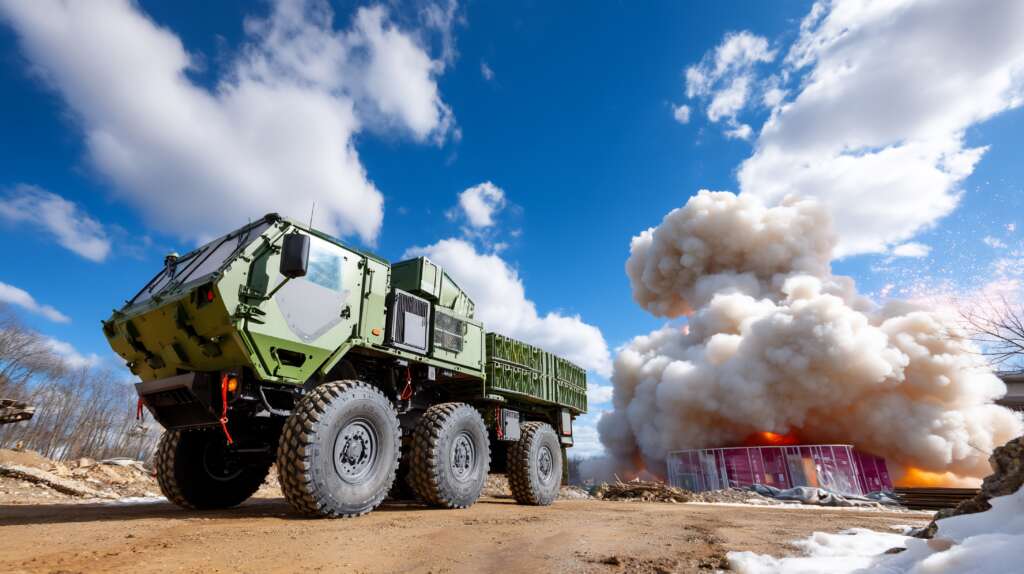
Gage System for Monitoring Explosion Testing
A military customer conducts explosion testing at a proving ground, where ordnances are detonated in a controlled environment surrounded by a network of sensors. Data collected during the detonation are used to characterize the explosion, with particular focus on parameters such as explosion intensity, symmetry, and the velocity of the blast front.
The two primary types of sensors used in these tests are pressure sensors and accelerometers, which can make extreme measurements, such as pressures of several thousand atmospheres and accelerations of several thousand times gravity (g), respectively. These sensors typically have a wide frequency response, ranging from below 1 Hz up to 1 MHz. Additional sensors include simple conductive wires. These act as binary break detectors that lose electrical continuity when severed by the blast.
The electrical outputs of all sensors are amplified to swing by a significant fraction of a volt during the explosion. Some sensor outputs are designed to drive a 50 Ohm load, while others require high-impedance inputs. Acquisition of waveforms from all sensors must be triggered precisely by the detonation event.
To standardize their data acquisition platform, the customer selected the Gage Octopus CompuScope 8389 digitizer. This unit offers:
- 14-bit vertical resolution
- 125 MegaSamples/second (MS/s) simultaneous sampling across all channels
- Multiple input voltage ranges for optimal dynamic range utilization
- 2 GigaSamples of onboard memory, providing 250 MegaSamples per channel, sufficient to record several seconds of data per event at a typical sampling rate of 10 MS/s.
The Octopus also supports both 50 Ohm and 1 MΩ (high-impedance) terminations, meeting the input requirements of the various sensors. Multiple Octopus cards may be synchronized either within a single PC chassis or across multiple chassis, enabling scalable, high-channel-count systems.
Waveform acquisition is performed using GageScope, Gage’s flagship oscilloscope software, which supports multi-card configurations and can save complete event datasets. All acquired waveform data can then be exported and post-processed using tools like MATLAB, enabling detailed analysis of each explosion.