Introduction
Modern military testing and measurement demand accuracy, reliability, and compatibility with both legacy and advanced systems. From avionics certification to explosive testing and radar imaging, defense engineers face unique challenges where precision digitization is critical. Outdated equipment often struggles to keep up with extreme conditions or interoperability requirements, putting mission readiness and safety at risk.
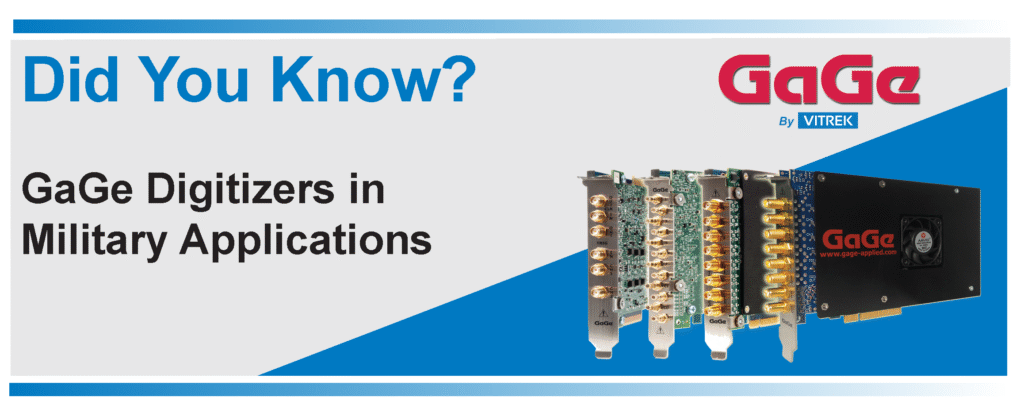
GaGe digitizers provide a bridge between past and future—delivering high-resolution, high-speed data acquisition while seamlessly integrating into established platforms. Whether it’s extending the life of legacy avionics test systems, capturing the violent transients of explosive events, or ensuring phase coherence in Synthetic Aperture Radar (SAR) applications, GaGe technology empowers defense teams with the tools needed to preserve mission-critical accuracy and insight.
Legacy Test System Challenges :
Preserving Mission-Critical Compatibility with Gage Programmable Digitizers

Challenge
A military customer relied on a legacy 1980s avionics test system to certify Line replaceable Units (LRUs) for a jet platform. A critical instrument—a 2-channel, 8-bit, 200 MS/s box digitizer—was obsolete, required frequent calibration, and communicated via GPIB with outdated software. Replacing it was difficult because the new unit had to behave identically to the original to preserve system compatibility.
How the GaGe Digitizer was used
Gage delivered a modern 2-channel, 8-bit, 200 MS/s digitizer card integrated into a rugged rackmount Windows PC with GPIB connectivity.
Engineers customized the digitizer’s sampling rates, input ranges, and startup behavior, and developed a LabVIEW shell to emulate the legacy unit’s command protocol. The replacement system operates headlessly, requires no routine calibration, and integrates seamlessly with he existing test software. Multiple units have been deployed, reliably testing thousands of LRUs and extending the life of the legacy test platform.
From Shockwaves to Insights:
Digitizing Data in Military Explosive Testing Applications
Challenge
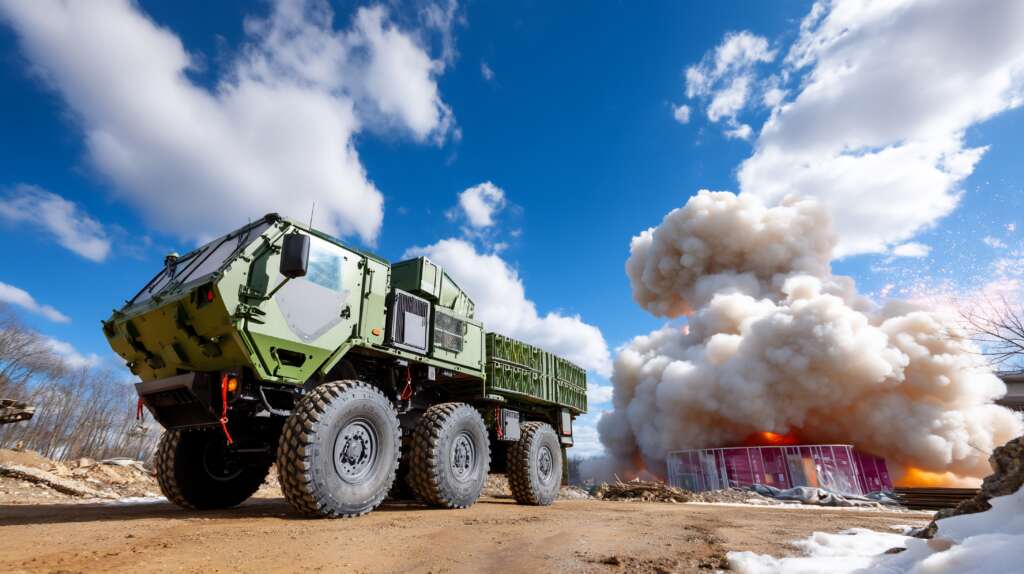
Explosion testing pushes measurement systems to their limits. Pressure transducers and accelerometers must endure thousands of atmospheres and accelerations of thousands of g’s, all unfolding in microseconds. The resulting signals mix sharp spikes with frequencies spanning from sub-1 Hz shifts to oscillations above 1 MHz.
The real challenge is capturing these extremes without distortion while preserving subtle waveform details essential for analyzing explosive dynamics. Conventional data acquisition often falls short—low-resolution digitizers clip peaks, and limited sampling
rates miss fast transients—leading to lost insights into safety performance and material behavior.
How GaGe Digitizers were used
The GaGe Octopus CompuScope 8389 digitizer is purpose-built for capturing high-energy, short-duration events. Its 14-bit resolution preserves fine amplitude detail, while 125 MS/s simultaneous sampling across all channels ensures accurate tracking of microsecond-scale transients. Adjustable input ranges let engineers optimize dynamic range, preventing saturation of large signals while still capturing small fluctuations. These capabilities deliver precise digitization of complex explosive waveforms, enabling detailed event reconstruction, sensor validation, and better safety and design decisions.
Synthetic Aperture Radar (SAR) Precision:
Capturing I/Q Signals with the GaGe Sabre Digitizer.
Challenge
Synthetic Aperture Radar (SAR) requires precise, phase-coherent capture of radar echoes to form sharp, reliable images. In X-Band systems, signals must be down-converted and digitized as I/Q pairs, with exact timing maintained across multiple channels. Even small jitter or phase misalignment can blur imagery, reduce moving-target detection, and compromise mission-critical intelligence.
How the GaGe Digitizer was used
The Gage Sabre digitizer meets this challenge with four synchronized input channels, 16-bit resolution, and sampling rates up to 250 MS/s. Its architecture delivers less than 5 ps of inter-channel jitter, ensuring coherent acquisition across receivers. By locking both digitizer and down-converters to a GPS-disciplined 10 MHz reference, timing stability is guaranteed. With deep onboard memory and high-speed streaming-to-RAM, the Sabre supports extended SAR missions, enabling defense teams to capture, analyze, and act on radar intelligence with confidence.