
Electron Spin Resonance (ESR) Experiment
Electron Spin Resonance (ESR) Experiment Customer Case A customer has an Electronic Spin Resonance (ESR) experiment. ESR is based on the fact that the magnetic moment of an electron precesses in an applied magnetic field, not unlike a child's top in a gravitational field, at a well-defined frequency called the Larmor frequency. Electromagnetic radiation at the Larmor frequency, when impinging on such an electron, will be preferentially absorbed. This principle is identical to that employed in Nuclear Magnetic Resonance (NMR), where the atomic nucleus precesses. In NMR, Larmor frequencies are of order 100 MHz. Because the electron is 2000 [...]
Nuclear Ion Testing
Nuclear Ion Testing Customer Case This customer is involved in nuclear ion testing. The pulse amplitudes of nuclear ions from a detector must be measured and sorted into a histogram, which will show the number of times a given amplitude was received. The customer wants a "multi-channel analyzer" capable of analyzing 4,000 to 8,000 "channels." In the customer's terminology, "channels" are actually histogram bins. The customer has pulses coming in at 20 - 30 ms minimum interval and needs to peak detect (calculate the maximum value of the pulse). Then, based on peak height, each is stored in a [...]
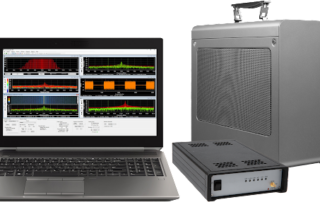
Time for a New Webinar — New Virtual Product Training Coming for Our Ultra-Portable RF Recording Solutions
When it comes to using the Vitrek family of products, knowing how to properly implement and understand the data they provide is of the utmost importance. While some people have prior knowledge of our products, it’s not out of the question that you might need a refresher course or a deeper dive into what makes these products tick. Our online training webinars provide our customers with the ability to speak with our industry experts and acquire the product knowledge training they need. […]
Alpha Particle Counting
Alpha Particle Counting Customer Case A customer has to characterize a new design for a solid state alpha particle detector. The detector is essentially a silicon diode with a large area face. Because alpha particles, which are high-speed helium nuclei, are electrically charged, they interact strongly with matter and lose their energy quickly upon entering a solid. When an alpha particle decelerates within the depletion region of the diode, it creates electron-hole pairs. The carriers are collected by the diode's electrodes and create a measurable current pulse. The customer's experimental solid state detector has two implanted electrodes whose signals [...]
Laser Spectroscopy
Laser Spectroscopy Customer Case An academic researcher is studying the attenuation properties of different materials inside Laser cavities for applications in Laser Spectroscopy. The Laser pulses are generated by one Laser, and are then transmitted by mirrors into another cavity filled with gaseous material. In the second cavity, the light pulses are continuously reflected by opposite mirrors and their intensities are measured by a transducer which converts them into decaying pulses of 30 nanosecond width. The decay takes about 40 microseconds to settle. The researcher is required to capture the decaying pulses and save the captured data onto the [...]
Laser Transient Absorption Spectroscopy
Laser Transient Absorption Spectroscopy Customer Case The customer's setup is a scientific application in which transient signals from a Laser Absorption Spectroscope are transferred to a computer. The laser power is modified in steps and the process is repeated. The measurement sensitivity is limited by noise generated by the current digitizer. The customer wants to capture and continuously average very small pulse responses. The lowest signal pulse height is 0.5 milliVolts and can range up to 2 mV. The duration of each response pulse is 1 to 10 microseconds. The Pulse Repetition Frequency (PRF) is 10 Hz. The customer's [...]
Charge-Couple Device (CCD) Data Capture
Charge-Couple Device (CCD) Data Capture Customer Case The client is involved in developing a charge-couple device (CCD) based system to function as an imaging spectrometer. The spectrometer will image 5x5 mm squares that will form a 50 mm line or 1.5x1.5 mm squares in a 15 mm line. The line is to be imaged on a CCD chip. In this application the customer needs to simultaneously acquire 10 independent spectra that are 200 pixels long each with 12-bit resolution. The read-out rate is 1000 frames per second for a period of 10 seconds. The 12-bit data is to be [...]
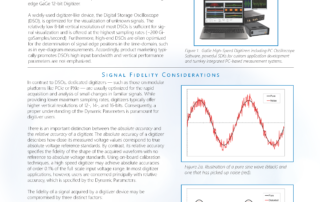


GaGe White Paper: ENOB: The Best Digitizer Performance Metric
Introduction Figure 1. GaGe High-Speed Digitizers including PC Oscilloscope Software, powerful SDKs for custom application development and turnkey integrated PC-based measurement systems. While the nominal vertical resolution of a high-speed waveform digitizer (specified in bits) is often promoted, its true performance is provided by its measured Dynamic Parameters and in particular by its Effective Number of Bits (ENOB). This article describes measurement of the Dynamic Parameters and presents measurements for a leading-edge GaGe 12-bit Digitizer. A widely used digitizer-like device, the Digital Storage Oscilloscope (DSO), is optimized for the visualization of unknown signals. The relatively [...]
Laser Measurement & Characterization of Flat Panel Displays
Laser Measurement & Characterization of Flat Panel Displays Customer Case This customer's application involves the characterization of flat panel displays (used in laptop computers, computer game displays, etc.) via laser scanning. The laser is bounced off a number of mirrors and then through lenses, from which it is scattered. The scattered laser light must then be analyzed in order to determine the quality of the flat panel display. This laser measurement system is used not only by flat panel display industries, but also by disk drive manufacturers to analyze platter quality and, in the near future, for characterizing silicon [...]
Laser Signals Striking Silicon-Diode Target
Laser Signals Striking Silicon-Diode Target Customer Case The customer wants to capture the output of some silicon diodes looking at a laser target. The typical signal is anywhere from 20mv to 1V in amplitude and 0 to 15ns in length. There are up to 16 of these diodes that are looking at the same target. Each diode has a different filter so the post-trigger depth and amplitude-scale must be user-adjustable. Their main interest is to sample and digitize the signals for archiving, with later retrieval and plotting. Fancy software is not needed for display as the data is gathered [...]