
MTI OEM Capacitance Products
MTI OEM Capacitance Products Capacitance Displacement and Gap Measurement Probes View Products Accumeasure OEM Boards View Products Custom Capacitance Sensors Measure displacement and gap with non-contact force at sub-micron resolution. Ideal for applications such as lobing, lens focusing, Piezo positioning, sheet metal thickness, gap measurement, as well as flatness and alignment test applications. Resources Capacitance Guide for Industrial Applications Capacitive Non-Contact Measurement Products Overview
MTI Webinar – How To Balance a Turbine Engine in Just 3 Steps
PAST WEBINAR: How to Balance A Turbine Engine in Just 3 Steps View Webinar Get Presentation Throughout the aviation industry, whether commercial or military, jet engine vibration is an everyday concern. Maintenance, repair, and overhaul crews worldwide are tasked with monitoring aircraft engine vibration to ensure flight safety and efficient service. With around 24,000 aircraft worldwide, and growing to over 34,000 aircraft by 2025, there is a growing need to ensure that jet engines are well maintained and properly balanced. You are invited to attend a webinar which will give you a quick, live tutorial on why engine balancing [...]
2D/3D Laser Profile Sensors
2D/3D Laser Profile Sensors Achieve precision and speed with MTI’s 2D/3D Laser Profile Sensors, ideal for real-time measurement of weld seams, adhesive beads, step heights, thickness, flatness, and alignment across curved or complex surfaces. Using advanced CMOS and laser triangulation technology, these profile sensors create detailed 2D profiles and accurate 3D models for quality control and process automation. Built for easy integration with PLCs and HMIs, ProTrak™ 2D/3D laser profile sensors feature plug-and-play setup, built-in displays, and SDKs for LabVIEW, C++, and .NET. With scan rates up to 6,000 Hz and resolution as fine as 2.5 microns, they [...]

Selecting a Displacement Sensor / Measuring System
Capacitive displacement sensors Capacitive displacement sensors are non-contact devices that are used for measurements at a high-resolution. It can also be used to check the position of any conductive object as well as measure the width or density of non-conductive materials. Capacitive displacement sensors have a large variety of uses including precision thickness measurements, assembly line testing, assembly metrology, and semiconductor processing. Capacitive displacement sensors can be found in manufacturing facilities all around the globe. There’s more to selecting the proper type of displacement sensor and measurement system than meets the eye. To select the appropriate type of device [...]
International System of Units (SI)
International System of Units (SI)
Target Material and Characteristics
Target Material and Characteristics Transparent/Opaque Targets There are a number of measurement systems that are capable of measuring a target that is opaque. When it comes to transparent targets, the measurement system being used must match the material of the target being measured. For example, if you’re attempting to measure plastic you should use a contact-type measurement system such as a micrometer. When performing a soft target measurement, such as film, a non-contact measurement system (such as a laser displacement sensor) should be utilized. Hard/Soft Targets Objects made out of hard material (such as a block of wood), would [...]
Measurement Errors
Measurement Errors: Definition, Types, Examples, Causes, and Prevention In any measurement process- whether in a physics lab, manufacturing line, or metrology test setup—differences between measured values and actual values are inevitable. These discrepancies are known as measurement errors, and understanding them is essential to improving accuracy, precision, and the reliability of results. Understanding these errors is essential for reliable decision-making in engineering, science, and manufacturing. What Is a Measurement Error? A measurement error is the difference between a measured value and the true value of the quantity being measured. These errors can arise from instrument limitations, human mistakes, environmental [...]

What is Measurement?
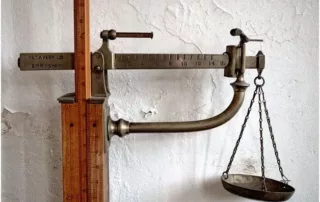
Measurement is about determining the quantifiable attributes of a target object. Examples of these attributes include: length weight distance thickness position capacity size The following sections explain more about what measurement is – and isn’t. Why is measurement misunderstood? Sometimes, people use the term “measure” instead of “calculate” or “quantify”. All these terms are related, but they’re not the same. For clarity’s sake, think of measurement as a single action that you perform with instrumentation. Collectively, “instrumentation” describes devices (i.e., instruments) that measure, indicate, and sometimes record values. Today, there are many different types of specialized measuring instruments. Bakers [...]
What is a displacement sensor?
What are Displacement Sensors (Displacement Gauges) and Dimension Measurement Systems? What is a displacement sensor? A displacement sensor (displacement gauge) is primarily used to measure the range of where an object has to travel and in relation to a reference position. Displacement sensors have multiple uses. Its primary use is for dimension measurement to figure out an object’s width, height, and thickness. Accuracy, application and usage environment is required when selecting the best equipment. What is a measurement sensor? A measurement sensor is a device that is used to measure an object to ascertain its dimensions such as by [...]
Displacement Measurement
Types of Displacement Measurement Run-Out/Vibration There are many ways to measure run-out/vibration including the type of measurement system, run-out or vibration (direction), and environment where the system is being installed. Choosing the wrong kind of equipment can lead to drastic consequences. You can run into issues such as increased man-hours during production and issues with insufficient precision. Example Applications Run-out measurement of HDD surface Laser displacement sensors are very helpful in measuring the oscillation at a single point on a specific target’s exterior. The further away that vibration amplitude is from the center of rotation from a target, [...]