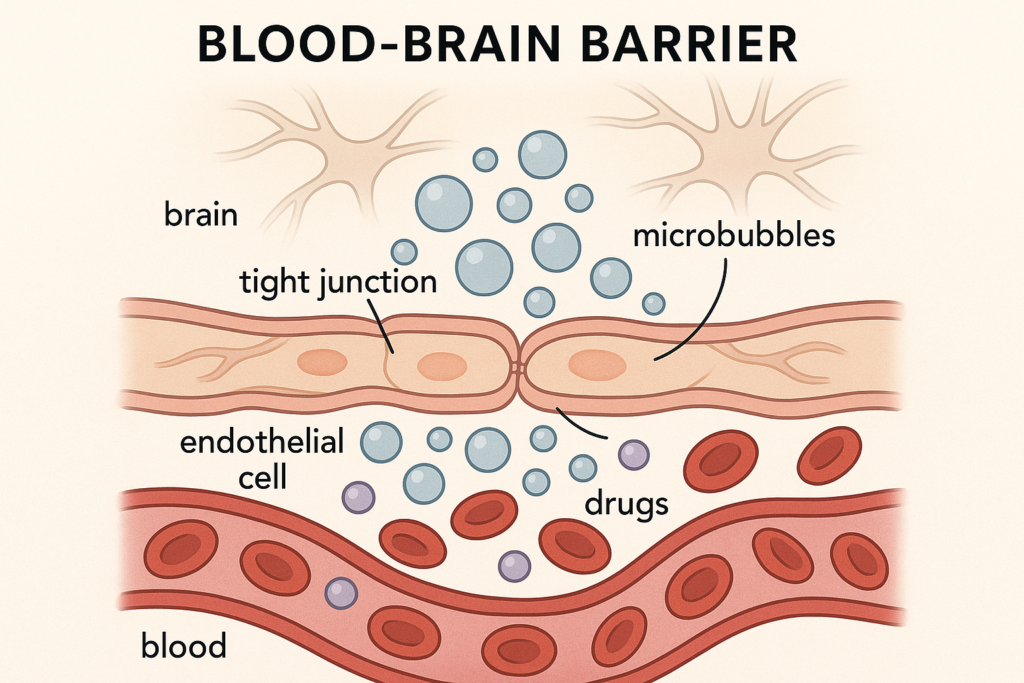
Unlocking the Brain: Noninvasive Method to Open the Blood-Brain Barrier Using Ultrasound and Microbubbles
Industry: The study focuses on medical imaging and treatment techniques, specifically improving methods for noninvasive brain treatment by opening the blood-brain barrier (BBB) using focused ultrasound (FUS) and microbubbles.
Challenge: The blood-brain barrier (BBB) is a protective barrier that prevents many drugs and treatments from reaching the brain, complicating the treatment of neurological disorders like Alzheimer’s and Parkinson’s. Current methods to open the BBB temporarily and noninvasively are limited and largely untested in primates, whose skulls are thicker than those of smaller animals.
Extraordinary Aspects of the Paper: This study is notable for its successful use of a transcranial approach to open the BBB in nonhuman primates, addressing the challenge of thicker skulls which attenuate sound waves. It demonstrates the feasibility of real-time cavitation monitoring, which provides crucial feedback on the treatment process. Additionally, it explores the impact of microbubble size on BBB opening effectiveness, which is important for optimizing treatment protocols.
Equipment & Sensors Used:
GaGe Digitizer: Part number Cs8325, used for acquiring acoustic emissions with a frequency range suitable for capturing detailed cavitation signals.
Ultrasound Transducer: Single-element, circular transducer with a center frequency of 500 kHz, used for focused ultrasound.
Passive Cavitation Detector (PCD): Single-element PCD with a center frequency of 7.5 MHz, used for detecting acoustic emissions from microbubbles during the BBB opening process.
Amplifiers: 50 dB power amplifier (ENI Inc.) for driving the FUS transducer and a 20 dB preamplifier (Olympus NDT) connected to the PCD.
Custom Sensors: The study involved in-house manufactured microbubbles and the use of polydispersed microbubbles, which were crucial for assessing the impact of bubble size on BBB opening