When it comes to validating insulation integrity of a wire or an enclosure, hipot testing is critical for ensuring electrical safety, no matter whether you’re testing consumer appliances, industrial control systems, or high-voltage power equipment.
Choosing between AC and DC hipot testing is a key decision in the process.
Both assess dielectric withstand capability, but each has specific strengths and applications. In this guide, we’ll break down the core differences, use cases, and how to select the right test for your application.
What Is Hipot Testing?
Hipot (short for high potential) testing verifies the integrity of insulation by applying a voltage significantly higher than the device’s normal operating voltage. The test checks whether leakage current flows through the insulation under stress and indicates risk of failure.
The two main types of hipot tests are:
- AC Hipot Test – Uses alternating current(AC) to simulate real-world stress
- DC Hipot Test – Applies direct current to reduce charging currents and allow steady-state measurement

AC Hipot Testing: When and Why to Use It
AC hipot testing applies a sinusoidal voltage at line frequency (typically 50 or 60 Hz) that. closely replicates how insulation performs under real-world AC operating conditions.
Key Features:
- Alternating voltage simulates real field conditions(redundant?)
- No post-test discharge needed
- Widely accepted in regulatory standards (UL, IEC, CSA)
Advantages:
- More realistic for AC-powered equipment
- No polarity concerns – both sides(ends?) of the insulation are stressed
- No need to discharge DUT – voltage returns to zero every half cycle
- Meets more standard requirements – e.g., UL, CSA, EN for consumer and industrial electronics
Considerations:
- Produces higher leakage currents due to capacitive charging
- Not ideal for devices with high capacitance (e.g., long cables or filters)
- Requires larger, more powerful testers to maintain consistent output
DC Hipot Testing Explained: Benefits and Use Cases
DC hipot testing applies a constant unidirectional voltage (positive or negative). Often used where the DUT has significant capacitance or where DC performance is more relevant, it is particularly effective for devices with high capacitance, like long cables, motor windings, or shielded assemblies.
Key Features:
- Suitable for high-capacitance DUTs (cables, capacitors, motors)- Redundant?
- Provides stable readings once capacitive charging is complete
- Allows insulation resistance to be measured simultaneously with what?…
Advantages:
- Lower current after initial charge
- Accurate leakage measurement with reduced capacitive distortion
- Requires less power – smaller, more efficient test equipment
- Ideal for cable, harness, and capacitor testing(redundant?)
Considerations:
- Stresses insulation in only one direction
- Requires manual or auto-discharge for capacitive DUTs
- Some regulatory standards still require AC testing
AC vs. DC Hipot Testing: Side-by-Side Comparison
| Feature | AC Hipot Test | DC Hipot Test |
| Voltage Type | Alternating (50/60 Hz) | Constant unidirectional |
| Best For | General AC equipment, transformers | Cables, motors, high-capacitance DUTs |
| Stress Polarity | Alternates (positive & negative) | Single polarity (positive or negative) |
| Capacitive Current | Continuous charging current | Temporary charging, then steady |
| Discharge Needed? | No | Yes (especially for high-capacitance DUTs) |
| Standard Compliance | Required for most safety standards | Accepted for specific applications |
| Equipment Size | Higher power demand | Smaller units possible |
| Leakage Detection | Includes capacitive + resistive | Primarily resistive |
How Vitrek Hipot Testers Support Both AC and DC Hipot Testing
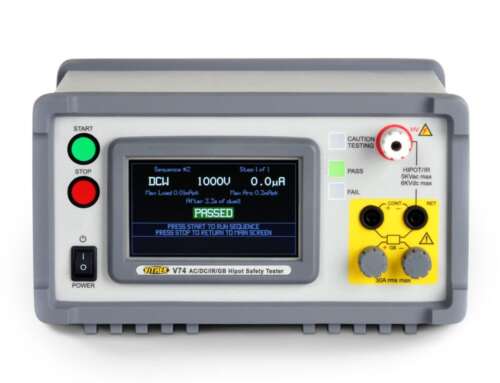
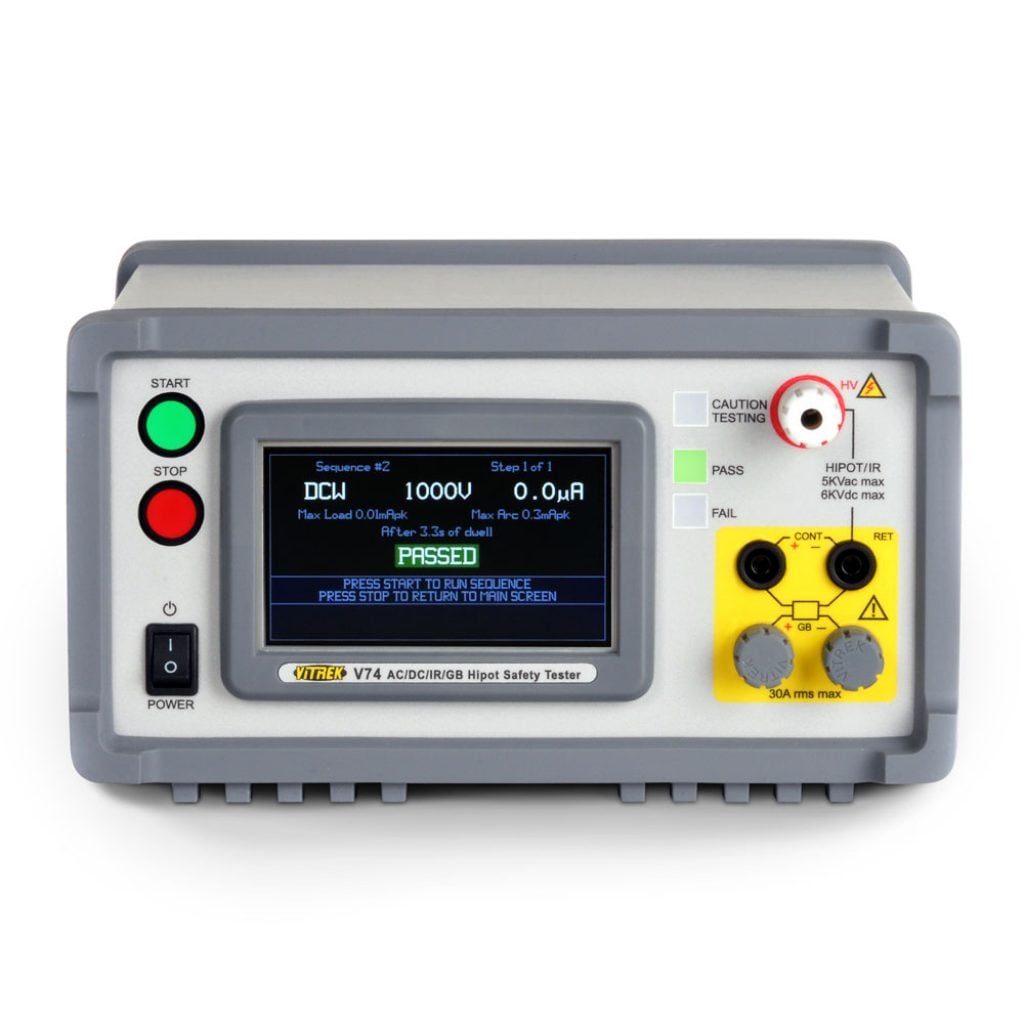
Vitrek’s V7X and 95X Series hipot testers are engineered to(not needed) provide both AC and DC hipot testing, giving users complete flexibility for various test requirements.
- V7X Series: Ideal for production lines and routine safety checks, offering up to 5 kV AC/DC, IR, and ground bond testing in a compact form factor.
- 95X Series: Designed for high-voltage and high-precision applications, with output up to 30 kV AC and 15 kV DC, plus picoamp-level leakage resolution.
Each model includes:
- Programmable ramp time, dwell time, and shutdown thresholds
- Advanced arc detection for early fault warnings
- Built-in data logging and interface connectivity for traceable testing
Choosing the Right Test for Your Application
| Application | Recommended Test |
| General AC devices (UL/IEC) | AC Hipot |
| High-voltage cables and harnesses | DC Hipot |
| Devices with large capacitors or EMI filters | DC Hipot |
| Double-insulated products | AC Hipot |
| Solar PV modules, inverters | DC or AC (based on specs) |
| Medical devices (IEC 60601) | Often AC Hipot |
If in doubt, always refer to the specific test standard (e.g., UL, IEC, ISO) for voltage type and test duration requirements.
Use the Right Voltage to Validate Safety
Both AC and DC hipot tests serve the same purpose – ensuring insulation is strong enough to protect against electrical hazards. The decision to use one over the other depends on:
- The type of product under test
- It’s expected operating environment
- Regulatory requirements
- Capacitance levels and insulation characteristics
By understanding the strengths and limitations of each method, you can apply the correct test and ensure safe, standards-compliant products reach your customers.
Need help selecting an AC/DC hipot tester for your application?
Explore Vitrek’s versatile lineup or contact our experts to get a recommendation tailored to your industry and compliance needs.