In advanced electrical systems signal and power transmission must be precise, fast, and reliable, making measuredcable integrity mandatory. Whether in electric vehicles, life-saving medical devices, or industrial robotics, cables serve as the spine of safe, high-performance operation.
But cables are also points of vulnerability. Twisting, bending, thermal stress, or cramped routing can compromise insulation performance. Even a microscopic defect can lead to short circuits, false signals, or catastrophic failure.
That’s why manufacturers turn to hipot cable testing- an essential and proven way to verify insulation performance before field use.

What Is Hipot Cable Testing?
A type of high-voltage insulation test applied across cable conductors, shields, and ground paths, hipot testing can detect :
- Weak or damaged insulation
- Manufacturing defects in wire assemblies
- Contamination or stress-induced material breakdowns
he Cable hipot testing is uniquely complexr due to the number of conductors, potential combinations, and capacitive loads on long cables.
ICable testing isn’t just about passing voltage- it’s about ensuring every conductor stays appropriately isolated from every other conductive surface.
Why Cables Require Specialized Testing?
Cable assemblies often include dozens or even hundreds of wires. When manufactured or installed these conductors may experience stress due to:
- Insulation damage during crimping or pinning
- Micro-cracks from mechanical strain or temperature cycling
- Contamination from chemicals in production processes
- Routing interference that causes leakage paths
Many faults aren’t externally visible , so non-destructive, high-voltage insulation testing is essential to reveal issues before the cable enters service.
Key Steps in Hipot Cable Testing
In hipot cable testing a high voltageis appliied in multitude of waysfrom:
- Conductor-to-conductor
- Conductor-to-ground
- Conductor-to-shielding
It then measures leakage current to detect if any insulation path is compromised. Unlike continuity tests (which check if two points are electrically connected), a hipot test verifies that they are properly isolated.
This test is especially critical in:
- Wire harness manufacturing
- Automotive and aerospace cables
- Medical catheter and sensor assemblies
- Industrial control systems
Typical Test Parameters:
| Parameter | Purpose |
| Voltage | Up to 5,000 V AC or DC, depending on spec |
| Leakage Current | Measured in µA or nA |
| Ramp & Dwell | Controls voltage rise and duration |
| IR Measurement | Optional insulation resistance (MΩ–GΩ) |
Common Challenges in Cable Testing
Cable and harness testing brings complexity beyond typical hipot applications:
High Wire Counts: Large assemblies can involve hundreds of possible combinations, requiring automation to ensure full test coverage.
High Capacitance: Long cables or shielded bundles introduce capacitance, which can skew leakage readings or trip false failures if not managed correctly.
Test Sequencing: In production, cables often need to be tested for:
- Continuity
- Shorts
- Hipot
- Ground bond
Performing these manually slows throughput and increases human error.
How Vitrek Hipot Testers Streamlines Cable Testing
Vitrek’s multi-function hipot testers – the V7X and 95X Series– are engineered to meet the specific demands of cable and harness testing.

1. Integrated High-Voltage Switching
Models like the V76 and V77 offer up to 24 HV channels, allowing automated scanning across multiple conductor paths no need for an external switch matrix.
- Eliminates manual lead movement
- Enables automated pin-to-pin testing
- Reduces operator fatigue and time per test
2. Precision Leakage Detection
Catch insulation failures before they become field problems.
- Nanoamp and picoamp-level sensitivity
- Detects breakdown-prone insulation early
- Ensures your cables meet tight safety margins
3. Multi-Test Capability in One System
With Vitrek testers, you can combine:
- Hipot (AC/DC)
- Insulation Resistance (IR)
- Continuity and short tests
- Ground bond verification
This eliminates the need for multiple instruments or handoffs between stations.
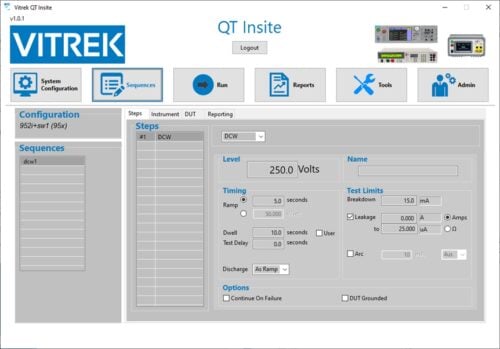
4. Automation & Traceability with QT Insite :
Vitrek’s QT Insite software offers:
- Test sequencing
- Barcode-based part identification
- Data logging for audits
- Automatic report generation for quality teams
Standards and Compliance for Cable Testing
Vitrek’s cable testing solutions help manufacturers meet global safety and performance standards, including:
- UL 817 / UL 2237 – Power cords, industrial cables
- IEC 60227 / 60245 – General flexible cables
- ISO 19642 -Automotive wire harness testing
- IPC/WHMA-A-620 -Acceptability of cable assemblies
All Vitrek testers meet IEC/UL 61010-1 safety requirements and are CE-certified, with features tailored for lab, production, or field use.
Why It Matters
When cables fail in the field, the consequences are serious- system shutdown, warranty costs, even safety recalls. Early testing prevents these risks and delivers measurable benefits:
- Reduced defect rates and improved yield
- Faster production with automated workflows
- Compliance assurance with minimal rework
- Audit-ready documentation for customers and regulators
Cable Testing You Can Trust
In high-reliability systems, one failed conductor can take down the entire operation. Vitrek’s hipot testers offer the precision, speed, and safety features required to confidently validate cables in the most demanding environments.
Whether you’re manufacturing EV wire harnesses, medical sensor cables, or high-voltage industrial connectors, Vitrek gives you the tools to deliver with confidence.