
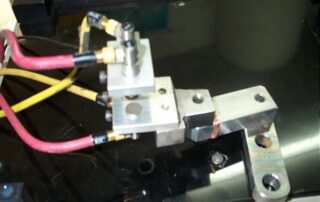
Capacitance Sensors Track Brake Rotor Thickness Variation
Capacitance Sensors Track Brake Rotor Thickness Variation Automotive, Aviation/Aerospace Brake Rotor Testing & Manufacturing Displacement, Amplitude Description [Application Note 51018] Today’s cars and trucks offer unprecedented fuel efficiencies and handling characteristics – thanks, in part, to vehicle lightweighting. Applied to all vehicle components, lightweighting lowers stress and strain to improve mileage and boost overall performance. In keeping with this trend, today’s brake rotors are thinner and lighter than those of just a few years ago. In addition, many feature cooling vents to further improve performance. These changes, however, reduce available [...]
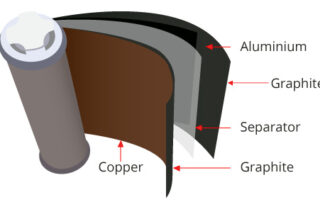
Two Ways to Measure EV Battery Plate Thickness
Two Ways to Measure EV Battery Plate Thickness Animation showing a system setup used to measure the thickness of thin conductive films such as electric vehicle (EV) battery electrodes. Description Learn how to measure EV battery plate thickness with MTI’s Digital Accumeasure, a high-precision capacitance measurement system with nanometer accuracy and stability. Problem Lithium battery plates for electric vehicles consist of lithium ion compounds applied to either a copper plate substrate (cathode plate) or an aluminum substrate (anode plate). The plates are approximately 100-200 um thick ( .004 - .008 inch). [...]

Ideal Charge Amplifier for Piezoelectric Sensor
Ideal Charge Amplifier for Piezoelectric Sensor Aviation (Turbine Engines), Automotive Research and Development, Industrial Manufacturing Vibration Monitoring: Turbine Engines; Vehicle Testing Pressure Monitoring: Combustion Engines; Pumps, Turbines Amplitude Measurements:  Acceleration, Vibration, Pressure Description Ideal Charge Amplifier for Piezoelectric Sensors Piezoelectric sensors, such as accelerometers for turbine vibration measurement and pressure transducers for combustion dynamics monitoring (CDM), generate a high-impedance charge output. This output requires proper conditioning and amplification before it can be transmitted over system cabling to measurement instrumentation. This is where a charge amplifier for piezoelectric sensors also known [...]
Foam Density Measurement: Capacitance Sensors vs. Nuclear Gauges
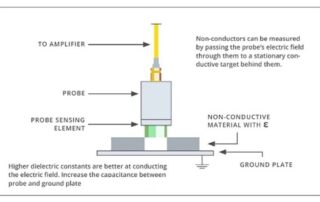
Foam Density Measurement: Capacitance Sensors vs. Nuclear Gauges Foam Density Measurement Manufacturing EV Battery Production Thickness, Distance This application note from MTI Instruments compares two technologies for measuring foam density: capacitance sensors and nuclear gauges. It examines the basic operating principles of each technology and explains why capacitance measurement is recommended for in-line measurement during foam manufacturing. Capacitance Sensors Capacitive probes are non-contact devices that use electric fields to measure foam density. In combination with a thickness value, a density measurement may be calculated. These probes consist of a capacitance [...]
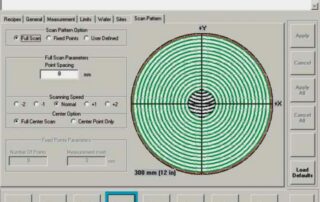
Brake Rotors
Brake Rotors Automotive Brake Rotors Surface Description Introduction Under normal operating conditions brake rotors are subjected to extreme temperatures and forces, which can cause rotor distortion and potential failure. To make certain it can withstand these conditions; extensive laboratory testing is performed to optimize design for longevity, short stopping distance, and vibration free operation. Extensive on-vehicle testing is done under real life conditions to test prototype units and engineering designs. Test vehicles are driven for long periods of time while brake performance is monitored by a variety of sensors and [...]

Tire Tread Measurement
Tire Tread Measurement Automotive Tire Tread Inspection Depth Description Tire manufacturers and Used Tire Reuse Centers want to satisfy their customers, and protect themselves from liabilities. Manufacturers are moving to 100% tire inspection for tread depth, defects and abnormality detection. Defects not only cause potential safety issues but they can also introduce unwanted vibration into the vehicle suspension system and cause excessive road noise. Belts can be overlapped, or not cover the complete tire surface, causing weak or bubbled areas and imbalances. The tread depth can be too shallow, leading to [...]
Tire Tread Measurement with 2D Laser
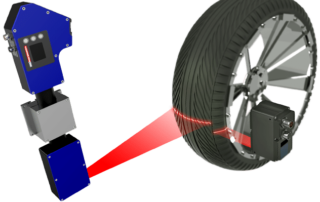
Tire Tread Measurement with 2D Laser Automotive Tire Tread Measurement with 2D Laser Depth Why Accurate Tire Tread Measurement Matters To maximize safety and tire longevity, modern tire manufacturers are adopting 100% tire inspection systems that include tread depth measurement, defect detection, and pattern recognition. Inadequate tire tread depth can lead to reduced traction, poor braking, and potential tire failure. Surface anomalies like blistering, bubbles, or belt overlap may cause runout, road noise, or even catastrophic failure. With consumer expectations rising and regulatory standards tightening, tire OEMs and testing labs need precise, [...]

Windshield Manufacturing
Windshield Manufacturing Automotive Windshield Manufacturing Tolerances Description In order to maintain proper profile and thickness within a glass furnace the extrusion plate spacing must be maintained at a predetermined gap. Unfortunately, due to process changes and temperature swings this gap can fluctuate significantly in short periods of time. This variation causes the glass thickness to change (check out our glass thickness measurement devices to accurately measure thickness), producing uneven temperature gradients and creating potentially weak glass panels. To control this critical parameter the manufacturing process requires automated active feedback control [...]

Thread Checking
Automotive Thread Checking Presence/Absence Description Manual thread inspection is slow, not always reliable and tedious for the inspector. Manufacturers have struggled to come up with ways to reliably automate the process at a reasonable cost. Automated systems are available that use “screw sensors” can quickly wear or be cross threaded, requiring operator attention and a tooling change. A worn screw can provide false rejections leading to the unnecessary scrapping of parts. Capacitance solutions are cost effective alternative which are becoming increasingly popular due to their high reliability and fast measurement speed. Special cylindrical “ring [...]


Spindle Run Out
Spindle Run Out Automotive Spindle Run Out Distance Description Rotating targets frequently have an intermittent, uncertain or nonexistent ground path. This introduces unwanted noise, instability, drift and reduces accuracy of the measurement. MTI Instruments offers a unique "Push-Pull" capacitance measurement system that does not require a grounded target. It utilizes two probes, built into one body, that work together to complete the ground path. One probe pushes current into the brake rotor while the adjacent probe pulls the current out. The result is a "clean", consistent electrical sensing path. As [...]