

Fiber Optic Sensors Help Stop Subway Shutdown
Fiber optic sensors will help keep commuters moving between Manhattan and Brooklyn this year and beyond. Recently, New York Governor Andrew Cuomo announced that New York City’s Metropolitan Transit Authority (MTA) would not close the L train tunnel for a planned 15-month repair project. Instead, the MTA will use technology-driven solutions to keep the tunnel open and operational for weekday riders. In a joint statement, a panel that included engineering experts from Columbia and Cornell explained that "The L Train Tunnel project gives us the opportunity to integrate technologies and methods that have never been used before in a [...]
 3D Integrated Circuits Use Capacitive Sensing to Ensure Coplanarity Gallery
3D Integrated Circuits Use Capacitive Sensing to Ensure Coplanarity
Application Notes-MTI, Brand-MTI, Industry-Consumer Products, Industry-Electronics, Industry-Manufacturing, Industry-Semiconductor, Industry-Semiconductor-MTI, Industry-Sensors, Z-REPUB, z1
3D Integrated Circuits Use Capacitive Sensing to Ensure Coplanarity
Three-dimensional (3D) integrated circuits (ICs) feature silicon wafers and dies that are stacked vertically for improved device performance. By using the Z-axis, 3D ICs can overcome the power and footprint limitations associated with two-dimensional (2D) integrated circuits. Yet 3D ICs need coplanar surfaces to contact all of the pads, pins, and pillars. To determine coplanarity, semiconductor manufacturers measure the angle and gap between two planes. Bonding tool actuators use these measurements to adjust components and ensure that all device pins and solder balls reside on the same geometric plane. This process, active parallelism compensation, promotes proper bonding without residual [...]

Common Test and Calibration Uses of the 1510A Portable Signal Generator
Introduction As one of the most versatile and powerful hand-held signal generators on the market, the 1510A is a two-channel, battery-powered, microprocessor-controlled direct digital signal generator. It has an average battery life of 3 hours of continuous use. Weighing in at under two pounds, makes it ideal for use in the field. There are many different ways this sophisticated device can be leveraged to perform precise test and calibration of equipment, wires, cables, sensors and much more. Use Case #1 | Sensor Simulation You can simulate sensors during system development, bring-up, and test. Often during [...]
Product Education & Training
Education & Training Vibration Measurement & Engine Rotor Balancing High-Speed Data Acquisition Products for Streaming Applications Industry Application Webinars Test & Measurement Solutions for Semiconductor Manufacturers GaGe Digitizers in Ultrasonic Applications Electrical Safety & Compliance Testing for Printed Circuit Board Manufacturers Vitrek Products for Metrologists & Calibration Labs Vitrek Electrical Safety Testing for the Appliance & Consumer Product Industries Compliance Testing for the Lighting Industry Webinar Vitrek [...]

Selecting a Displacement Sensor / Measuring System
Capacitive displacement sensors Capacitive displacement sensors are non-contact devices that are used for measurements at a high-resolution. It can also be used to check the position of any conductive object as well as measure the width or density of non-conductive materials. Capacitive displacement sensors have a large variety of uses including precision thickness measurements, assembly line testing, assembly metrology, and semiconductor processing. Capacitive displacement sensors can be found in manufacturing facilities all around the globe. There’s more to selecting the proper type of displacement sensor and measurement system than meets the eye. To select the appropriate type of device [...]
Target Material and Characteristics
Target Material and Characteristics Transparent/Opaque Targets There are a number of measurement systems that are capable of measuring a target that is opaque. When it comes to transparent targets, the measurement system being used must match the material of the target being measured. For example, if you’re attempting to measure plastic you should use a contact-type measurement system such as a micrometer. When performing a soft target measurement, such as film, a non-contact measurement system (such as a laser displacement sensor) should be utilized. Hard/Soft Targets Objects made out of hard material (such as a block of wood), would [...]



What is Measurement?
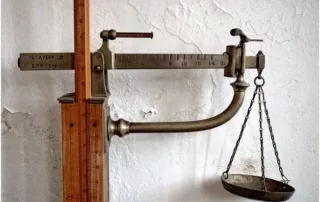
Measurement is about determining the quantifiable attributes of a target object. Examples of these attributes include: length weight distance thickness position capacity size The following sections explain more about what measurement is – and isn’t. Why is measurement misunderstood? Sometimes, people use the term “measure” instead of “calculate” or “quantify”. All these terms are related, but they’re not the same. For clarity’s sake, think of measurement as a single action that you perform with instrumentation. Collectively, “instrumentation” describes devices (i.e., instruments) that measure, indicate, and sometimes record values. Today, there are many different types of specialized measuring instruments. Bakers [...]
What is a displacement sensor?
What are Displacement Sensors (Displacement Gauges) and Dimension Measurement Systems? What is a displacement sensor? A displacement sensor (displacement gauge) is primarily used to measure the range of where an object has to travel and in relation to a reference position. Displacement sensors have multiple uses. Its primary use is for dimension measurement to figure out an object’s width, height, and thickness. Accuracy, application and usage environment is required when selecting the best equipment. What is a measurement sensor? A measurement sensor is a device that is used to measure an object to ascertain its dimensions such as by [...]
Displacement Measurement
Types of Displacement Measurement Run-Out/Vibration There are many ways to measure run-out/vibration including the type of measurement system, run-out or vibration (direction), and environment where the system is being installed. Choosing the wrong kind of equipment can lead to drastic consequences. You can run into issues such as increased man-hours during production and issues with insufficient precision. Example Applications Run-out measurement of HDD surface Laser displacement sensors are very helpful in measuring the oscillation at a single point on a specific target’s exterior. The further away that vibration amplitude is from the center of rotation from a target, [...]