
Nuclear Ion Testing
Nuclear Ion Testing Customer Case This customer is involved in nuclear ion testing. The pulse amplitudes of nuclear ions from a detector must be measured and sorted into a histogram, which will show the number of times a given amplitude was received. The customer wants a "multi-channel analyzer" capable of analyzing 4,000 to 8,000 "channels." In the customer's terminology, "channels" are actually histogram bins. The customer has pulses coming in at 20 - 30 ms minimum interval and needs to peak detect (calculate the maximum value of the pulse). Then, based on peak height, each is stored in a [...]
T&M White Paper: Cable & Connector Test System Facilitates Multi-Point High Voltage/Current Testing
Introduction Hipot testing is critical in assuring compliance with a host of electrical safety standards and in confirming the assembled product is free from electrical or mechanical defects. Hipot testers are used to measure leakage current and insulation resistance between all components and connections, confirm solid ground connections and test ground bonds. All of these tests require the sequential application of precise and controlled high voltages or currents between pairs of elements then accurately measuring and recording the results. Products like the Vitrek 95x and V7X series are excellent examples of the industry's best electrical safety testers. [...]
Alpha Particle Counting
Alpha Particle Counting Customer Case A customer has to characterize a new design for a solid state alpha particle detector. The detector is essentially a silicon diode with a large area face. Because alpha particles, which are high-speed helium nuclei, are electrically charged, they interact strongly with matter and lose their energy quickly upon entering a solid. When an alpha particle decelerates within the depletion region of the diode, it creates electron-hole pairs. The carriers are collected by the diode's electrodes and create a measurable current pulse. The customer's experimental solid state detector has two implanted electrodes whose signals [...]
 Press Release: Vitrek Acquires MTI Instruments, Expanding Its Portfolio of Precision Measurement Solutions Gallery
Press Release: Vitrek Acquires MTI Instruments, Expanding Its Portfolio of Precision Measurement Solutions
Brand-MTI, Brand-Vitrek, New & Press Releases, News-All Brands, News-GaGe, News-Industry, News-MTI, News-Vitrek, Press Releases-Vitrek, z1
Press Release: Vitrek Acquires MTI Instruments, Expanding Its Portfolio of Precision Measurement Solutions
Vitrek Acquires MTI Instruments, Expanding Its Portfolio of Precision Measurement Solutions Vitrek's product portfolio now includes precision measurement tools for applications including turbine balancing and vibration analysis and non-contact measurements Poway, CA - April 13, 2022 — Vitrek, the leader in high-voltage test and measurement equipment and board-level data acquisition systems, announces the acquisition of MTI Instruments, a U.S.-based manufacturer of sophisticated test and measurement equipment. MTI Instruments' precision tools, systems and solutions are utilized in non-contact metrology, position, displacement and vibration applications within the design, QA/QC, manufacturing, production, test and research markets. Products include: Turbine Engine/Rotating Machine [...]


Soluna Holdings Announces Sale of its MTI Instruments Business
$10.75 Million Sale Price Allows for Further Acceleration of Cryptocurrency Mining Business Soluna Holdings, Inc. (“SHI” or the “Company”), (NASDAQ: SLNH), the parent company of Soluna Computing, Inc. (“SCI”), a developer of green data centers for cryptocurrency mining and other intensive computing, today announced the sale of its MTI Instruments subsidiary to Vitrek LLC, a strategic buyer in the test and measurement space. Per the sale agreement, the Buyer is acquiring 100% of the common stock of MTI Instruments for $10.75 million. With the sale completed, Soluna Holdings expects that it will be solely focused on developing and monetizing [...]
Laser Spectroscopy
Laser Spectroscopy Customer Case An academic researcher is studying the attenuation properties of different materials inside Laser cavities for applications in Laser Spectroscopy. The Laser pulses are generated by one Laser, and are then transmitted by mirrors into another cavity filled with gaseous material. In the second cavity, the light pulses are continuously reflected by opposite mirrors and their intensities are measured by a transducer which converts them into decaying pulses of 30 nanosecond width. The decay takes about 40 microseconds to settle. The researcher is required to capture the decaying pulses and save the captured data onto the [...]
 White Paper: High Performance Test Equipment Assures LED Lighting Products Comply with Industry Standards Gallery
White Paper: High Performance Test Equipment Assures LED Lighting Products Comply with Industry Standards
Brand-Vitrek, Industry-Consumer Products, Industry-Lighting, News-Industry, News-Vitrek, Products-Vitrek, Whitepapers-Vitrek, z1

White Paper: High Performance Test Equipment Assures LED Lighting Products Comply with Industry Standards
Introduction Manufacturers and users of LED lighting applications need to be assured that their products will be qualified according to a multitude of reliability and efficiency standards. In addition to voluntary initiatives and programs like EnergyStar, mandatory standards and specifications for the lighting industry must be kept in mind during project development, including the latest IES LM-79-19 and the ANSI C82.16 documents. This article gives an overview of relevant lighting standards and specifications for LED lighting products. It also describes the features of Vitrek’s test equipment, including the PA900 power analyzer — featuring built-in lighting specifications — as [...]
Laser Transient Absorption Spectroscopy
Laser Transient Absorption Spectroscopy Customer Case The customer's setup is a scientific application in which transient signals from a Laser Absorption Spectroscope are transferred to a computer. The laser power is modified in steps and the process is repeated. The measurement sensitivity is limited by noise generated by the current digitizer. The customer wants to capture and continuously average very small pulse responses. The lowest signal pulse height is 0.5 milliVolts and can range up to 2 mV. The duration of each response pulse is 1 to 10 microseconds. The Pulse Repetition Frequency (PRF) is 10 Hz. The customer's [...]
 The Benefits of Manual, Semi-Automated, and Fully-Automated Systems for Semiconductor Wafer Inspection and Metrology Gallery
The Benefits of Manual, Semi-Automated, and Fully-Automated Systems for Semiconductor Wafer Inspection and Metrology
Application Notes-MTI, Brand-MTI, Industry-Consumer Products, Industry-Electronics, Industry-Manufacturing, Industry-Semiconductor, Industry-Semiconductor-MTI, News-MTI-Metrology, Products-MTI-Semiconductor/Metrology, z1
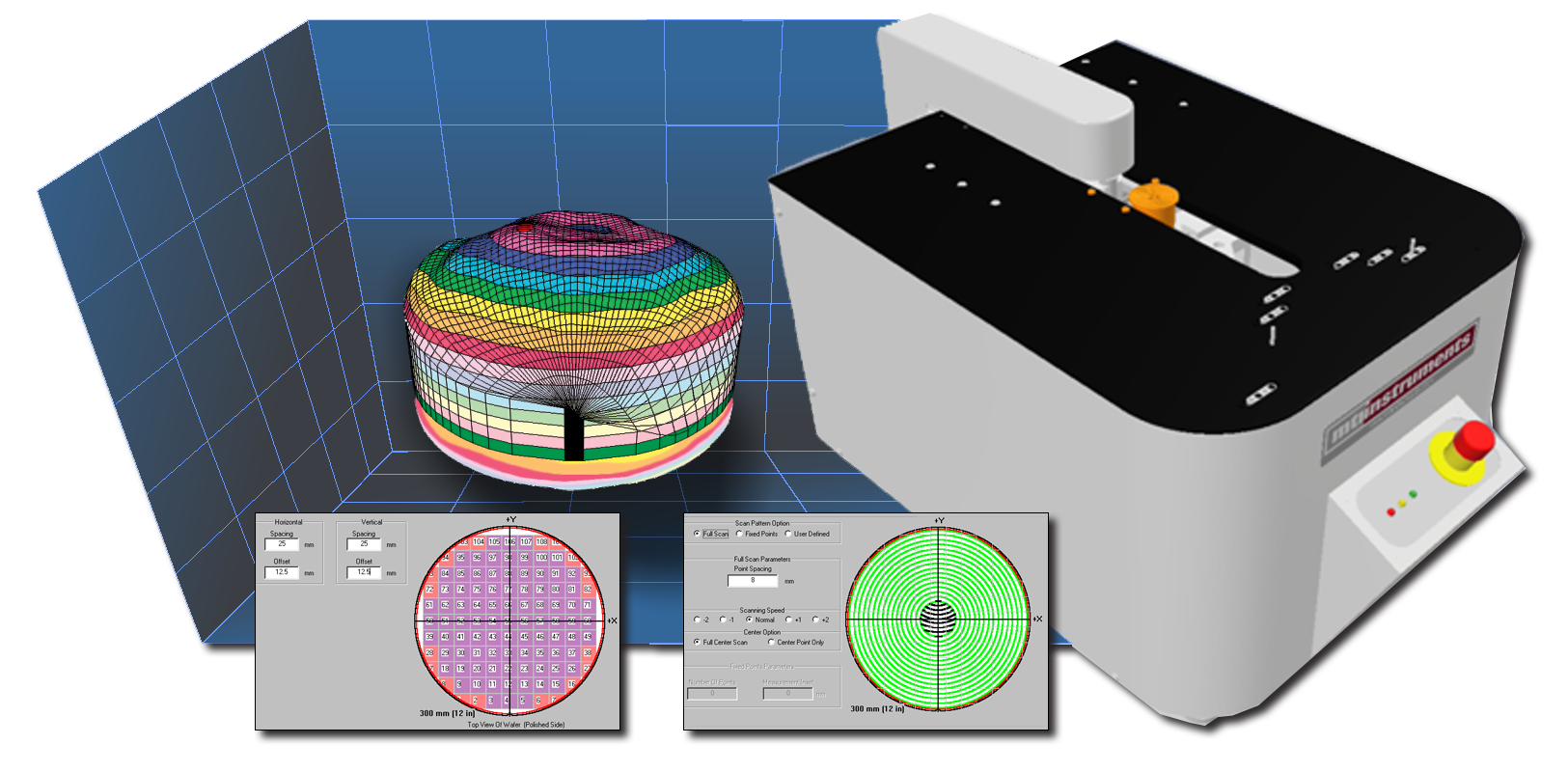
The Benefits of Manual, Semi-Automated, and Fully-Automated Systems for Semiconductor Wafer Inspection and Metrology
This is the third of three articles in Semiconductor Wafer Measurement for Increased Profitability. The first article in this series explains why disc geometry matters. The second article examines the cost of failing to inspect semiconductor wafers. Fully automated systems that can load, scan, and unload wafers are fast, convenient, and efficient at high volumes. They’re useful for checking every wafer in every batch, but these systems are expensive. Semi-automated and manual systems cost significantly less and are generally used for lower volumes; however, they’re also easy-to-use and can make fast, accurate measurements that support production flow. Semi-automated and [...]
 Why Disc Geometry Matters In Wafer Production Gallery
Why Disc Geometry Matters In Wafer Production
Application Notes-MTI, Brand-MTI, Industry-Consumer Products, Industry-Electronics, Industry-Manufacturing, Industry-Semiconductor, Industry-Semiconductor-MTI, News-MTI-Metrology, Products-MTI-Semiconductor/Metrology, z1

Why Disc Geometry Matters In Wafer Production
This is the first of three articles in Semiconductor Wafer Measurement for Increased Profitability. The second article examines the cost of failing to inspect semiconductor wafers. The third article describes the benefits of using semi-automated, fully-automated, and manual systems for wafer metrology and inspection. Semiconductor wafers are cut from cylindrical silicon crystals, or ingots. The flatness of these disc-shaped wafers is controlled to tight tolerances to ensure that the entire wafer surface is suitable for integrated circuit (IC) production. If disc geometry is out-of-spec after cutting, it may be possible to reprocess the wafer. Cutting is only the first [...]