

Soluna Holdings Announces Sale of its MTI Instruments Business
$10.75 Million Sale Price Allows for Further Acceleration of Cryptocurrency Mining Business Soluna Holdings, Inc. (“SHI” or the “Company”), (NASDAQ: SLNH), the parent company of Soluna Computing, Inc. (“SCI”), a developer of green data centers for cryptocurrency mining and other intensive computing, today announced the sale of its MTI Instruments subsidiary to Vitrek LLC, a strategic buyer in the test and measurement space. Per the sale agreement, the Buyer is acquiring 100% of the common stock of MTI Instruments for $10.75 million. With the sale completed, Soluna Holdings expects that it will be solely focused on developing and monetizing [...]
Radioactive Nuclear-Decay Detection
Radioactive Nuclear-Decay Detection Customer Case The customer has a requirement for PC-based waveform digitizer cards to digitize shaped pulses derived from nuclear-decay detectors. These pulses vary in their rate (frequency of occurrence) and amplitude. Their shape is approximately Gaussian with a full-width at half the maximum amplitude (FWHM) of 3-5 microseconds. The characterization of each pulse is critical for the accurate and precise determination of the activity of radioactive materials. These materials have very low count-rates (0.02 pulses per minute) to relatively high count-rates (>1000 pulses per minute). Important to the measurement process are the speed and reliability of [...]
Neutrino Detection System
Neutrino Detection System Customer Case Neutrinos are tiny (possibly massless) neutral elementary particles which interact with matter via the weak nuclear force. The weakness of the weak force gives neutrinos the property that matter is almost transparent to them. The sun, and all other stars, produce neutrinos copiously due to nuclear fusion and decay processes within the core. Since they rarely interact, these neutrinos pass through the sun and the earth (and you) unhindered. Other sources of neutrinos include exploding stars (supernovae), relic neutrinos (from the birth of the universe) and nuclear power plants (in fact a lot of [...]
 White Paper: High Performance Test Equipment Assures LED Lighting Products Comply with Industry Standards Gallery
White Paper: High Performance Test Equipment Assures LED Lighting Products Comply with Industry Standards
Brand-Vitrek, Industry-Consumer Products, Industry-Lighting, News-Industry, News-Vitrek, Products-Vitrek, Whitepapers-Vitrek, z1
White Paper: High Performance Test Equipment Assures LED Lighting Products Comply with Industry Standards
Introduction Manufacturers and users of LED lighting applications need to be assured that their products will be qualified according to a multitude of reliability and efficiency standards. In addition to voluntary initiatives and programs like EnergyStar, mandatory standards and specifications for the lighting industry must be kept in mind during project development, including the latest IES LM-79-19 and the ANSI C82.16 documents. This article gives an overview of relevant lighting standards and specifications for LED lighting products. It also describes the features of Vitrek’s test equipment, including the PA900 power analyzer — featuring built-in lighting specifications — as [...]
 The Benefits of Manual, Semi-Automated, and Fully-Automated Systems for Semiconductor Wafer Inspection and Metrology Gallery
The Benefits of Manual, Semi-Automated, and Fully-Automated Systems for Semiconductor Wafer Inspection and Metrology
Application Notes-MTI, Brand-MTI, Industry-Consumer Products, Industry-Electronics, Industry-Manufacturing, Industry-Semiconductor, Industry-Semiconductor-MTI, News-MTI-Metrology, Products-MTI-Semiconductor/Metrology, z1
The Benefits of Manual, Semi-Automated, and Fully-Automated Systems for Semiconductor Wafer Inspection and Metrology
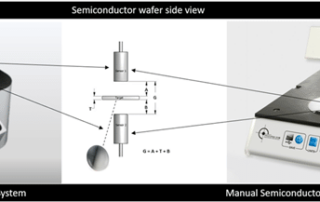
This is the third of three articles in Semiconductor Wafer Measurement for Increased Profitability. The first article in this series explains why disc geometry matters. The second article examines the cost of failing to inspect semiconductor wafers. Fully automated systems that can load, scan, and unload wafers are fast, convenient, and efficient at high volumes. They’re useful for checking every wafer in every batch, but these systems are expensive. Semi-automated and manual systems cost significantly less and are generally used for lower volumes; however, they’re also easy-to-use and can make fast, accurate measurements that support production flow. Semi-automated and [...]
Nuclear Particle Location
Nuclear Particle Location Customer Case The customer studies nuclear particles traveling in an electrically charged medium. The particles emit two types of short 53 MHz signal bursts. The first type lasts for 1.6 ms, the second type lasts for 6 ms. The customer had to capture these bursts in at least two locations and analyze their amplitudes in order to determine the position and some of the characteristics of the nuclear particles. The application requires two channels of capture at speeds of at least 500 MS/s. The depth of capture at 1 GS/s is 6,000 samples for the 6 [...]
Ozone Profiling Lidar System
Ozone Profiling Lidar System Customer Case The customer is designing an ozone-profiling lidar system for measuring the concentration of ozone from ground level up to about 4 kilometer (km) altitude. The system operates in the ultraviolet range and uses multiple receiver telescopes to cover the range. The dynamic range of the signal is enormous, so small aperture telescopes are used to collect backscattered light from low altitudes and large ones are used to collect backscattered light from high altitudes. The customer is operating simultaneously at three laser wavelengths, and the current design requires a total of nine photodetectors (three [...]
 Why Disc Geometry Matters In Wafer Production Gallery
Why Disc Geometry Matters In Wafer Production
Application Notes-MTI, Brand-MTI, Industry-Consumer Products, Industry-Electronics, Industry-Manufacturing, Industry-Semiconductor, Industry-Semiconductor-MTI, News-MTI-Metrology, Products-MTI-Semiconductor/Metrology, z1
Why Disc Geometry Matters In Wafer Production
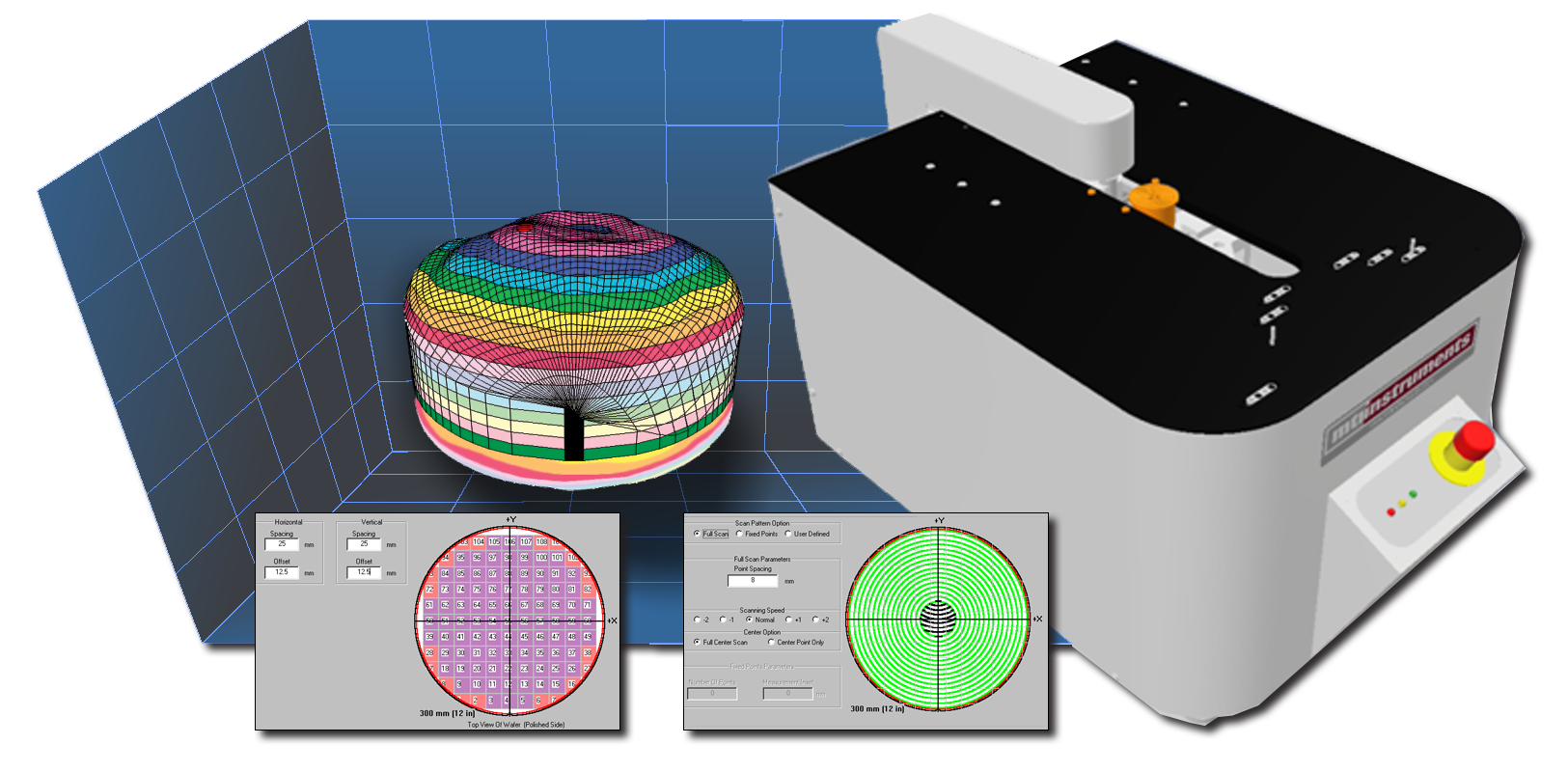
This is the first of three articles in Semiconductor Wafer Measurement for Increased Profitability. The second article examines the cost of failing to inspect semiconductor wafers. The third article describes the benefits of using semi-automated, fully-automated, and manual systems for wafer metrology and inspection. Semiconductor wafers are cut from cylindrical silicon crystals, or ingots. The flatness of these disc-shaped wafers is controlled to tight tolerances to ensure that the entire wafer surface is suitable for integrated circuit (IC) production. If disc geometry is out-of-spec after cutting, it may be possible to reprocess the wafer. Cutting is only the first [...]
High-Spatial Resolution Lidar
High-Spatial Resolution Lidar Customer Case In Lidar, which is Laser Radar, spatial resolution is limited by the laser pulse width. This customer's laser pulse width is 3.5 ns. The total range interrogated by the Lidar system will be on the order of 250 meters. The customer needs to digitize the Lidar signal at 500 MS/s into 8 MegaSamples of memory. 8-bit digitizer resolution will be sufficient and they would also prefer to keep software programming at an absolute minimum. GaGe Case Solution Had the customer required higher resolution, say 12 or 14-bit, and sampling rates of 100 MS/s, then [...]




Vitrek Returns to the APEC Conference This March
In the world of power electronics, one event has defined the industry for the last 35+ years, setting expectations, introducing new technologies, and providing networking opportunities. The Applied Power Electronics Conference — APEC — has brought together generations of power electronic professionals from across multiple industries to learn and grow their knowledge base. Vitrek is proud to announce our return to the APEC conference in Houston, TX, this year! […]