
 3D Integrated Circuits Use Capacitive Sensing to Ensure Coplanarity Gallery
3D Integrated Circuits Use Capacitive Sensing to Ensure Coplanarity
Application Notes-MTI, Brand-MTI, Industry-Consumer Products, Industry-Electronics, Industry-Manufacturing, Industry-Semiconductor, Industry-Semiconductor-MTI, Industry-Sensors, Z-REPUB, z1
3D Integrated Circuits Use Capacitive Sensing to Ensure Coplanarity
Three-dimensional (3D) integrated circuits (ICs) feature silicon wafers and dies that are stacked vertically for improved device performance. By using the Z-axis, 3D ICs can overcome the power and footprint limitations associated with two-dimensional (2D) integrated circuits. Yet 3D ICs need coplanar surfaces to contact all of the pads, pins, and pillars. To determine coplanarity, semiconductor manufacturers measure the angle and gap between two planes. Bonding tool actuators use these measurements to adjust components and ensure that all device pins and solder balls reside on the same geometric plane. This process, active parallelism compensation, promotes proper bonding without residual [...]
Oiling System Uses Capacitive Sensing to Detect Water Contamination
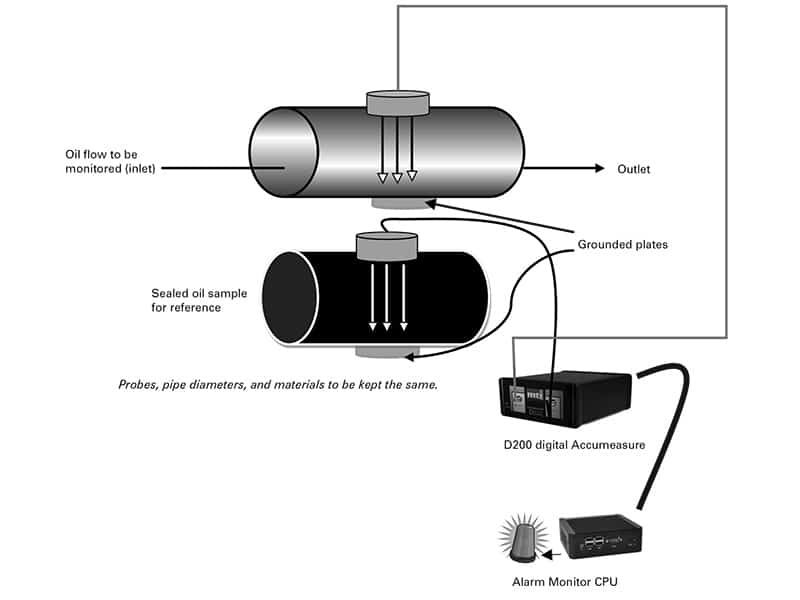
Water contamination can reduce the life of lubricants and increase the frequency of maintenance and repairs. If corrective action isn’t taken before an out-of-limit incident occurs, operational costs can escalate. When unplanned maintenance disrupts operations, productivity suffers and technicians may focus on a quick fix instead of the root cause. To detect water contamination in oil systems, in-line capacitance probes can be used. These flexible, off-the-shelf devices provide automatic and continuous monitoring. Yet checking moisture levels isn’t just about enhancing reliability or eliminating corrosion. In-line capacitance probes improve operations by supporting a proactive approach to maintenance. How In-Line Capacitance [...]

Offshore Wind Supply Chain Uses MTI Capacitance Sensors
Capacitance sensors from MTI Instruments are an important part of the supply chain for offshore wind (OSW) in New York State. According to a recent report from the Center for Economic Growth (CEG), New York’s Capital Region is home to MTI Instruments and dozens of other manufacturers who support this growing form of wind power. The Capital Region also offers essential infrastructure for OSW. As the CEG report explains, the New York State Energy Research Development Authority (NYSERDA) has assessed 54 waterfront sites for OSW-related projects such as component staging, manufacturing, and fabrication. Two of the most promising sites [...]



Common Test and Calibration Uses of the 1510A Portable Signal Generator
Introduction As one of the most versatile and powerful hand-held signal generators on the market, the 1510A is a two-channel, battery-powered, microprocessor-controlled direct digital signal generator. It has an average battery life of 3 hours of continuous use. Weighing in at under two pounds, makes it ideal for use in the field. There are many different ways this sophisticated device can be leveraged to perform precise test and calibration of equipment, wires, cables, sensors and much more. Use Case #1 | Sensor Simulation You can simulate sensors during system development, bring-up, and test. Often during [...]
Download How to Reduce Inconsistent Wafer Measurements
How to Reduce Inconsistent Wafer Measurements Thank you for downloading! Here's the link to How to Reduce Inconsistent Wafer Measurements.
White Paper: Three Vibration/Balancing Solutions for the Aviation Industry
Three Vibration/Balancing Solutions for the Aviation Industry Audience Turbine engine balancing for aviation professionals: - AMTs - Test Cell Engineers and Managers - Engine Flight Line Technicians - Engine Vibration Specialists Description Throughout the aviation industry, jet engine vibration is an everyday concern. Maintenance, repair, and overhaul crews worldwide are tasked with monitoring aircraft engine vibration to ensure flight safety and efficient service. Gone unchecked, jet engine vibration can be the catalyst for any number of problems, from minor annoyances such as cabin noise to undue parts wear. In the most severe cases, an out-of-balance turbine could [...]