
Radar Altimeter
Radar Altimeter Customer Case In this RADAR application the customer has pulses coming in at 1660 Hz. For every pulse they need to capture 500 samples which, at that rate, will amount to 1.7 Megs of data every second. The experiment will be running for at least a few minutes. They would then like to log all the captured data to the PC host memory. The final requirement is for the system to be on the PCI bus. By having the system on the PCI bus, the customer can stream the data directly to the PC's memory, which is [...]
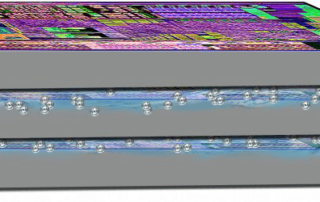
Capacitance Sensors Facilitate 3D IC Construction
Capacitance Sensors Facilitate 3D IC Construction Semiconductor, Research & Development 3D IC Construction Distance, Positioning, Displacement Description [Application Note 70518] To boost device performance, today's semiconductor and microelectronics manufacturers are building three-dimensional integrated circuits featuring vertically-stacked silicon wafers and dies. The rationale is simple. Exploiting the Z-axis avoids the power and footprint penalties associated with two-dimensional processes. Implementing the rationale, however, is not so simple. Going vertical requires coplanar surfaces to make contact with all pins, pads, and pillars. Problem Typically, manufacturers measure the angle and gap between two planes [...]
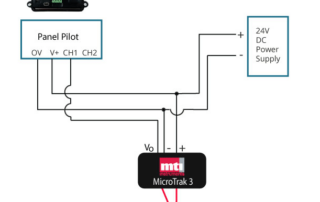
Adding a Digital Panel Meter to MTI Analog Output Products
Adding a Digital Panel Meter to MTI Analog Output Products Consumer Electronics Electronics Parts Profiling Thickness Description Some MTI Products with Analog outputs, Accumeasure 9000 and Microtrak 3 laser  How To Use Digital Displays with Analog Outputs MTI Microtrak 3 Lasers and some of our Accumeasure amplifiers such as the Accumeasure 9000 only have analog outputs. If you wish to add a digital display, then the Lascar Panel pilot © makes a nice cost effective (~ $110) addition - Fig 1. These Digital panel meters have both 1 & [...]
Ultra High-Speed Radar
Ultra High-Speed Radar Customer Case This application requires the acquisition of very fast analog signals at relatively slow sample rates for a long period of time. In other words, the input bandwidth requirement is very high (1 GHz), but the sampling rate needs to be no more than 5 or 6 MSPS. The most important requirement is that the acquisition must go on, without any breaks, for many hours. The customer does not need very high dynamic range. In fact, a 4-bit A/D converter will be sufficient. The customer has already identified a 4-bit A/D chip from TRW which [...]
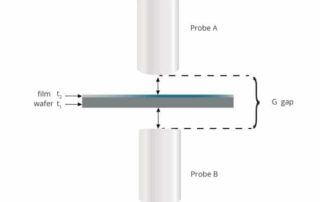
Thickness Gauge Measurement With Conductive Wafers and Thin Films
Thickness Gauge Measurement With Conductive Wafers and Thin Films Consumer Electronics Electronics Parts Profiling Thickness Description Using MTI's capacitive thickness gauge Proforma 300i with conductive wafers and thin films G = (a+b+t1+t2 ) Where G is the fixed gap between two probes When making the thickness measurement t2 can appear as t2 (film thickness) when it is a conductor, or 0 thickness when t2 is just air. So t2 will vary between the actual film thickness t2 if it's a conductor all the way down to 0 thickness if the [...]
Radar Rackmount System for Large Record Lengths
Radar Rackmount System for Large Record Lengths Customer Case The customer needs to acquire data from his radar system at a sampling rate of 1.5 MSPS for two channels (I & Q). At the moment, this data must be acquired for at least 10 seconds, but the record length may increase by almost 100 times in the future. This equipment needs to be installed in a rackmounted environment, so the host computer must have rackmount capability. An integrated monitor is also important as it eliminates the need to purchase a rack-mounted monitor. Keyboard and mouse must also be rackmountable. [...]
Interfacing to Offset IF Radar Altimeter
Interfacing to Offset IF Radar Altimeter Customer Case The customer is using an offset IF radar to map forest terrain density. The equipment will be mounted in an aircraft, which will also be carrying a Global Positioning System (GPS) for reference. The plane will fly at an altitude of 10,000 feet. A 512 ns radar pulse will be sent out and a return pulse will be received about 20 uS later, from which 10,000 samples will be acquired. After the pulse is received, there will be a relatively long re-arm time of about 250 to 300 uS for the [...]
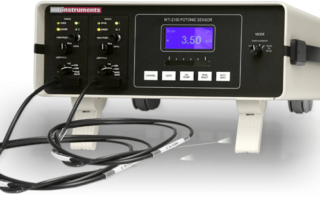
Measuring Piezoelectric Properties with Fiber Optics
Measuring Piezoelectric Properties with Fiber Optics Research & Development Piezoceramic, 1-3 Pzt / Polymer Composite And Pvdf Film Amplitude Description Figure 4: Fiber Optic MTI 2100 Fotonic Sensor Introduction Researchers from the University of Arizona used the MTI-2000 Fotonic Sensor to measure the indirect piezoelectric properties (d33) and strain of bulk ferroelectric and thin film samples. The team then correlated these results with data acquired from direct piezoelectric effect measurement. By comparing data sets, the researchers concluded that the MTI-2000 provides a useful optical technique for measuring the [...]
Trigger Out Modification for CP500 Class Boards
Trigger Out Modification for CP500 Class Boards Customer Case Many A/D applications including Ultrasonics, Radar, Lidar, Hard Disk testing and CCD capture require maximal synchronicity between a trigger and the sampling clock. GaGe Case Solution GaGe now offers the TRIGGER OUT option as a means of synchronizing systems to the sampling clock on GaGe's CP500-class of A/D and scope cards, including CS8500, CS12100 and CS1250. The need for synchronicity can be understood by considering a typical ultrasonic pulse-echo system. An ultrasonic pulser-receiver generates ultrasonic pulses from a transducer which, microseconds later, receives echo signals reflected from a test specimen. [...]


Semiconductor Wafer Lapping and Displacement Measurement
Introduction This application note explains how MTI's Accumeasure technology was used with a lapping machine to measure displacement (wafer material removal) and determine the new semiconductor wafer thickness. Changes in electrical capacitance (displacement) were measured and then directly converted into a 24-bit digital reading to obtain precise digital thickness measurements. During lapping, a wafer of known start thickness is placed on a rotary lapping table. The backside of the wafer faces downward and toward a lapping surface that rotates and removes unwanted material. The amount of material that is removed varies by device type, and the entire semiconductor [...]