
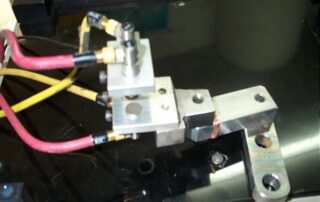
Capacitance Sensors Track Brake Rotor Thickness Variation
Capacitance Sensors Track Brake Rotor Thickness Variation Automotive, Aviation/Aerospace Brake Rotor Testing & Manufacturing Displacement, Amplitude Description [Application Note 51018] Today’s cars and trucks offer unprecedented fuel efficiencies and handling characteristics – thanks, in part, to vehicle lightweighting. Applied to all vehicle components, lightweighting lowers stress and strain to improve mileage and boost overall performance. In keeping with this trend, today’s brake rotors are thinner and lighter than those of just a few years ago. In addition, many feature cooling vents to further improve performance. These changes, however, reduce available [...]
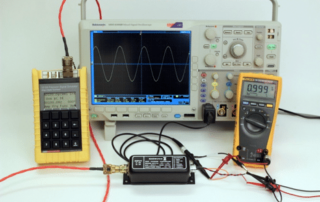 Signal Generator Tests Charge Amplifier Gain, Frequency Response Gallery
Signal Generator Tests Charge Amplifier Gain, Frequency Response
App Notes, Application Notes-MTI, Applications, Brand-MTI, Brands, Editorials, Industry, Industry-Aerospace, Industry-Energy, Industry: Transportation, Z-REPUB, z1
Signal Generator Tests Charge Amplifier Gain, Frequency Response
Testing Charge Amplifier Gain and Frequency Response with a Signal Generator Aviation/Aerospace, Industrial, Power Generation, Research & Development Charge Amplifier Gain and Frequency Response Testing Amplitude (Acceleration, Vibration, Pressure) Description [Application Note 40518] Piezoelectric transducers produce small electrical charges in response to pressure. Their sensitivity, ruggedness, and stability at high temperatures make them an essential building block of many accelerometers and pressure sensors. Applications include turbine vibration measurement (accelerometers) and combustion dynamics monitoring (pressure sensors). Typically, the high-impedance charge output produced by a piezoelectric transducer must be conditioned and amplified [...]
Monitoring Critical Variables
Monitoring Critical Variables Customer Case The customer wanted a quick visual inspection of many readings of slow varying parameters. Readings of pressure, temperature and voltages had to be compared with reference values and the differences had to be displayed in analog fashion in the form of a simple visual display. A Go/No Go decision had to be reached almost instantly. GaGe Case Solution The solution suggested by a major electronics company was to multiplex the differences 32 readings a channel for two channels, this gives a total of 72 reading in one display. The zero line is the no [...]
Signal Generator Simulates Gas Turbine Speed Signals
Signal Generator Simulates Gas Turbine Speed Signals Aviation, Power Generation Simulation of Speed Signals Amplitude, Displacement Description [Application Note 61318] Gas turbine engines are complex machines comprised of two rotating sections, generally referred to as the low pressure compressor (N1) and the high pressure compressor (N2). These turbine sections feature separate shafts that produce unique tachometer signals. Gas turbine engines have multiple rotating sections generally referred to as the low pressure compressor (N1) and the high pressure compressor (N2). These turbine sections have separate shafts that produce unique tach [...]
Hopkinson Bar Testing (Stress Pulse Reaction Testing)
Hopkinson Bar Testing (Stress Pulse Reaction Testing) Customer Case This customer is involved in testing materials for how they react to stress pulses. The idea is to introduce a stress pulse into the Material Under Test (MUT) and monitor it as it travels through the material. This method of material characterization is also known as "Hopkinson Bar" testing. Multiple sensors pick up the reaction of the material and provide outputs which need to be digitized. These outputs are transient signals of approximately 2 Volts and have a rise time of approximately 600 nanoseconds. The resulting system must be programmable [...]
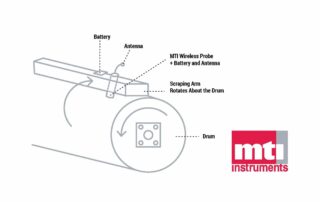
Capacitance Probes Measure Gaps in Rotating Environments
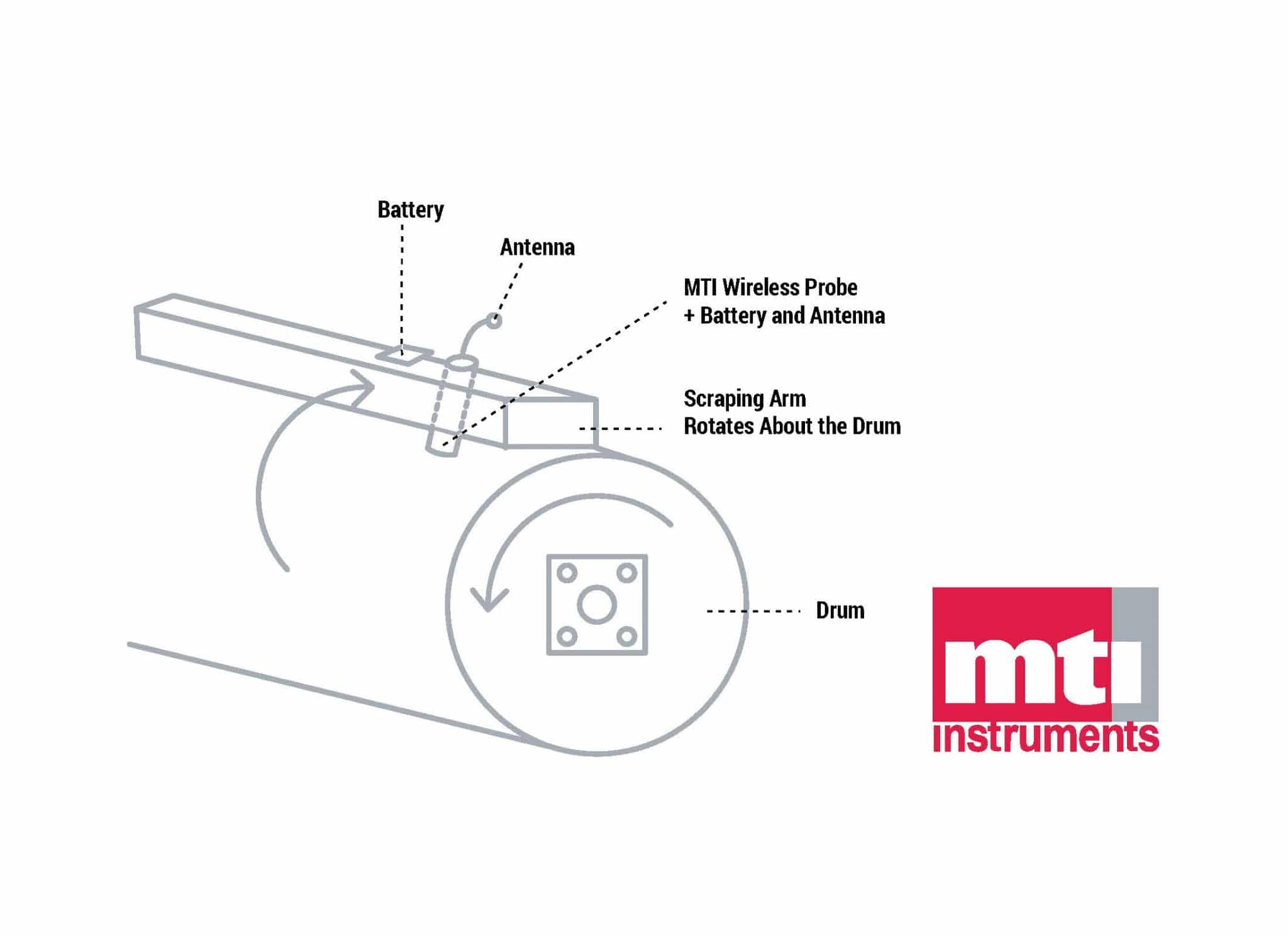
Capacitance Probes Measure Gaps in Rotating Environments Textiles, Industrial Optimizing Performance of Rotating Cylinders Gap Description [Application Note 72518] Sensor environments are not always ideal. Across the various Gap sensor applications conditions may vary drastically. Some setups may have requirements of miniaturization, and others of wireless signal propagation. In rotating environments where cables cannot go, often there is a need for both. Problem Traditional sensing solutions can’t be used in environments requiring wireless propagation such as inside a rotating body. In these situations, the size and power requirements restrict the [...]

Monitor Roller Gaps and Parallelism
Monitor Roller Gaps and Parallelism Industrial Printing, Calendering, Crushing Gap Easy Roller Gap Measurement Ensures Calendering Success Many roll-to-roll finishing processes typically use a calender, or series of hard pressure rollers, to deliver smooth, high-quality products of plastic, textile, or paper (Fig 1). Ensuring a consistent material thickness, however, depends on the ability to monitor, and maintain, a precise gap between rollers. This application note describes a quick and easy means for roller gap measurement. Figure 1: Calender Rollers where consistent gap across the rollers are vital [...]
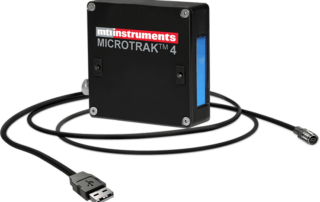
MicroTrak 4 Over a LAN for Ethernet Signaling
MicroTrak 4 Over a LAN for Ethernet Signaling Semiconductor, Research & Development 3D IC Construction Distance, Positioning, Displacement Description The MicroTrak 4, which is a USB device, can also be used over a LAN or even CAT 5e/6/7 wiring with additional hardware to convert the USB sensor to Ethernet signaling. The devices required to run over the LAN or direct CAT wire are Icron USB 2.0 Ranger 2301GE-LAN extender system. The MicroTtrak 4 basic software then runs on the host computer.  The LAN does not have to be dedicated; it can [...]
Non-Destructive Testing (NDT)
Non-Destructive Testing (NDT) Customer Case This customer manufactures non-destructive test equipment which allows customers such as steel mills to test the quality of their end-products. Presently, the ultrasound frequencies being used are centered at either 5 MHz, 10 MHz or 15 MHz. The worst case analog bandwidth requirement in this case is 35 MHz. In order to set up their equipment properly, the customer presently views the return signal (including the flaw) on an analog oscilloscope with a sweep time of either 50 us or 100 us (providing approximately 5 to 10 inches of depth in a metal). The [...]




Displacement Measurement by Fiber Optics
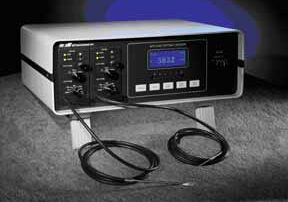
Displacement Measurement by Fiber Optics Semiconductor, Research & Development 3D IC Construction Displacement, Vibration Description The Fotonic™ Sensor is a non-contact instrument which uses the fiber optics lever¬π principle to perform displacement, vibration and surface-condition measurements (Figure 1). The Fotonic Sensor transmits a beam of light through a flexible fiber-optic probe, receives light reflected from a target surface, and converts it into an electrical signal proportional to the distance between the probe tip and the target being measured.¬† The output signal voltage from the fiber optic sensor is then used [...]