
Radar Altimeter
Radar Altimeter Customer Case In this RADAR application the customer has pulses coming in at 1660 Hz. For every pulse they need to capture 500 samples which, at that rate, will amount to 1.7 Megs of data every second. The experiment will be running for at least a few minutes. They would then like to log all the captured data to the PC host memory. The final requirement is for the system to be on the PCI bus. By having the system on the PCI bus, the customer can stream the data directly to the PC's memory, which is [...]
Ultra High-Speed Radar
Ultra High-Speed Radar Customer Case This application requires the acquisition of very fast analog signals at relatively slow sample rates for a long period of time. In other words, the input bandwidth requirement is very high (1 GHz), but the sampling rate needs to be no more than 5 or 6 MSPS. The most important requirement is that the acquisition must go on, without any breaks, for many hours. The customer does not need very high dynamic range. In fact, a 4-bit A/D converter will be sufficient. The customer has already identified a 4-bit A/D chip from TRW which [...]

Vitrek Press Release: GaGe Adds New 16-Bit/14-Bit Resolution 2-Channel Models to its Razor Series of High-Speed PCIe Digitizers
GaGe Adds New 16-Bit/14-Bit Resolution 2-Channel Models to its Razor Series of High-Speed PCIe Digitizers Boasting Industry’s Best ENOB New RazorEdge Express 16-bit/14-bit digitizers support A/D sampling rates up to 250 MS/s, while new 14-bit resolution model option is added to existing 16-bit RazorPlus Express with 500 MS/s sampling rate; pricing reduced on 16-bit 500 MS/s RazorPlus/RazorMax Express models; providing best price/performance options aligning with user requirements Lockport, IL—September 6, 2023— GaGe by Vitrek, a US-based manufacturer of high-speed data acquisition and signal recording systems, announces two new versions of its popular Razor Series line of dual-channel (2-CH) [...]
Radar Rackmount System for Large Record Lengths
Radar Rackmount System for Large Record Lengths Customer Case The customer needs to acquire data from his radar system at a sampling rate of 1.5 MSPS for two channels (I & Q). At the moment, this data must be acquired for at least 10 seconds, but the record length may increase by almost 100 times in the future. This equipment needs to be installed in a rackmounted environment, so the host computer must have rackmount capability. An integrated monitor is also important as it eliminates the need to purchase a rack-mounted monitor. Keyboard and mouse must also be rackmountable. [...]
Interfacing to Offset IF Radar Altimeter
Interfacing to Offset IF Radar Altimeter Customer Case The customer is using an offset IF radar to map forest terrain density. The equipment will be mounted in an aircraft, which will also be carrying a Global Positioning System (GPS) for reference. The plane will fly at an altitude of 10,000 feet. A 512 ns radar pulse will be sent out and a return pulse will be received about 20 uS later, from which 10,000 samples will be acquired. After the pulse is received, there will be a relatively long re-arm time of about 250 to 300 uS for the [...]
 Whitepaper: Semiconductor Wafer Measurement for Increased Productivity Gallery
Whitepaper: Semiconductor Wafer Measurement for Increased Productivity
Brand-GaGe, Brand-MTI, Brand-Vitrek, Brands-All, Industry-Consumer Products, Industry-Electronics, Industry-Manufacturing, Industry-OEM, Industry-Semiconductor, Industry-Semiconductor-MTI, Knowledge Center-MTI, News-Industry, News-MTI, Whitepapers-MTI
Whitepaper: Semiconductor Wafer Measurement for Increased Productivity
Semiconductor Wafer Measurement for Increased Productivity This three-part article describes how manufacturers leverage capacitance-based inspection systems for semiconductor wafers. The article reviews best-practices, consequences of failing to inspect semiconductor wafers and benefits of using semi-automated, fully-automated and manual systems for wafer metrology and inspection. Part 1: Why Disc Geometry Matters in Wafer Production Semiconductor wafers are cut from cylindrical silicon crystals, or ingots. The flatness of these disc-shaped wafers is controlled to tight tolerances to ensure that the entire wafer surface is suitable for integrated circuit (IC) production. If disc geometry is out-of-spec [...]
Trigger Out Modification for CP500 Class Boards
Trigger Out Modification for CP500 Class Boards Customer Case Many A/D applications including Ultrasonics, Radar, Lidar, Hard Disk testing and CCD capture require maximal synchronicity between a trigger and the sampling clock. GaGe Case Solution GaGe now offers the TRIGGER OUT option as a means of synchronizing systems to the sampling clock on GaGe's CP500-class of A/D and scope cards, including CS8500, CS12100 and CS1250. The need for synchronicity can be understood by considering a typical ultrasonic pulse-echo system. An ultrasonic pulser-receiver generates ultrasonic pulses from a transducer which, microseconds later, receives echo signals reflected from a test specimen. [...]
Monitoring Critical Variables
Monitoring Critical Variables Customer Case The customer wanted a quick visual inspection of many readings of slow varying parameters. Readings of pressure, temperature and voltages had to be compared with reference values and the differences had to be displayed in analog fashion in the form of a simple visual display. A Go/No Go decision had to be reached almost instantly. GaGe Case Solution The solution suggested by a major electronics company was to multiplex the differences 32 readings a channel for two channels, this gives a total of 72 reading in one display. The zero line is the no [...]
Hopkinson Bar Testing (Stress Pulse Reaction Testing)
Hopkinson Bar Testing (Stress Pulse Reaction Testing) Customer Case This customer is involved in testing materials for how they react to stress pulses. The idea is to introduce a stress pulse into the Material Under Test (MUT) and monitor it as it travels through the material. This method of material characterization is also known as "Hopkinson Bar" testing. Multiple sensors pick up the reaction of the material and provide outputs which need to be digitized. These outputs are transient signals of approximately 2 Volts and have a rise time of approximately 600 nanoseconds. The resulting system must be programmable [...]
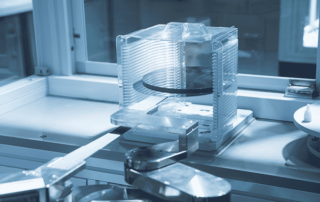
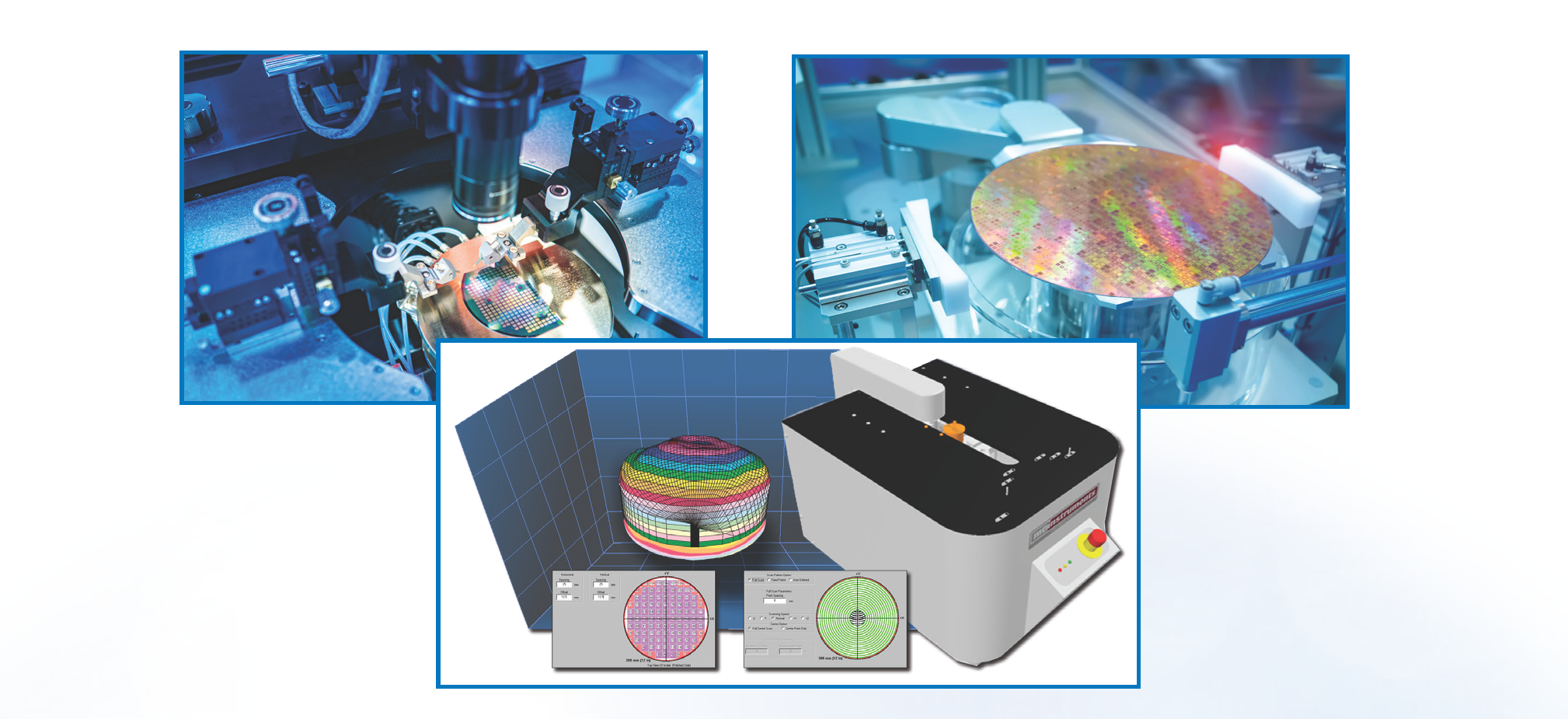

The Cost of Failing to Inspect Semiconductor Wafers
This is the second of three articles in Semiconductor Wafer Measurement for Increased Profitability. The first article in this series explains why disc geometry matters. The third article describes the benefits of using semi-automated, fully-automated, and manual systems for wafer metrology and inspection. Most semiconductor wafers are made of silicon, the second most common element in the Earth’s crust. Yet, silicon’s abundance does not mean that wafers are inexpensive. The pure form of silicon that’s used in semiconductors does not occur naturally and must be refined and mixed with a dopant that alters material properties and electrical characteristics. Silicon ingots are formed, wafers [...]