


MTI Case-In-Point: Gap Monitor Keeps Wind Turbines Running
Gap Monitor Keeps Wind Turbines Running System helps operators minimize downtime and protect against catastrophic failure Introduction Wind turbine production has been steadily increasing to meet growing demand for renewable energy. As power outputs and the number of installations climb, maintenance becomes ever more critical. Operators want to minimize downtime and protect against catastrophic failure. The ability to predict when maintenance will be required can go a long way to ensure these goals are met. Challenge A leading manufacturer of wind turbine power generators approached MTI for critical gap monitoring sensors. Specifically, the company wished to monitor [...]
Laser Based Position Measurement System
Laser Based Position Measurement System Customer Case In order to test their Laser Based Position Measurement Systems, the customer needs to characterize an output pulse from his circuitry which lasts for approximately 5 microseconds. According to the customer's estimates, he must use a sampling rate of 50 MSPS or higher in order to be able to analyze the signal completely. An additional requirement of the test system is that a specific number of successive pulses be digitized and then averaged in order to eliminate system noise. The number of such successive pulses must be variable. The repeat rate of [...]
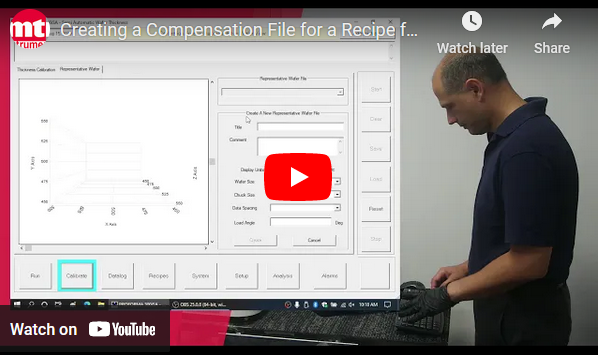
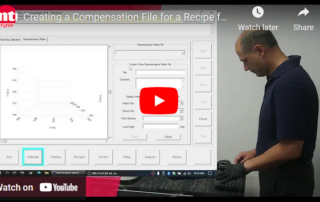 Creating a Compensation File for a Recipe for the Proforma 300iSA – Video Gallery
Creating a Compensation File for a Recipe for the Proforma 300iSA – Video
Brand-MTI, Industry-Compliance Testing, Industry-Electronics, Industry-Manufacturing, Industry-Semiconductor, Industry-Semiconductor-MTI, Industry-Semiconductor-Videos, News-MTI-Metrology, Products-MTI-Semiconductor/Metrology, Videos-MTI-Manual Semiconductor Metrology System, Videos-MTI-Semiautomated Metrology System, z1
High-Power Laser Lamp Array Tester
High-Power Laser Lamp Array Tester Customer Case The customer is building a tester for an array of high-power laser lamps. These lamps draw 35,000 Amps of current. The test involves sending a control signal to the laser lamp and measuring the time between the signal and the switching on of the lamp (which is picked up by a photodiode). This time is representative of the quality of the lamp. The customer currently has a 16-channel system, and would like to explore increasing the number of channels. In the customer's present system, eight CompuScope 512 cards are installed in a [...]
Synchronizing Over A Wide Sampling Speed Range
Synchronizing Over A Wide Sampling Speed Range Customer Case The client has set up an experiment where he needs to generate a stimulus signal and apply it to a He-Ne Laser with some polarizing optics. The response signal is a measurement of the Faraday effect. The signal is noisy and requires averaging over a very long time. The stimulus and response must be synchronized over a wide frequency range. For synchronization, the application requires a wide band of sampling speed from, 1 KS/s to 50 MS/s. GaGe Case Solution While GaGe's CompuScope 14100 provides the required digitizer performance, it [...]
Time Resolved Spectroscopy of Protein Crystals
Time Resolved Spectroscopy of Protein Crystals Customer Case The customer is involved in Time Resolved Spectroscopy of protein crystals. This involves shooting a laser onto the protein crystals and measuring the pulses generated by the crystals (as they are projected out of the sample) and their decay over time. Due to the very noisy nature of the return signals, it is essential to average many pulses in order to recover the pulse shape and measure the decay. The decay takes place over many tens of milliseconds, so it is necessary to acquire very long records (in the order of [...]
 MTI Application Note: Testing for Connector Failure Due To Vibration or Shock Gallery
MTI Application Note: Testing for Connector Failure Due To Vibration or Shock
App Notes, Application Notes-MTI, Brand-MTI, Industry-Consumer Products, Industry-Electronics, Industry-Manufacturing, Products-MTI, Products-MTI-Laser/Fiber Optic, z1

MTI Application Note: Testing for Connector Failure Due To Vibration or Shock
Testing for Connector Failure Due to Vibration or Shock Mobile Communications Equipment Needs Reliable Connectors That Will Not Disconnect with Shock or Vibration Introduction A large multinational company approached MTI to provide a sensor capable of measuring displacement that also wouldn’t load the target (connector). Shock and vibration testing would span 2-15G and the target connectors were very small. Application MTI’s 2100 optical displacement sensor system is ideal for this kind of application because very small probes can be used and they measure displacement via reflected light. [...]
Hyper Remote Laser Sensor
Hyper Remote Laser Sensor Customer Case The customer is at the prototype stage for building a hyper remote sensor which will fly over the ocean and be able to see 100 to 200 feet below the surface. The sensor is being designed in order to determine the composition of the ocean and the ocean floor. This remote sensor will be extremely useful in the detection of pollution and studying the way pollution is being distributed by ocean currents. It will also be useful to the military (navy) for creating mine-finding systems. A deep blue laser will be used to [...]