

Using Laser Technology to Detect Fatigue Cracks
Using Laser Technology to Detect Fatigue Cracks Aviation/ Aerospace Jet Turbine Blade Vibration Amplitude Description In order to simulate real world conditions turbine blades are vibrated in a sound chamber at a variety of elevated temperatures. A siren directs a blast of pulsed air at the leading edge of the turbine blade creating a tremendous amount of force. This force excites the turbine blade at its resonant frequency, inducing strain in the blade structure. To accurately monitor vibration amplitude and frequency, a non-contact measurement sensor is required. Non-contact eliminates any “mass [...]
Brake Rotors
Brake Rotors Automotive Brake Rotors Surface Description Introduction Under normal operating conditions brake rotors are subjected to extreme temperatures and forces, which can cause rotor distortion and potential failure. To make certain it can withstand these conditions; extensive laboratory testing is performed to optimize design for longevity, short stopping distance, and vibration free operation. Extensive on-vehicle testing is done under real life conditions to test prototype units and engineering designs. Test vehicles are driven for long periods of time while brake performance is monitored by a variety of sensors and [...]

Tire Tread Measurement
Tire Tread Measurement Automotive Tire Tread Inspection Depth Description Tire manufacturers and Used Tire Reuse Centers want to satisfy their customers, and protect themselves from liabilities. Manufacturers are moving to 100% tire inspection for tread depth, defects and abnormality detection. Defects not only cause potential safety issues but they can also introduce unwanted vibration into the vehicle suspension system and cause excessive road noise. Belts can be overlapped, or not cover the complete tire surface, causing weak or bubbled areas and imbalances. The tread depth can be too shallow, leading to [...]
Piezoelectric Device Amplitude
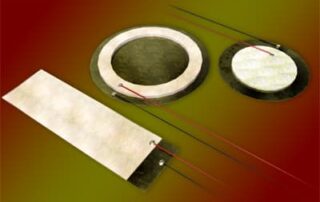
Piezoelectric Device Amplitude Research & Development Piezoceramic, 1-3 Pzt / Polymer Composite And Pvdf Film Amplitude Description Measuring Piezoelectric device amplitude including piezoceramic, 1-3 PZT/polymer composite and PVDF film A “PZT ” is a piezoelectric device which generates motion when a voltage is applied across the crystal. The motion can be anywhere from DC to ultrasonic and the motion is typically very small. PZT devices are used to generate sound and to convert voltage to motion. MTI's MTI-2100 controller in conjunction with a High resolution fiber optic probe such as [...]

Angle Measurement And Monitoring
Angle Measurement And Monitoring Industrial Angle measurement and monitoring Robot Guide Introduction What do sheet metal, speakers, and wine bottles all have in common? They all require precise angle measurement to ensure product consistency and quality. Whether you're working in metal fabrication or consumer product packaging, an angle measurement sensor is essential for measuring critical angles and profiles with high precision. Precision Angle Measurement in Sheet Metal Press Brake Applications Many industrial applications, especially in sheet metal fabrication, rely on angle measurement sensors to monitor and control bends. For example, in [...]

Piezoelectric Stack Motion
Piezoelectric Stack Motion Research & Development Piezoelectric Stack Motion Displacement Description Fotonic sensors are ideal for making dynamic measurement of very small oscillatory motions. Using the MTI-2100 with a spectrum analyzer, angstrom level measurements are possible. Would you like to know more? Okay let’s set up some basic equipment and get started. Piezoelectric crystals expand and contract when voltage is applied across the stack. By controlling the amplitude of the applied signal we control the magnitude of the displacement. The test setup A Spectrum Analyzer A Signal Generator to drive piezo device [...]
Thickness and TTV of Semiconducting Wafers
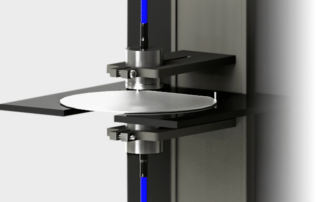
Thickness and TTV of Semiconducting Wafers Semiconductor Thickness And TTV Of Semiconducting Wafers Thickness Description Introduction:  Silicon wafers are ordinarily highly conductive and easy to measure with standard capacitive displacement sensors (See MTI’s Proforma 300i). Measuring the thickness of GaAs wafers that have high bulk resistivity (>10k Ohm/cm) is a little more difficult because the wafers act as non-conductive insulators in a capacitive sensors measuring field. Fortunately, MTI has a solution to this problem. Solution:  It’s possible to measure the thickness and TTV of high resistivity semiconducting wafers (like GaAs) [...]

Lithography Optics Position Focus
Lithography Optics Position Focus Semiconductor Lithography Optics Position Focus Positioning Description One specific area where capacitance systems excel is high resolution focusing of complex lens systems such as those found in atomic force microscopes, vision inspection machines and photolithography tools. In a multi-million dollar photolithography tool, high accuracy, nanometer resolution and maximum thermal stability are absolutely critical to maintain proper focus and obtain integrated circuit line widths as small as 45 nanometers. Additionally, most systems demand low power consumption and maximum heat dissipation to eliminate any adverse affects from temperature [...]
Camera Shield Measurement
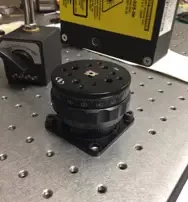
Camera Shield Measurement Consumer Electronics Camera shield measurement Surface Equipment Setup Equipment Used DTS-25-04 laser head Rotary Stage PC with Digital Microtrak Basic Support software Setup: Power is automatic mode. Filter is 100Hz Sample rate is 1000 samples sec The head was operated in diffuse mode (not specular/tilted) Validation of Setup The setup should be validated by performing a total runout scan on the rotary stage with no target present. The stage should be cleaned with Isopropyl alcohol and allowed to dry prior to the scan. This reduces any dust [...]
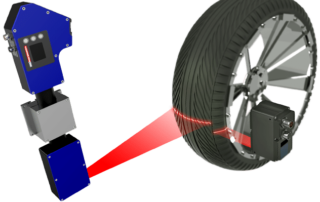


Tire Tread Measurement with 2D Laser
Tire Tread Measurement with 2D Laser Automotive Tire Tread Measurement with 2D Laser Depth Why Accurate Tire Tread Measurement Matters To maximize safety and tire longevity, modern tire manufacturers are adopting 100% tire inspection systems that include tread depth measurement, defect detection, and pattern recognition. Inadequate tire tread depth can lead to reduced traction, poor braking, and potential tire failure. Surface anomalies like blistering, bubbles, or belt overlap may cause runout, road noise, or even catastrophic failure. With consumer expectations rising and regulatory standards tightening, tire OEMs and testing labs need precise, [...]