
 Press Release: Vitrek Offers Metrologists Laboratory-Level Accuracy in a Portable, Battery Operated DC Calibrator Gallery
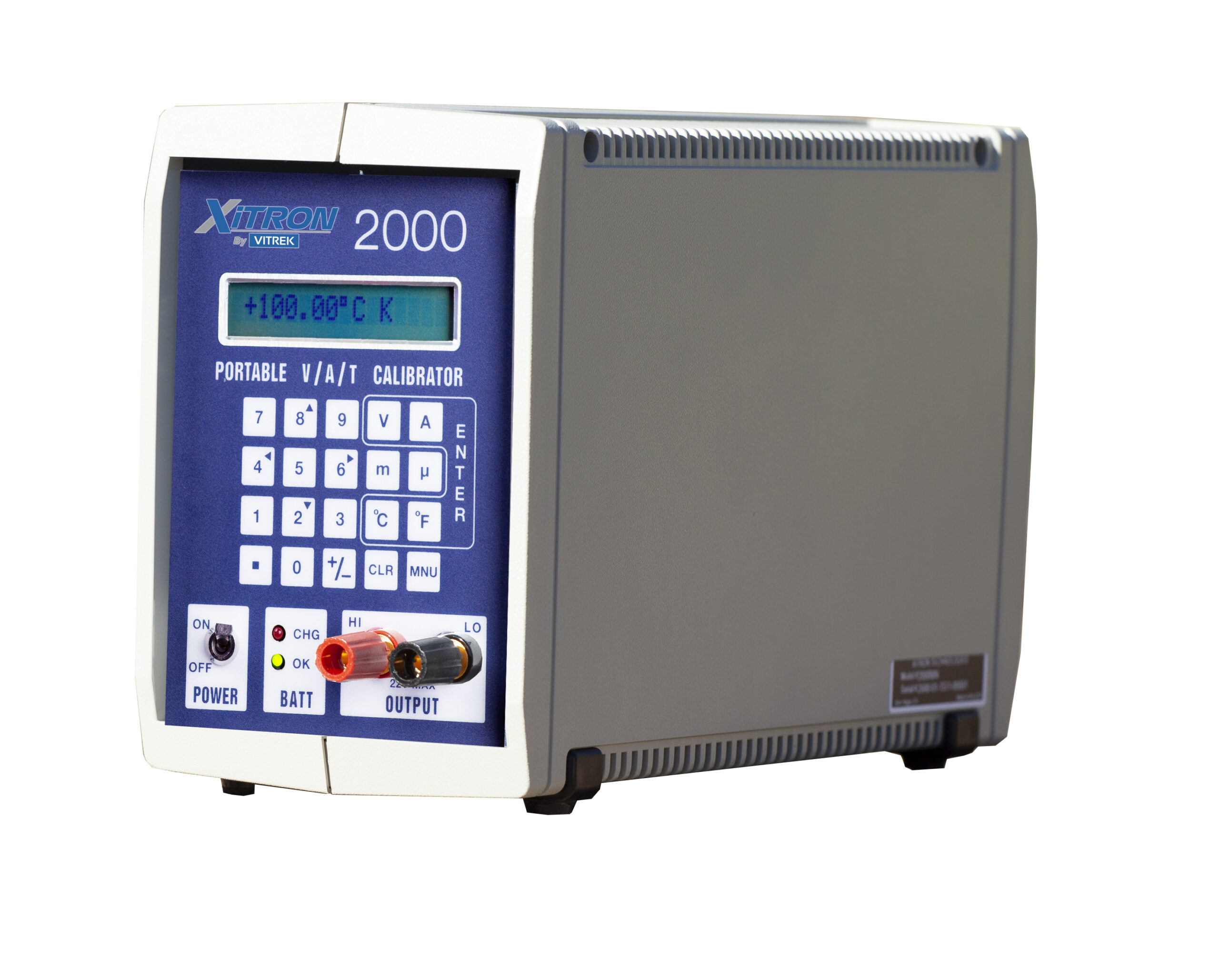
Press Release: Vitrek Offers Metrologists Laboratory-Level Accuracy in a Portable, Battery Operated DC Calibrator
Brand-Vitrek, Industry-Compliance Testing, Industry-Manufacturing, Industry-R&D, New & Press Releases, News-Product Updates, News-Products, News-Vitrek, Press Releases-Vitrek, Products-Vitrek-DL Load, z1
Press Release: Vitrek Offers Metrologists Laboratory-Level Accuracy in a Portable, Battery Operated DC Calibrator
Vitrek Offers Metrologists Laboratory-Level Accuracy in a Portable, Battery-Operated DC Calibrator The XiTRON 2000 Series provides flexibility when calibrating thermocouple, pressure, flow and DC voltage instrumentation; portable DC calibrator’s performance rivals costlier devices traditionally used in lab settings […]
Ultrasonic Medical Imaging System
Ultrasonic Medical Imaging System Customer Case A customer wants to construct an ultrasonic medical imaging system based on a transducer array. A central ultrasonic generation transducer generates a burst of ultrasonic energy which travels towards a tissue specimen. Echoes reflected off the tissue specimen are simultaneously detected by an array of 48 ultrasonic receiver transducers arranged in a dish-like pattern. The customer must simultaneously digitize all 48 signals and download them to PC RAM as quickly as possible. The customer requires 8 bit vertical resolution and would like to sample at 40 MS/s, but 20 MS/s would be acceptable. [...]
Intra-Vascular Ultrasound
Intra-Vascular Ultrasound Customer Case The customer does intra-vascular diagnostic ultrasound. In this novel technique, an ultrasonic catheter is guided through a patient's blood vessel. Throughout its helical or corkscrew-like path, the ultrasonic transducer-tipped catheter emits bursts of ultrasonic energy. Reflections from the vessel wall return into the transducer and can be used to characterize such features as plaque deposits. The customer wishes to resolve features as small as 3 mm. The amount of time, D t, required for ultrasound to reflect off an interface that is a distance x away and return to the transducer is: D t = [...]
 CMP and Capacitance-Based Semiconductor Wafer Measurement Gallery
CMP and Capacitance-Based Semiconductor Wafer Measurement
Application Notes-MTI, Brand-MTI, Industry-Compliance Testing, Industry-Consumer Products, Industry-Electronics, Industry-Manufacturing, Industry-Semiconductor, Industry-Semiconductor-MTI, Industry-Sensors, Products-MTI-Capacitance, Products-MTI-Semiconductor/Metrology, z1

CMP and Capacitance-Based Semiconductor Wafer Measurement
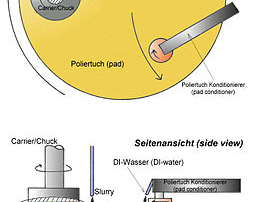
Chemical mechanical polishing (CMP) uses chemical oxidation and mechanical abrasion to selectively remove material from semiconductor wafers in order to achieve very high levels of planarity. The planarity, or flatness, of these wafers is important for optical lithography, a microfabrication technique that produces integrated circuits (ICs) by transferring a geometric pattern from a photomask to a light-sensitive chemical photoresist. Also known as photolithography or UV lithography, optical lithography can produce a geometric pattern on a thin film or directly onto the substrate. Semiconductor Wafer Measurements: Flatness and Shape During optical lithography, variations in wafer flatness must be smaller than [...]
Deep Capture of Medical Sonography Signals
Deep Capture of Medical Sonography Signals Customer Case Medical sonography refers to the use of reflected ultrasonic echoes to image a patient's internal organs. A customer has a commercial medical diagnostic ultrasound system. During its operation, an external probe is placed upon the patient. An ultrasonic transducer within the probe head mechanically scans in a linear frame pattern at a rate of approximately 22 frames/sec. The transducer generates a sharp ultrasonic pulse into the patient and the same transducer detects reflected echoes from various tissue interfaces. In normal operation, the system processes the ultrasonic echoes in a prescribed fashion [...]
 MTI Instruments Announces Newest Addition of the PBS-4100+ Portable Vibration and Balancing System Gallery
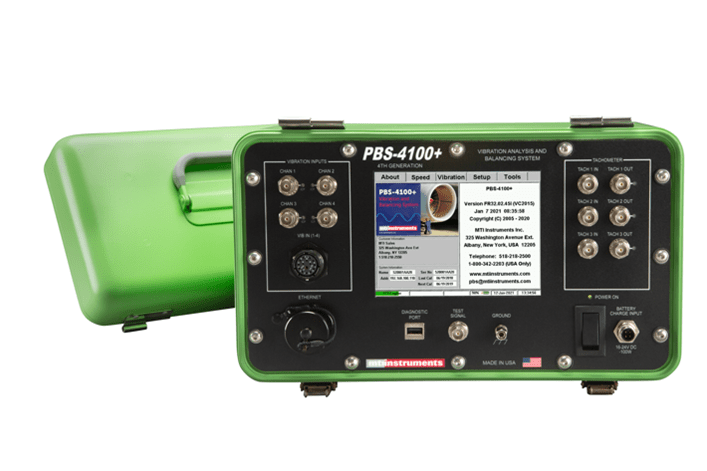
MTI Instruments Announces Newest Addition of the PBS-4100+ Portable Vibration and Balancing System
Brand-MTI, Industry-Aerospace, Industry-Compliance Testing, Industry-Manufacturing, Industry: Transportation, New & Press Releases, News-MTI, News-MTI-PBS, News-Product Updates, News-Products, Press Releases-Vitrek, Products-MTI, Products-MTI-Engine Balancing, z1
MTI Instruments Announces Newest Addition of the PBS-4100+ Portable Vibration and Balancing System
[/fusion_builder_row][/fusion_builder_container] [/fusion_text] [/fusion_builder_column][/fusion_builder_column][/fusion_builder_column] [/fusion_builder_row][/fusion_builder_container] [/fusion_builder_column][/fusion_builder_column] [/fusion_text] [/fusion_builder_column] [/fusion_builder_column]Learn More About PBS-4100+ Gen4 [/fusion_builder_column] MTI Instruments Announces Newest Addition of the PBS-4100+ Portable Vibration and Balancing System; Continuing its Industry Leading Excellence in Aircraft Engine Maintenance Systems The fourth-generation iteration of MTI Instruments’ engine vibration analysis and balancing system is more mobile than ever, while maintaining the highest standards in the industry for commercial aviation Lockport, IL, April 27, [...]
Laser Scanning Microscope Interface
Laser Scanning Microscope Interface Customer Case This customer needs to interface a scanning laser microscope to their PC so that image data can be acquired and stored. Data is received from the laser microscope via an optical sensor at 1300 line scans per image. Each scan has an 8 ms duration, but 2/3 of that time is scan time and 1/3 is flyback time (dead time). The customer has determined that a 1 us sample width (or faster) would be adequate. There is also a price vs. performance issue - the customer has a tight budget and wants the [...]
 MTI Instrument’s PBS ROI Calculator: See How Much Money You Can Save Gallery
MTI Instrument’s PBS ROI Calculator: See How Much Money You Can Save
Application Notes-MTI, Brand-MTI, Industry-Aerospace, Industry-Compliance Testing, Industry-Government/Military, Industry-Manufacturing, Industry: Transportation, New & Press Releases, News-MTI, News-MTI-PBS, News-Products, Press Releases-Vitrek, Products-MTI, Products-MTI-Engine Balancing, Z-REPUB, z1

MTI Instrument’s PBS ROI Calculator: See How Much Money You Can Save
Ensuring the proper operation of your aircraft engine is essential to complying with manufacturers guidelines for the safety and longevity of the aircraft. Ensuring engines are not operating outside acceptible vibration limits and operating optimally isn't just smart, it is vital to your business. Excessive engine vibration can lead to cracked turbine, fan and compressor components potentially leading to catastrophic failure. The costs of catastrophic engine failure due to an unbalanced engine can measure in the millions of dollars. As airlines push to get more and more life out of their aging fleets, the need to properly maintain the [...]
 Multinational Manufacturer Saint-Gobain Selects MTI Instruments’ Digital Capacitance Measurement Technology to Streamline R&D Gallery
Multinational Manufacturer Saint-Gobain Selects MTI Instruments’ Digital Capacitance Measurement Technology to Streamline R&D
Brand-MTI, Industry-Manufacturing, Industry-R&D, New & Press Releases, News-MTI-Instrumentation, Press Releases-Vitrek, Products-MTI-Capacitance, Z-REPUB, z1
Multinational Manufacturer Saint-Gobain Selects MTI Instruments’ Digital Capacitance Measurement Technology to Streamline R&D
Multinational Manufacturer Saint-Gobain Selects MTI Instruments’ Digital Capacitance Measurement Technology to Streamline R&D Lockport, IL, April 21, 2021 /PRNewswire/ — MTI Instruments, Inc. (“MTI Instruments”), a wholly-owned subsidiary of Mechanical Technology, Incorporated (NASDAQ: MKTY), announced today that Compagnie de Saint-Gobain (“Saint-Gobain”) has selected MTI Instruments’ non-destructive measurement technology to help streamline the Saint-Gobain’s manufacturing research and development. Saint-Gobain, a French multinational corporation that designs, manufactures, and distributes various high-performance materials, chose MTI Instruments as a partner after identifying that the process for producing accurate and repeatable measurement solutions was time-consuming and cost-prohibitive. Saint-Gobain estimated that just 30% of their process [...]
Electron Paramagnetic Resonance Imaging (EPRI) Measuring of Tumor Oxygen Levels
Electron Paramagnetic Resonance Imaging (EPRI) Measuring of Tumor Oxygen Levels Customer Case The customer is improving their Electron Paramagnetic Resonance Imaging (EPRI) system that is used for the diagnosis of tumors. Using this non-invasive method, the concentration of oxygen in living tissues can be determined without the need for biopsies. Tumors that have little or no oxygen content (i.e. hypoxia) also have increased resistance to radio-frequency radiation, making it less effective as a choice for cancer treatment. Identifying those patients with hypoxic tumors allow alternative treatments to be used instead. The requirement is to capture the returned RF signals [...]