
Neutrino Detection System
Neutrino Detection System Customer Case Neutrinos are tiny (possibly massless) neutral elementary particles which interact with matter via the weak nuclear force. The weakness of the weak force gives neutrinos the property that matter is almost transparent to them. The sun, and all other stars, produce neutrinos copiously due to nuclear fusion and decay processes within the core. Since they rarely interact, these neutrinos pass through the sun and the earth (and you) unhindered. Other sources of neutrinos include exploding stars (supernovae), relic neutrinos (from the birth of the universe) and nuclear power plants (in fact a lot of [...]
Nuclear Particle Location
Nuclear Particle Location Customer Case The customer studies nuclear particles traveling in an electrically charged medium. The particles emit two types of short 53 MHz signal bursts. The first type lasts for 1.6 ms, the second type lasts for 6 ms. The customer had to capture these bursts in at least two locations and analyze their amplitudes in order to determine the position and some of the characteristics of the nuclear particles. The application requires two channels of capture at speeds of at least 500 MS/s. The depth of capture at 1 GS/s is 6,000 samples for the 6 [...]
 The Benefits of Manual, Semi-Automated, and Fully-Automated Systems for Semiconductor Wafer Inspection and Metrology Gallery
The Benefits of Manual, Semi-Automated, and Fully-Automated Systems for Semiconductor Wafer Inspection and Metrology
Application Notes-MTI, Brand-MTI, Industry-Consumer Products, Industry-Electronics, Industry-Manufacturing, Industry-Semiconductor, Industry-Semiconductor-MTI, News-MTI-Metrology, Products-MTI-Semiconductor/Metrology, z1
The Benefits of Manual, Semi-Automated, and Fully-Automated Systems for Semiconductor Wafer Inspection and Metrology
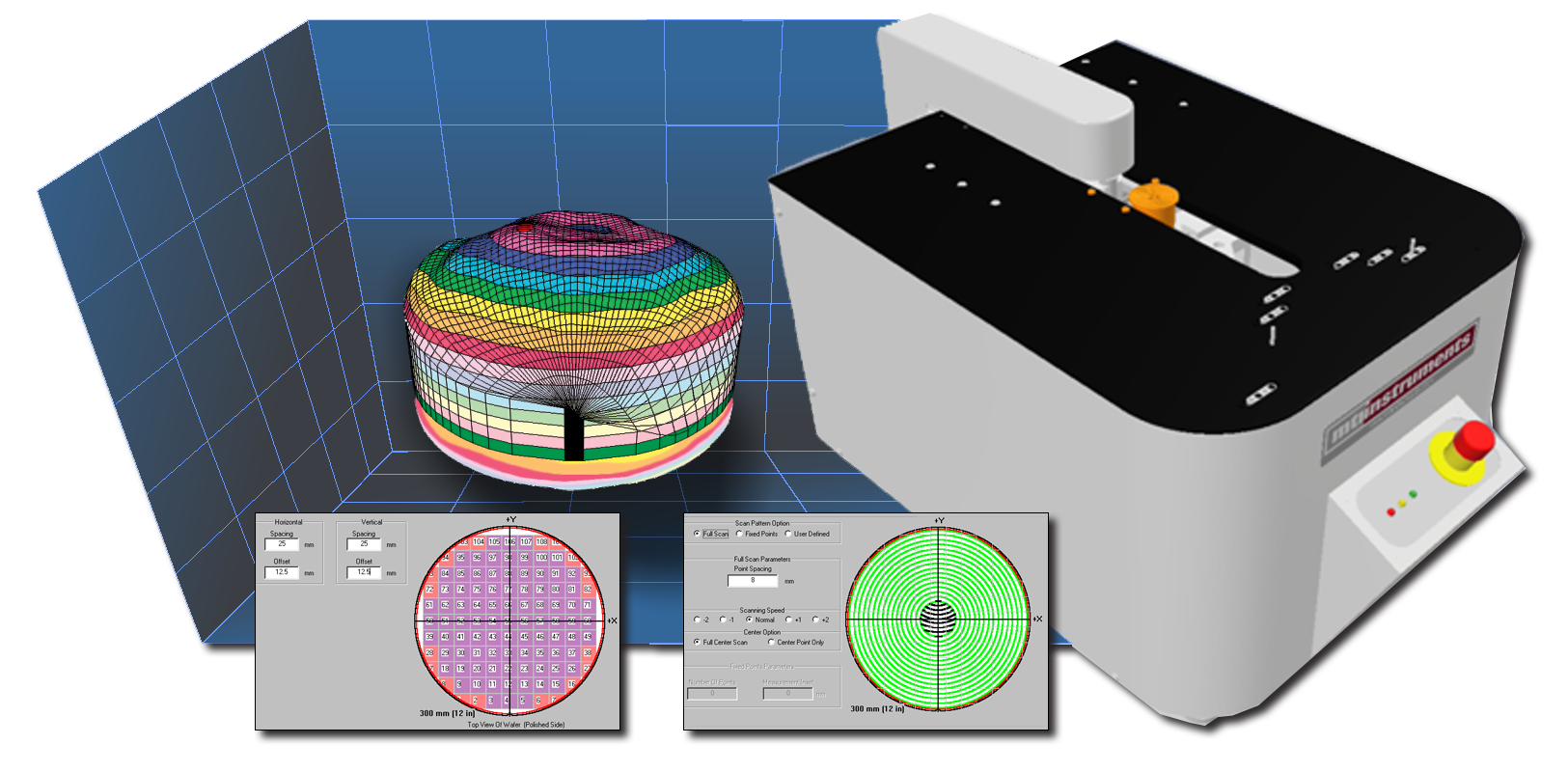
This is the third of three articles in Semiconductor Wafer Measurement for Increased Profitability. The first article in this series explains why disc geometry matters. The second article examines the cost of failing to inspect semiconductor wafers. Fully automated systems that can load, scan, and unload wafers are fast, convenient, and efficient at high volumes. They’re useful for checking every wafer in every batch, but these systems are expensive. Semi-automated and manual systems cost significantly less and are generally used for lower volumes; however, they’re also easy-to-use and can make fast, accurate measurements that support production flow. Semi-automated and [...]
Ozone Profiling Lidar System
Ozone Profiling Lidar System Customer Case The customer is designing an ozone-profiling lidar system for measuring the concentration of ozone from ground level up to about 4 kilometer (km) altitude. The system operates in the ultraviolet range and uses multiple receiver telescopes to cover the range. The dynamic range of the signal is enormous, so small aperture telescopes are used to collect backscattered light from low altitudes and large ones are used to collect backscattered light from high altitudes. The customer is operating simultaneously at three laser wavelengths, and the current design requires a total of nine photodetectors (three [...]
 Why Disc Geometry Matters In Wafer Production Gallery
Why Disc Geometry Matters In Wafer Production
Application Notes-MTI, Brand-MTI, Industry-Consumer Products, Industry-Electronics, Industry-Manufacturing, Industry-Semiconductor, Industry-Semiconductor-MTI, News-MTI-Metrology, Products-MTI-Semiconductor/Metrology, z1

Why Disc Geometry Matters In Wafer Production
This is the first of three articles in Semiconductor Wafer Measurement for Increased Profitability. The second article examines the cost of failing to inspect semiconductor wafers. The third article describes the benefits of using semi-automated, fully-automated, and manual systems for wafer metrology and inspection. Semiconductor wafers are cut from cylindrical silicon crystals, or ingots. The flatness of these disc-shaped wafers is controlled to tight tolerances to ensure that the entire wafer surface is suitable for integrated circuit (IC) production. If disc geometry is out-of-spec after cutting, it may be possible to reprocess the wafer. Cutting is only the first [...]
High-Spatial Resolution Lidar
High-Spatial Resolution Lidar Customer Case In Lidar, which is Laser Radar, spatial resolution is limited by the laser pulse width. This customer's laser pulse width is 3.5 ns. The total range interrogated by the Lidar system will be on the order of 250 meters. The customer needs to digitize the Lidar signal at 500 MS/s into 8 MegaSamples of memory. 8-bit digitizer resolution will be sufficient and they would also prefer to keep software programming at an absolute minimum. GaGe Case Solution Had the customer required higher resolution, say 12 or 14-bit, and sampling rates of 100 MS/s, then [...]
Ozone Profiling
Ozone Profiling Customer Case Ozone profiling involves many averaging operations, which makes it very difficult to obtain the results immediately. There can be a delay of many days before a reliable reading is dispatched, which, by then, would be too late to take measures to protect the population and agriculture from the harmful effects. A customer has an Ozone profiling Lidar capable of downloading readings to a PC. The customer wanted to speed up the process of the averaging and analysis of the readings, also called data reduction, to near real-time speeds. This could be achieved if it was [...]
Radar Waveform Sampling & Processing
Radar Waveform Sampling & Processing Customer Case A customer involved in Naval Research needed to sample and process radar waveforms, to be used as reference in their lab. They were looking at implementing a digitizer solution. They needed 8-bit vertical resolution and a sampling speed of 500 MS/s. The customer also needed 2 GB of acquisition memory and wanted a portable solution. The customer also wanted to develop software in MATLAB and LabVIEW. GaGe Case Solution The customer was looking at the deepest acquisition memory available so they showed most interest in the CompuScope 8500. With its 8-bit vertical [...]
Polar Ice Thickness Measurements
Polar Ice Thickness Measurements Customer Case The customer is an academic researcher in climate change. He wants to record the depth of the permafrost ice sheets in the arctic regions of Canada, Greenland and elsewhere. The change in world climate is directly related to the changes in the thickness of polar ice. Abrupt changes can be a predictor of climatic changes in the world. The measuring apparatus is an ice-penetrating radar mounted on an aircraft flying at 500-600 meters. The radar pulses at 20 kHz Pulse Repeat Frequency (PRF), captures the reflections of groups of 32-64 pulses. Each pulse [...]
Storm Watch / Tornado Radar
Storm Watch / Tornado Radar Customer Case On average, the United States experiences 100,000 thunderstorms each year, causing about 1,000 tornadoes. The customer is trying to determine what meteorological conditions enable a large rotating thunderstorm (a "supercell") to drop a dangerous tornado-funnel. By determining what conditions must exist for the formation of an especially fierce tornado, researchers hope to develop accurate predictions of when and where such a tornado may touch down, giving the people time to evacuate. The customer wants to study tornadoes and other severe-storm features with an X-Band polarimetric Doppler radar. This mobile cloud-profiling radar is [...]