
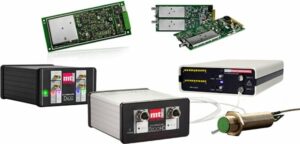
 A Comprehensive Guide to Non-Contact Sensors and Their Applications Gallery
A Comprehensive Guide to Non-Contact Sensors and Their Applications
Application Notes-MTI, Articles-MTI, Brand-MTI, Industry-Sensors, News-MTI-Metrology, Products-MTI-Capacitance, Products-MTI-Laser/Fiber Optic, Products-MTI-Semiconductor/Metrology, Whitepapers-MTI, Z-REPUB, z1
A Comprehensive Guide to Non-Contact Sensors and Their Applications
Sensors, both contact and non-contact, are crucial devices that allow the monitoring, detection, and reaction to conditions in an environment or within a process or piece of equipment. While myriad types of sensors exist and are designed to monitor varying conditions, all of them can be characterized as being one of two types — contact sensors and non-contact sensors. We’ll focus on the latter, diving into different technologies, types, and applications of non-contact sensor technology; but first, let’s explore what differentiates contact and non-contact sensors. Contact vs. Non-Contact Sensors: What’s the Difference? Measuring, monitoring, or detecting a particular condition [...]
 MTI’s Wireless Gap Measurement Probe System Is Ideal for Rotating Machinery Gallery
MTI’s Wireless Gap Measurement Probe System Is Ideal for Rotating Machinery
Brand-MTI, Industry-Aerospace, Industry-Automotive, Industry-Electronics, Industry-Government/Military, Industry-Manufacturing, Industry: Transportation, New & Press Releases, News-MTI-PBS, Press Releases-Vitrek, Products-MTI-Capacitance, Products-MTI-Engine Balancing, z1
MTI’s Wireless Gap Measurement Probe System Is Ideal for Rotating Machinery
The Accumeasure capacitance probe system offers major improvement over conventional eddy current probes; network up to four probes per system to deliver rich geometrical in-situ measurements in a variety of industry standard formats. Lockport, IL—June 28, 2022—MTI Instruments, a US-based manufacturer of advanced test and measurement equipment, announces the introduction of its Accumeasure Wireless Gap Measurement Probe System. The system consists of up to four, battery-powered, wireless capacitance probes paired via Bluetooth to their receiving device. The wireless capability and compact form factor of the battery-powered probes are designed specifically to measure gap in difficult-to-reach or [...]
 Press Release: MTI’s Wireless Gap Measurement Probe System Is Ideal for Rotating Machinery Gallery
Press Release: MTI’s Wireless Gap Measurement Probe System Is Ideal for Rotating Machinery
Brand-MTI, Industry-Aerospace, Industry-Automotive, Industry-Consumer Products, Industry-Government/Military, Industry-Manufacturing, Industry: Transportation, New & Press Releases, News-MTI, News-MTI-Instrumentation, Press Releases-Vitrek, Products-MTI-Capacitance, z1
Press Release: MTI’s Wireless Gap Measurement Probe System Is Ideal for Rotating Machinery
The Accumeasure capacitance probe system offers major improvement over conventional eddy current probes; network of up to four probes delivers rich geometrical in-situ measurement Lockport, IL —June 28, 2022—MTI Instruments, a US-based manufacturer of advanced test and measurement equipment, announces the introduction of its Accumeasure Wireless Gap Measurement Probe System. The system consists of up to four, battery-powered, wireless capacitance probes paired via Bluetooth to their receiving device. The wireless capability and compact form factor of the battery-powered probes are designed specifically to measure gap in difficult-to-reach or inaccessible locations. Unlike eddy current probe [...]

Automotive Cable & Harness Testing Made Easy – EE World June 2022
Download a PDF of This Article!
Digital I/O ASIC Testing
Digital I/O ASIC Testing Customer Case A customer needs to generate stimulus to test his Application Specific Integrated Circuits and to capture response from that ASIC. The stimulus definition exists as an ASCII file with rows and columns of 1s and 0s. Each column corresponds to a different input pin of the ASIC and each rows corresponds to a different time tic (every 50 nanoseconds). The controlling baud clock runs at 10 MHz. The requirement is to record the digital response from the separate output pins of the ASIC as another ASCII file of 1s and 0s. Again, every [...]
 Vitrek’s Automated Testing System Simplifies and Speeds Automotive Cable/Harness Testing Gallery
Vitrek’s Automated Testing System Simplifies and Speeds Automotive Cable/Harness Testing
Application Notes-Vitrek, Brand-Vitrek, Industry-Automotive, Industry-Consumer Products, Industry-Government/Military, Industry: Transportation, Whitepapers, z1
Vitrek’s Automated Testing System Simplifies and Speeds Automotive Cable/Harness Testing
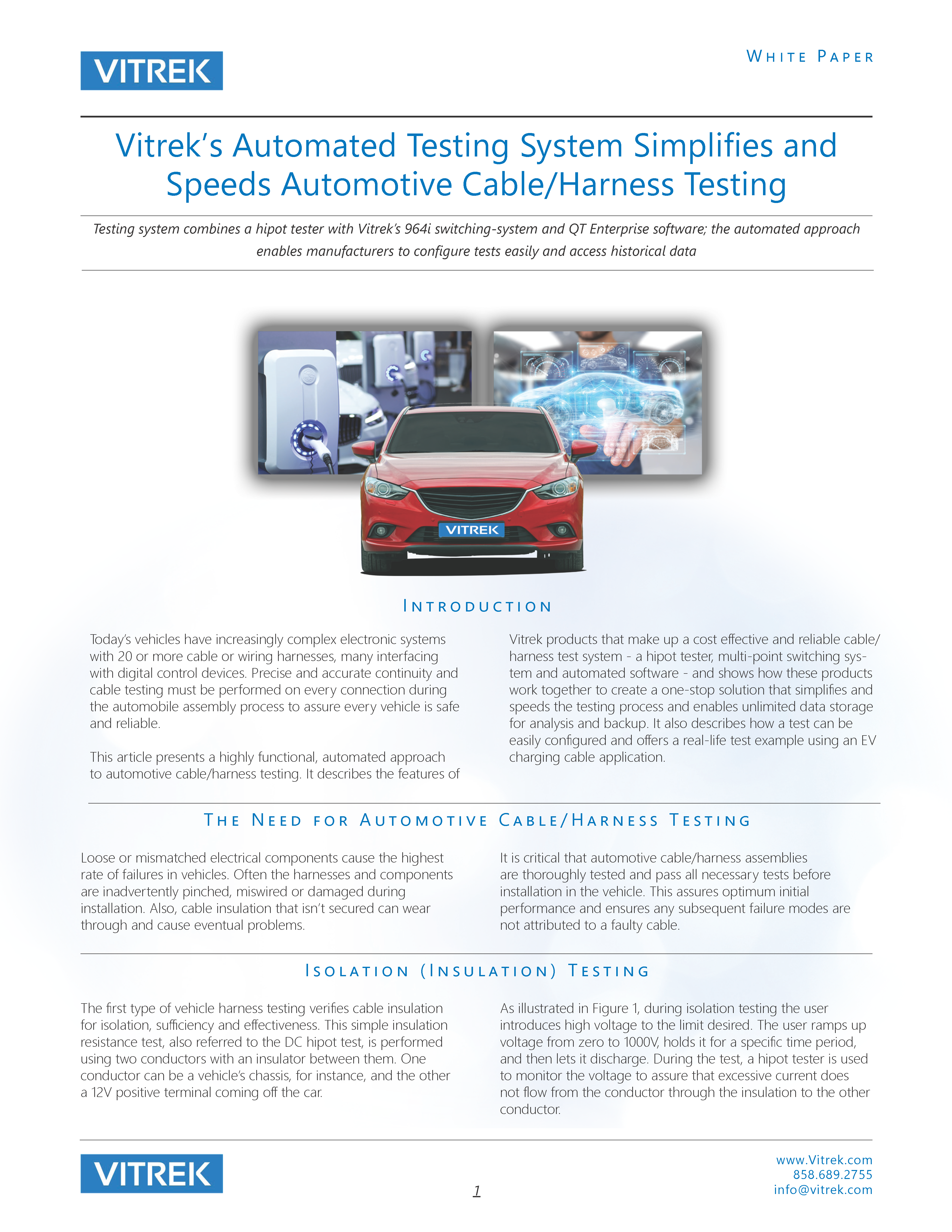
Vitrek's Automated Testing System Simplifies and Speeds Automotive Cable/Harness Testing Testing system combines a hipot tester with Vitrek’s 964i switching system and QT Insite software; the automated approach enables manufacturers to configure tests easily and access historical data Introduction With 20 or more harnesses, many interfacing with digital control devices, today's vehicles have increasingly complex electronic systems. Precise and accurate continuity and cable testing must be performed on every connection during the assembly process to assure safety and reliability in the application. This article presents a highly functional, automated approach to automotive/cable harness testing. It describes the features [...]
Modernizing a Passive Sonar that has a Beam-Former with Digital Output
Modernizing a Passive Sonar that has a Beam-Former with Digital Output Customer Case The customer's requirement is to capture 10 signals, lasting 0.6 milliseconds each. 120 such signals arrive sequentially from a multiplexer within a beam-former. The clock rate is 2 MHz. The beam-former creates 120 beams and the raw digital data (underwater acoustic signal) from each beam is present at the output port of beam-former with a clock rate of 2 Mhz. At a certain time, we get the digital raw data of one beam. We plan to get 120 x 10 12-bit data records. That is, we [...]
 Press Release: Signatec Adds New Features To Its SpectraScopeRT Spectrum Analyzer Software Gallery
Press Release: Signatec Adds New Features To Its SpectraScopeRT Spectrum Analyzer Software
Brand-GaGe, New & Press Releases, News-GaGe, News-Product Updates, News-Products, Press Releases-Vitrek, Products-GaGe, Products-GaGe-Oscilloscope, z1
Press Release: Signatec Adds New Features To Its SpectraScopeRT Spectrum Analyzer Software
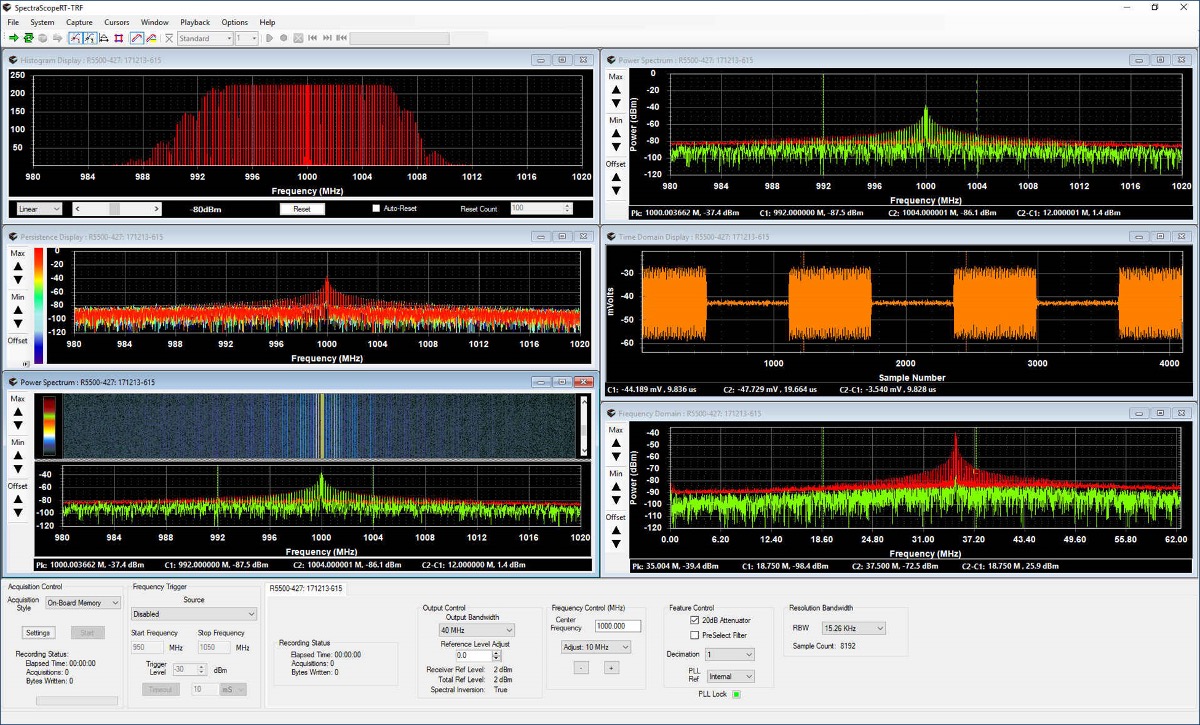
Popular spectrum analyzer application requires no programming; New features expand and enhance functionality Lockport, IL—June 2, 2022—Signatec, a Vitrek brand, is a US-based manufacturer of signal data recording systems, announces five significant feature additions to its SpectraScopeRT Windows-based spectrum analyzer application software. SpectraScopeRT allows for integrated operational control of both the downconverter receiver and the digitizer for signal capture, analysis and real-time streaming of signal recordings, all without requiring any programming. The new feature upgrades are designed to expand and enhance the functionality of the software platform. Here is a quick summary of SpectraScopeRT’s five [...]




Press Release: Vitrek Offers White Paper on Testing LED Lighting Products for Compliance
Vitrek Offers White Paper on Testing LED Lighting Products for Compliance New paper discusses how Vitrek’s power analyzers, DC loads and hipot testers provide engineers with the highly functional, accurate, efficient, and compact tools needed to assure their LED lighting devices and systems meet lighting industry compliance standards. Poway, CA—May 17, 2022—Vitrek, a major manufacturer of electrical safety testing equipment, announces a new white paper geared to engineers and technicians who need to navigate myriad industry standards when testing LED lighting applications. The paper begins with an overview of relevant EnergyStar and other voluntary initiatives, as well as mandatory [...]
Neutrinos Study
Neutrinos Study Customer Case Neutrinos are said to be the most elusive and exotic particles in the universe. They are tiny neutral elementary particles that interact with matter via the weak nuclear force. Scientists are still trying to measure the mass and to characterize their properties. A customer who is studying neutrinos will be using photo multiplier tubes (PMT) coupled to a scintillating material to detect them. The PMT will produce a small electrical pulse when a neutrino is detected. These PMTs are located 2 Kilometers deep, in a mine located in Ontario, Canada. The customer is looking for [...]