
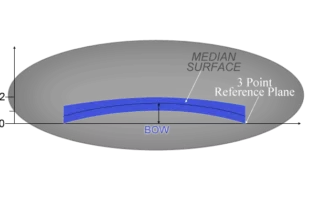
WAFER MEASUREMENT – UNGROUNDED
Industry Semiconductor Applications Wafer Measurement – Ungrounded Measurement Type Metrology Description MTI Instruments Inc. has developed a thickness measurement device that eliminates the effect of varying target conductivity. Called the Push-Pull probe, it’s a unique version of the AccumeasureTM amplifier series. This special design provides accurate surface information for wafer bow and warp. Bow is the deviation of the center point of the median surface of a free, un-clamped wafer from the median surface to the reference plane. Where, the reference plane is defined by three corners of equilateral triangle. This [...]
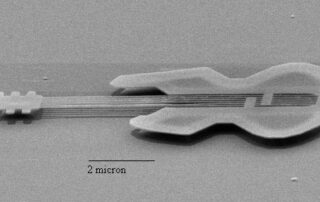
PHOTOLITHOGRAPHY USING CAPACITANCE SENSORS
Industry Semiconductor Applications Lithography Optics Position Focus Measurement Type Positioning Description When it comes to photolithography, how accurate are our sensors? Photo by D. Carr and H. Craighead, Cornell - The world’s smallest guitar is 10 micrometers long — about the size of a single cell — with six strings each about 50 nanometers, or 100 atoms, wide. Made by Cornell University researchers from crystalline silicon, it demonstrates a new technology for a new generation of electromechanical devices. Even the world’s smallest guitar’s 2 micron [...]
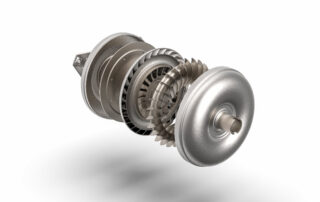


Torque Converter
Industry Automotive Applications Torque Converter Measurement Type Surface Description Since minute defects in the torque converter casing wall thickness can result in unacceptable and dangerous torque converter expansion, a precision measurement system was needed to measure the impeller hub displacement and thus the torque converter axial displacement. An AC dynamometer would be required to spin the torque converter at a high rate of speed while a fast response hydraulic system is needed to pressurize the converter to pressures up to 150 psi. MTI’s MicroTrak laser sensor was selected because it offered [...]
 Contact vs. Non-Contact Measurement and Linear Displacement Sensors Gallery
Contact vs. Non-Contact Measurement and Linear Displacement Sensors
Application Notes-MTI, Brand-MTI, Industry-Compliance Testing, Industry-Consumer Products, Industry-Electronics, Industry-Manufacturing, Industry-Semiconductor, Industry-Semiconductor-MTI, Industry-Sensors, Products-MTI-Capacitance, Z-REPUB, z1, ZOK
Contact vs. Non-Contact Measurement and Linear Displacement Sensors
Contact vs. Non-Contact Measurements Choosing between a contact measurement system and a non-contact measurement system requires careful evaluation of your application’s performance needs, material properties, environmental conditions, and measurement goals. Each system type offers unique advantages- and understanding these distinctions can help you make a more informed decision. Let's explores how contact and non-contact measurement techniques work, their strengths and limitations, and where they’re best applied. What Are Contact Measurement Systems? Contact measurement systems involve tools and sensors that physically touch the object to determine various physical characteristics. These systems are widely used in dimensional metrology, offering high precision, [...]
Foam Density Measurement: Capacitance Sensors vs. Nuclear Gauges
This application note from MTI Instruments compares two technologies for measuring foam density: capacitance sensors and nuclear gauges. It examines the basic operating principles of each technology and explains why capacitance measurement is recommended for in-line measurement during foam manufacturing. Capacitance Sensors Capacitive probes are non-contact devices that use electric fields to measure foam density. In combination with a thickness value, a density measurement may be calculated. These probes consist of a capacitance sensor inside of a protective housing and are part of a larger measurement system that includes amplifiers, cables, and software. With parallel plate capacitance, the capacitance probe [...]
Webinar Recap: Cable Testing Systems
For over thirty years, Vitrek has been a leading provider of high-quality, multi-functional electrical and high voltage testing equipment. Based in San Diego, CA, Vitrek is an internationally recognized electrical and safety test equipment manufacturer supplying customers in 30 countries. Vitrek designs and manufactures cutting-edge test equipment used in industries such as aerospace, military, medical, automotive, and many more! […]
Applications by Industry
Vitrek is a world leader in providing safety and electrical test equipment, solar & metrology systems, vibration/engine balancing systems, high-speed data acquisition and real-time signal recording solutions to a range of industries including electronic, appliance and automotive manufacturers, calibration & test labs, R & D departments, medical, aerospace, military and lighting. Offering both the best equipment and top-notch support, choose Vitrek for your next test, measurement and high-speed data acquisition equipment needs. Choose from industries below to see how Vitrek products can help improve quality and efficiency in your business. [...]
Product Information
Request product information, get a quote and more. Please complete the following information.
Company Information
Please complete the following information so that we can provide an appropriate response.
Laser Triangulation Sensor Principles
Laser triangulation sensors can be divided into two categories based upon their performance and intended use. High-resolution lasers are typically used in displacement and position monitoring applications where high accuracy, stability and low temperature drift are required. Quite frequently these laser sensors are used in process monitoring and closed-loop feedback control systems. Proximity type laser triangulation sensors are much less expensive and are typically used to detect the presence of a part, or used in counting applications. Laser Triangulation Sensor Applications Position Sensing General positioning is the [...]