
 Silicon Carbide vs. Silicon in EV Power Electronics Gallery
Silicon Carbide vs. Silicon in EV Power Electronics
Application Notes-MTI, Brand-MTI, Industry-Automotive, Industry-Battery, Industry-Compliance Testing, Industry-Consumer Products, Industry-Electronics, Industry-Government/Military, Industry-Manufacturing, Industry-R&D, News-MTI-Instrumentation, Products-MTI-Capacitance, Z-REPUB, z1
Silicon Carbide vs. Silicon in EV Power Electronics
Compare silicon carbide vs. silicon for electric vehicle (EV) power electronics and learn about SiC wafer measurement. As demand for electric vehicles (EVs) continues to grow, manufacturers are comparing two semiconductor technologies, silicon carbide and silicon, for power electronics applications. Silicon carbide (SiC) provides the high temperature resistance, low power consumption, rigidity, and support for smaller, thinner designs that EV power electronics need. Examples of SiC’s current applications include on-board DC/DC converters, off-board DC fast chargers, on-board battery chargers, EV powertrains, and automotive lighting for LEDs. According to Automotive World, SiC technology could also drive future EV innovations [...]
 Press Release: Vitrek Announces New SE Series High Voltage Safety Enclosures Gallery
Press Release: Vitrek Announces New SE Series High Voltage Safety Enclosures
Brand-Vitrek, Industry-Automotive, Industry-Cable Test, Industry-Compliance Testing, Industry-Consumer Products, Industry-Education, Industry-Electronics, Industry-Lighting, Industry-Manufacturing, New & Press Releases, News-Products, News-Vitrek, Press Releases-Vitrek, Products-Vitrek-Hipot, z1
Press Release: Vitrek Announces New SE Series High Voltage Safety Enclosures
Vitrek Announces the SE Series of High Voltage Safety Enclosures The SE Series offers the utmost in operator safety for high voltage testing with solid aluminum frame construction, a durable acrylic cover and a magnetic interlock safety switch. […]
 EV Batteries Need Thickness Gauging for Lower Costs and Higher Performance Gallery
EV Batteries Need Thickness Gauging for Lower Costs and Higher Performance
Application Notes-MTI, Brand-MTI, Industry-Automotive, Industry-Compliance Testing, Industry-Consumer Products, Industry-Electronics, Industry-Manufacturing, Industry: Transportation, News-MTI, Products-MTI, Products-MTI-Capacitance, Products-MTI-Laser/Fiber Optic, Z-REPUB, z1
EV Batteries Need Thickness Gauging for Lower Costs and Higher Performance
EV batteries need to cost less and last longer. Until the e-mobility industry solves these challenges, electric vehicle (EV) adoption won’t match the hype that’s driven by Tesla, the established automakers, and a host of startups who are attracting investors. According to Axios, the expense of owning an electric vehicle will exceed that of owning a conventional one until EV batteries cost less than $100/KWh to produce. Unfortunately, the EV industry isn’t expected to hit that target for another ten years. Yet, there is some encouraging news. Less expensive and better performing EV batteries are just a few years [...]
 How to Measure Dielectric Separator Thickness in EV Batteries Gallery
How to Measure Dielectric Separator Thickness in EV Batteries
Application Notes-MTI, Brand-MTI, Industry-Automotive, Industry-Compliance Testing, Industry-Consumer Products, Industry-Electronics, Industry-Government/Military, Industry-Manufacturing, Industry: Transportation, News-MTI, News-MTI-Instrumentation, Products-MTI-Capacitance, Products-MTI-Laser/Fiber Optic, Products-MTI-Signal Generators, Z-REPUB, z1
How to Measure Dielectric Separator Thickness in EV Batteries
The International Energy Agency predicts that as many as 125 million electric vehicles (EVs) will be on the road by 2030. At the heart of these electric cars, trucks, and buses is the lithium-ion (Li-ion) battery, a type of rechargeable battery with high energy density and low self-discharge. The plates in Li-ion batteries consist of lithium compounds that are applied to either a copper plate substrate (cathode) or an aluminum substrate (anode). In turn, these two plates are separated by a dielectric separator. All of the layers in an EV battery are extremely thin. In fact, the cathode and [...]
 Capacitance Sensing Provides Two Ways to Measure EV Battery Plate Thickness Gallery
Capacitance Sensing Provides Two Ways to Measure EV Battery Plate Thickness
Application Notes-MTI, Brand-MTI, Industry-Automotive, Industry-Energy, Industry-Manufacturing, News-MTI, News-MTI-Instrumentation, News-MTI-Metrology, News-Product Updates, Products-MTI-Capacitance, Products-MTI-Laser/Fiber Optic, Products-MTI-Semiconductor/Metrology, Z-REPUB, z1
Capacitance Sensing Provides Two Ways to Measure EV Battery Plate Thickness
MTI Instruments has released an application note that explains how to use capacitance to measure the thickness of the lithium battery plates in electric vehicles (EVs). Manufacturers need to check these plates for thickness before calendaring them together to ensure that the overall battery diameter is within specifications. In EV batteries, lithium ion compounds are applied to either a copper plate substrate (cathode) or an aluminum substrate (anode plate). These conductive plates are separated by a dielectric. MTI Instruments, a global supplier of precision measurement solutions, makes capacitance sensors that can measure thicknesses materials down to nanometers. Moreover, MTI [...]
 White Paper: Cable & Connector Test System Facilitates Multi-Point High Voltage/Current Testing Gallery
White Paper: Cable & Connector Test System Facilitates Multi-Point High Voltage/Current Testing
Brand-Vitrek, Industry-Aerospace, Industry-Automotive, Industry-Cable Test, Industry-Compliance Testing, Industry-Consumer Products, Industry-Government/Military, Industry-Manufacturing, Industry: Transportation, Whitepapers-Vitrek
White Paper: Cable & Connector Test System Facilitates Multi-Point High Voltage/Current Testing
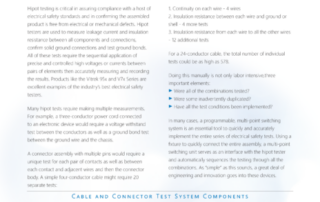
White Paper: Cable & Connector Test System Facilitates Multi-Point High Voltage/Current Testing Introduction Hipot testing is critical in assuring compliance with a host of electrical safety standards and in confirming the assembled product is free from electrical or mechanical defects. Hipot testers are used to measure leakage current and insulation resistance between all components and connections, confirm solid ground connections and test ground bonds. All of these tests require the sequential application of precise and controlled high voltages or currents between pairs of elements then accurately measuring and recording the results. Products like the Vitrek 95x and V7X series [...]
 Position, Displacement, and Vibration Measurement with Precision, High Resolution, and Flexibility Gallery
Position, Displacement, and Vibration Measurement with Precision, High Resolution, and Flexibility
Application Notes-MTI, Brand-MTI, Industry-Aerospace, Industry-Automotive, Industry-Compliance Testing, Industry-Consumer Products, Industry-Government/Military, Industry-Manufacturing, Industry: Transportation, News-MTI-PBS, Products-MTI-Engine Balancing, Z-REPUB, z1
Position, Displacement, and Vibration Measurement with Precision, High Resolution, and Flexibility
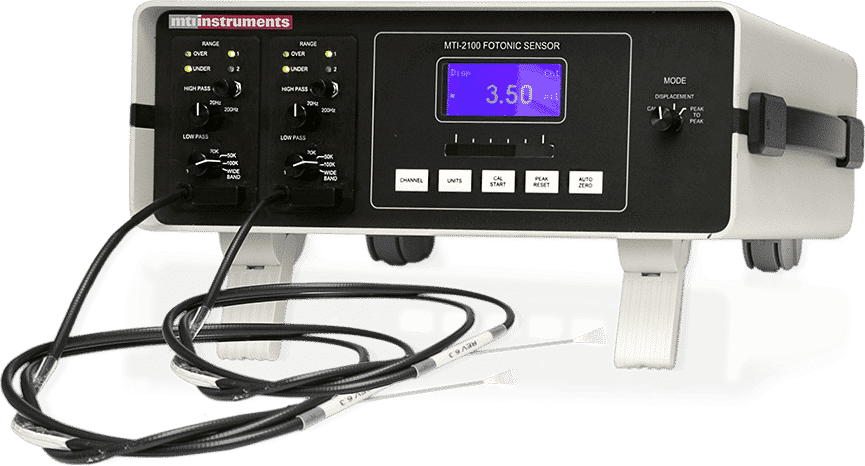
The MTI-2100 Fotonic™ sensor uses advanced fiber optics and electronics to precisely measure position, displacement, and vibration. This high-resolution, non-contact metrology system supports a wide range of interchangeable fiber-optic probes and works with almost any surface, including metallic, composite, plastic, glass, ceramic, or liquid. Made in the USA by MTI Instruments, the MTI-2100 Fotonic™ features a modular design and supports application-specific requirements in R&D, quality, and process control. With its dual channel capabilities, the MTI-2100 Fotonic™ sensor allows users to make simultaneous measurements, such as for structure dynamics and modal analysis. All probe modules have two distinct operating ranges [...]
 How the Aviation Industry Solves Vibration and Balancing Challenges Gallery
How the Aviation Industry Solves Vibration and Balancing Challenges
Application Notes-MTI, Brand-MTI, Industry-Aerospace, Industry-Automotive, Industry-Compliance Testing, Industry-Consumer Products, Industry-Government/Military, Industry-Manufacturing, Industry: Transportation, News-MTI-PBS, Products-MTI-Engine Balancing, Z-REPUB, z1
How the Aviation Industry Solves Vibration and Balancing Challenges
The aviation industry spends significant amounts of time and money on problems caused by engine vibration. Imbalance, the most common cause of engine vibration, happens because of bird strikes and other impacts, but also because of natural wear and corrosion that redistribute mass. In turn, out-of-balance parts can result in cabin noise, metal fatigue, and cracked turbine, fan, or compressor components. In the most extreme cases, catastrophic engine failure may result MTI Instruments, a worldwide supplier of precision measurement solutions, makes equipment for monitoring vibration levels and balancing rotors. For maintenance, repair and overhaul (MRO) crews who want to [...]
 Measuring Brake Rotor Thickness Variation with Capacitive Sensing Gallery
Measuring Brake Rotor Thickness Variation with Capacitive Sensing
Brand-MTI, Industry-Aerospace, Industry-Automotive, Industry-Consumer Products, Industry-Government/Military, Industry-Manufacturing, Industry: Transportation, Knowledge Center-MTI, Products-MTI-Capacitance, Whitepapers-MTI, Z-REPUB, z1
Measuring Brake Rotor Thickness Variation with Capacitive Sensing
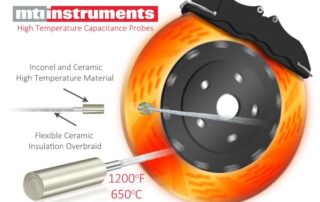
Brake rotor thickness variation, or disc thickness variation (DTV), causes uneven wear to brake rotors, disc-shaped automotive parts that are squeezed between brake pads to slow or stop a vehicle’s wheels. When a brake rotor has areas of different thickness, the amount of clamping force that’s applied across the rotor’s surface varies. These differences in clamping force lead to difference in torque, and the results may include brake shuddering, pulsating, or vibration. Even under normal driving conditions, brake rotors are subjected to extreme conditions that can cause performance-related issues. To ensure that brake rotors can perform [...]










Fiber Optic Sensors Help Stop Subway Shutdown
Fiber optic sensors will help keep commuters moving between Manhattan and Brooklyn this year and beyond. Recently, New York Governor Andrew Cuomo announced that New York City’s Metropolitan Transit Authority (MTA) would not close the L train tunnel for a planned 15-month repair project. Instead, the MTA will use technology-driven solutions to keep the tunnel open and operational for weekday riders. In a joint statement, a panel that included engineering experts from Columbia and Cornell explained that "The L Train Tunnel project gives us the opportunity to integrate technologies and methods that have never been used before in a [...]