
 Enabling Intelligent, Automation-Ready Electrical Safety Testing in Modern Production Gallery
Enabling Intelligent, Automation-Ready Electrical Safety Testing in Modern Production
Application Notes-Vitrek, Brand-Vitrek, Industry-Compliance Testing, Industry-Electronics, Industry-Manufacturing, Industry-Measurement Applications, Whitepapers-Vitrek
Enabling Intelligent, Automation-Ready Electrical Safety Testing in Modern Production
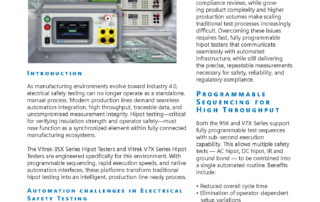
Application Note: Enabling Intelligent, Automation-Ready Electrical Safety Testing in Modern Production Introduction As manufacturing environments evolve toward Industry 4.0, electrical safety testing can no longer operate as a standalone, manual process. Modern production lines demand seamless automation integration, high throughput, traceable data, and uncompromised measurement integrity. Hipot testing—critical for verifying insulation strength and operator safety—must now function as a synchronized element within fully connected manufacturing ecosystems. The Vitrek 95X Series Hipot Testers and Vitrek V7X Series Hipot Testers are engineered specifically for this environment. With programmable sequencing, rapid execution speeds, and native automation interfaces, these platforms transform traditional [...]
 Testing Energy-Efficient Washing Machines with the PA900 Power Analyzer Gallery
Testing Energy-Efficient Washing Machines with the PA900 Power Analyzer
Application Notes-Vitrek, Brand-Vitrek, Industry-Compliance Testing, Industry-Electronics, Industry-Manufacturing, Industry-Measurement Applications, Whitepapers-Vitrek
Testing Energy-Efficient Washing Machines with the PA900 Power Analyzer
Application Note: Testing Energy-Efficient Washing Machines with the PA900 Power Analyzer Introduction Today’s consumers demand home appliances that use less energy and water. Washing machines are no exception. Manufacturers must meet strict energy labeling standards and provide proof that their products are truly efficient. This means accurate, repeatable measurements of electrical power and energy use throughout a full wash cycle are essential. The Vitrek PA900 Power Analyzer is an ideal tool for this task. Testing Challenges Testing a washing machine for energy efficiency isn’t as simple as reading its average power draw. Wash cycles can last over an [...]
 Ultra-Low Standby Power Testing Made Simple with Vitrek Power Analyzers and EN50564:2011 Gallery
Ultra-Low Standby Power Testing Made Simple with Vitrek Power Analyzers and EN50564:2011
Application Notes-Vitrek, Brand-Vitrek, Industry-Compliance Testing, Industry-Electronics, Industry-Manufacturing, Industry-Measurement Applications, Whitepapers-Vitrek
Ultra-Low Standby Power Testing Made Simple with Vitrek Power Analyzers and EN50564:2011
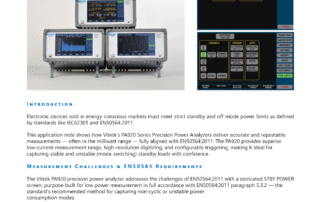
Application Note: Ultra-Low Standby Power Testing Made Simple with Vitrek Power Analyzers and EN50564:2011 Introduction Electronic devices sold in energy-conscious markets must meet strict standby and off-mode power limits as defined by standards like IEC62301 and EN50564:2011. This application note shows how Vitrek’s PA920 Series Precision Power Analyzers deliver accurate and repeatable measurements — often in the milliwatt range — fully aligned with EN50564:2011. The PA920 provides superior low-current measurement range, high-resolution digitizing, and configurable triggering, making it ideal for capturing stable and unstable (mode-switching) standby loads with confidence. Measurement Challenges & EN50564 Requirements The Vitrek PA920 precision [...]



High Precision Portable Signal Generators and Calibrators: Everything You Need to Know
High precision portable signal generators are portable electronic devices that generate highly precise signals for testing, system calibration, sensor simulation, troubleshooting, and monitoring. Unlike the benchtop signal generators that are used in laboratories, these hand-held portable devices are designed to be used in the field. The best high precision portable signal generators are also rugged and NIST traceable, meaning that their manufacturer calibrates them to standards from the National Institute of Standards and Technology (NIST). In terms of cost, high precision portable signal generators are more expensive than less precise, lower-end devices that can be held in the hand; [...]
 Metrology Engineer Standardizes on Vitrek 4700 for HV Measurement Accuracy & Traceability Gallery
Metrology Engineer Standardizes on Vitrek 4700 for HV Measurement Accuracy & Traceability
Brand-Vitrek, Case Studies-Vitrek, Industry-Compliance Testing, Industry-Consumer Products, Industry-Electronics, Industry-Manufacturing, News-Vitrek

Metrology Engineer Standardizes on Vitrek 4700 for HV Measurement Accuracy & Traceability
Metrology Engineer Standardizes on Vitrek 4700 for HV Measurement Accuracy & Traceability Legacy HV Test Tools Less Accurate and More Cumbersome About Customer: Ken Sams, Metrology & QC Engineer Ken works for a leading global electrical insulation test equipment provider serving a wide range of industries including high power cable applications. The company provides critical electrical insulation measurement products, from insulation testers to dielectric breakdown testers. Ken’s responsibility includes both internal quality and field service. Challenge Achieve high voltage measurement during production testing and calibration procedures, including specialized testing. In these challenging testing environments, even the smallest [...]
Cable Testing Applications
Cable failures can shut down production, compromise safety, and create costly compliance risks. That’s why manufacturers across aerospace, EV, medical, industrial, telecommunications, and defense industries rely on Vitrek cable testing solutions to verify performance, insulation integrity, and long-term reliability before products ever reach the field. Vitrek’s advanced cable testing platforms help manufacturers meet demanding industry and regulatory standards while improving throughput, traceability, and quality assurance. From high-voltage harnesses to mission-critical interconnects, Vitrek automated cable testing solutions deliver safer products, stronger compliance documentation, and greater confidence in every connection. Hipot Testing for Electrical Safety Compliance [...]
 Whitepaper: Mastering High Voltage: The Importance of Accurate Test Equipment Gallery
Whitepaper: Mastering High Voltage: The Importance of Accurate Test Equipment
Industry-Cable Test, Industry-Compliance Testing, Industry-Consumer Products, Industry-Electronics, Industry-Manufacturing, Industry-Measurement Applications, Knowledge Center-Vitrek, News-Vitrek, Whitepapers-Vitrek

Whitepaper: Mastering High Voltage: The Importance of Accurate Test Equipment
Introduction Accurate definition and measurement of critical electrical performance parameters is essential for ensuring the reliability and safety of high-voltage equipment and cabling. For applications which can involve tens of thousands of volts, safety risks are high, as are the demands on the test equipment used to measure the equipment and cables. Proper calibration of the test instruments themselves is critical to achieving the strict performance needs of many equipment types. Calibration results must often meet national and international specific standards and calibration measurements are typically conducted by certified laboratories with traceability to national standards, like those [...]
 Video: GaGe Products for the Semiconductor Industry Gallery
Video: GaGe Products for the Semiconductor Industry
Brand-GaGe, Industry-Compliance Testing, Industry-Consumer Products, Industry-Electronics, Industry-Manufacturing, Industry-Measurement Applications, Industry-R&D, Industry-Semiconductor, Industry-Semiconductor-GaGe, Industry-Semiconductor-Videos, Knowledge Center-GaGe, News-GaGe, News-Products, News-Vitrek, Videos-GaGe

 Video: MTI Products for the Semiconductor Industry Gallery
Video: MTI Products for the Semiconductor Industry
Brand-MTI, Industry-Compliance Testing, Industry-Consumer Products, Industry-Electronics, Industry-Manufacturing, Industry-Measurement Applications, Industry-R&D, Industry-Semiconductor, Industry-Semiconductor-MTI, Industry-Semiconductor-Videos, Knowledge Center-MTI, News-MTI, Videos-MTI, Videos-MTI-Capacitance Sensors, Videos-MTI-Manual Semiconductor Metrology System, Videos-MTI-Semiautomated Metrology System
 MTI Instruments Whitepaper: Capacitance Guide for Industrial Applications Gallery
MTI Instruments Whitepaper: Capacitance Guide for Industrial Applications
Brand-MTI, Industry-Aerospace, Industry-Automotive, Industry-Battery, Industry-Compliance Testing, Industry-Consumer Products, Industry-Electronics, Industry-Energy, Industry-Government/Military, Industry-Industrial Processing, Industry-Lighting, Industry-Manufacturing, Industry-Measurement Applications, Industry-OEM, Industry-R&D, Industry-Semiconductor, Industry-Semiconductor-MTI, Industry-Sensors, Industry: Transportation, Knowledge Center-MTI, News-MTI, Whitepapers-MTI

MTI Instruments Whitepaper: Capacitance Guide for Industrial Applications
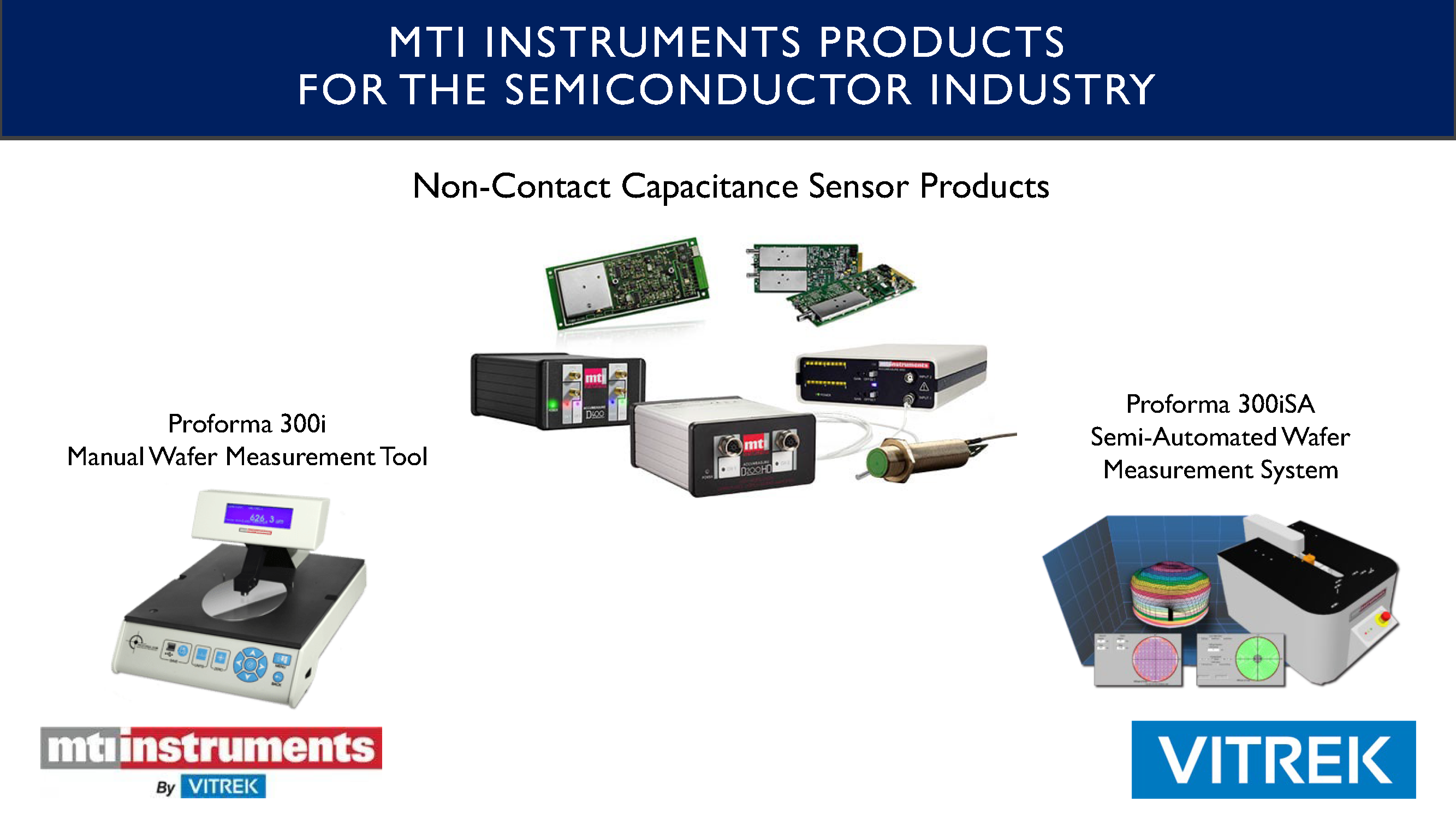
Capacitance Guide for Industrial Applications This guide from MTI Instruments explains what you need to know about using electrical capacitance for measurement in industrial applications, including advanced manufacturing. Basic Principles Capacitance is the ratio of the change in an electric charge to the corresponding change in its electrical potential (i.e., voltage). Capacitors, components that that have the “capacity” to store an electric charge, consist of conductive parallel plates that don’t touch or connect with each other. Instead, these metal plates are electrically-separated by air or a layer of insulating material (i.e., the dielectric). MTI’s [...]