


WAFER MEASUREMENT – UNGROUNDED
Industry Semiconductor Applications Wafer Measurement – Ungrounded Measurement Type Metrology Description MTI Instruments Inc. has developed a thickness measurement device that eliminates the effect of varying target conductivity. Called the Push-Pull probe, it’s a unique version of the AccumeasureTM amplifier series. This special design provides accurate surface information for wafer bow and warp. Bow is the deviation of the center point of the median surface of a free, un-clamped wafer from the median surface to the reference plane. Where, the reference plane is defined by three corners of equilateral triangle. This [...]
 Case-In-Point: High-Accuracy Capacitive Thickness Measurement Optimizes Li-Ion EV Battery Plate Qualities Gallery
Case-In-Point: High-Accuracy Capacitive Thickness Measurement Optimizes Li-Ion EV Battery Plate Qualities
Application Notes-MTI, Brand-MTI, Industry-Automotive, Industry-Battery, Industry-Compliance Testing, Industry-Consumer Products, Industry-Electronics, Industry-Manufacturing, Products-MTI-Capacitance, Z-REPUB, z1

Case-In-Point: High-Accuracy Capacitive Thickness Measurement Optimizes Li-Ion EV Battery Plate Qualities
High-Accuracy Capacitive Thickness Measurement Optimizes Li-Ion EV Battery Plate Qualities EV Battery manufacturers need to measure EV battery plate thickness with a high degree of precision (repeatable <2um accuracy and resolution) to optimize manufacturing efficiencies while maintaining uniform cell capacity and minimizing waste. The MTI Accumeasure System provides an effective means of monitoring plate thickness achieving sub 2um accuracy with high repeatability Introduction The rapidly expanding demand for electric vehicles is driving advances in the production of rechargeable cells that comprise the first stage in the composition of EV battery packs. Individual Li-Ion cells are combined to form [...]
 MTI Application Note: How to Achieve Gallery
MTI Application Note: How to Achieve <1um Accuracy When Measuring Roller Gap
Application Notes-MTI, Brand-MTI, Industry-Compliance Testing, Industry-Consumer Products, Industry-Manufacturing, Industry-Sensors, News-MTI-Metrology, Products-MTI-Capacitance, z1

MTI Application Note: How to Achieve <1um Accuracy When Measuring Roller Gap
How to Achieve <1um Accuracy When Measuring Roller Gap Roller Gap Measurement with MTI Digital Accumeasure Capacitive Probes Many roll-to-roll finishing processes typically use a calender, or series of hard pressure rollers, to deliver smooth, high-quality products of plastic, textile, or paper (Fig 1). Ensuring a consistent material thickness, however, depends on the ability to monitor, and maintain, a precise gap between rollers. This application note describes a quick and easy means for roller gap measurement. Problem How to measure the small gap between rollers to keep track of product thickness. Typically, it’s not possible to [...]
 Creating a Compensation File for a Recipe for the Proforma 300iSA – Video Gallery
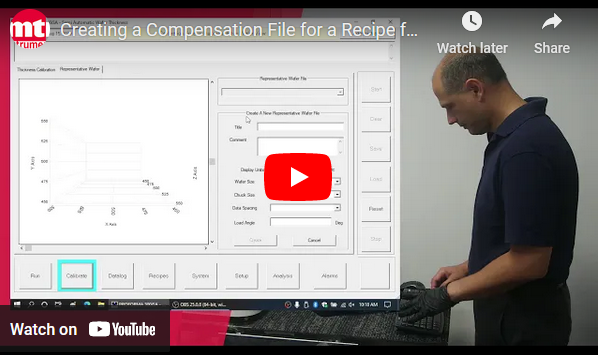
Creating a Compensation File for a Recipe for the Proforma 300iSA – Video
Brand-MTI, Industry-Compliance Testing, Industry-Electronics, Industry-Manufacturing, Industry-Semiconductor, Industry-Semiconductor-MTI, Industry-Semiconductor-Videos, News-MTI-Metrology, Products-MTI-Semiconductor/Metrology, Videos-MTI-Manual Semiconductor Metrology System, Videos-MTI-Semiautomated Metrology System, z1
 GaGe Application Note: Creating a Data Link Signal Integrity Test Platform Gallery
GaGe Application Note: Creating a Data Link Signal Integrity Test Platform
App Notes, Application Notes-GaGe, Brand-GaGe, Industry-Aerospace, Industry-Compliance Testing, Industry-Consumer Products, Industry-Education, Industry-Electronics, Industry-Government/Military, Industry-Manufacturing, News-GaGe, Products-GaGe, z1

GaGe Application Note: Creating a Data Link Signal Integrity Test Platform
Download a PDF Copy of this App Note Data Link Device Testing The data link device under test (Figure 1) is characterized by comparing test signals that are input to the link with signals measured at the link output. Differences between these two test signals indicate a degradation by the link during transmission. Figure 1. Two test platforms (PCIe and PXIe, respectively) transmit and receive the data link test signals. GaGe RazorMax high-speed data acquisition cards record the data for signal integrity comparison. The input and output test signals require sampling at 1 GS/s (GigaSample per second) [...]
 Why You Need Automotive Cable Tests Before Cars Hit the Road Gallery
Why You Need Automotive Cable Tests Before Cars Hit the Road
Articles-Vitrek, Blog, Brand-Vitrek, Electrical Safety Testing Blog, Industry-Automotive, Industry-Cable Test, Industry-Compliance Testing, Industry-Government/Military, Industry-Manufacturing, Industry: Transportation, Products-Vitrek-964i, z1

Why You Need Automotive Cable Tests Before Cars Hit the Road
The automotive industry deals with some of the most technologically diverse pieces of commercially available machinery worldwide — cars and trucks. As these machines continue to evolve and the technology under the hood becomes more complex, ensuring that every wire, electrical connection, and more meets the strict safety standards remains a high point of emphasis. […]
 MTI Instruments Enters Advanced Qualification Stage for Electric Vehicle Battery Measurement Device with Several Major Automotive OEM Manufacturers Gallery
MTI Instruments Enters Advanced Qualification Stage for Electric Vehicle Battery Measurement Device with Several Major Automotive OEM Manufacturers
Brand-MTI, Industry-Automotive, Industry-Compliance Testing, Industry-Consumer Products, Industry-Manufacturing, New & Press Releases, News-MTI, Press Releases-Vitrek, z1

MTI Instruments Enters Advanced Qualification Stage for Electric Vehicle Battery Measurement Device with Several Major Automotive OEM Manufacturers
NEW YORK, December 16, 2021 – MTI Instruments division, a manufacturer of precision tools and testing equipment for electronics, aviation, automotive, power and other industries, today announced that it has entered into the advanced qualification stage for its electric vehicle (EV) battery measurement device with several major automotive OEM manufacturers. Moshe Binyamin, President and CEO of MTI Instruments commented, “We committed to shareholders that we would communicate with them as we began to get traction in the growing and large EV Battery manufacturing segment. I am pleased to report, we are gaining serious traction.” Binyamin further added, “In fact, [...]