
 MTI Instruments Whitepaper: Capacitance Guide for Industrial Applications Gallery
MTI Instruments Whitepaper: Capacitance Guide for Industrial Applications
Brand-MTI, Industry-Aerospace, Industry-Automotive, Industry-Battery, Industry-Compliance Testing, Industry-Consumer Products, Industry-Electronics, Industry-Energy, Industry-Government/Military, Industry-Industrial Processing, Industry-Lighting, Industry-Manufacturing, Industry-Measurement Applications, Industry-OEM, Industry-R&D, Industry-Semiconductor, Industry-Semiconductor-MTI, Industry-Sensors, Industry: Transportation, Knowledge Center-MTI, News-MTI, Whitepapers-MTI
MTI Instruments Whitepaper: Capacitance Guide for Industrial Applications
Capacitance Guide for Industrial Applications This guide from MTI Instruments explains what you need to know about using electrical capacitance for measurement in industrial applications, including advanced manufacturing. Basic Principles Capacitance is the ratio of the change in an electric charge to the corresponding change in its electrical potential (i.e., voltage). Capacitors, components that that have the “capacity” to store an electric charge, consist of conductive parallel plates that don’t touch or connect with each other. Instead, these metal plates are electrically-separated by air or a layer of insulating material (i.e., the dielectric). MTI’s [...]
 Whitepaper: Why Capacitance? Benefits and Applications of Digital Capacitive Sensors Gallery
Whitepaper: Why Capacitance? Benefits and Applications of Digital Capacitive Sensors
Brand-MTI, Industry-Automotive, Industry-Compliance Testing, Industry-Consumer Products, Industry-Electronics, Industry-Industrial Processing, Industry-Manufacturing, Industry-Measurement Applications, Industry-Semiconductor, Industry-Semiconductor-MTI, Industry-Sensors, Knowledge Center-MTI, News-MTI, News-Vitrek, Whitepapers-MTI
Whitepaper: Why Capacitance? Benefits and Applications of Digital Capacitive Sensors
Industry applications illustrate the versatility and benefits of today's digital capacitive sensor technology. The electrical capacitance formed between a capacitance probe and target surface varies as a function of the distance, or gap, between those two surfaces.
 Whitepaper: Semiconductor Wafer Measurement for Increased Productivity Gallery
Whitepaper: Semiconductor Wafer Measurement for Increased Productivity
Brand-GaGe, Brand-MTI, Brand-Vitrek, Brands-All, Industry-Consumer Products, Industry-Electronics, Industry-Manufacturing, Industry-OEM, Industry-Semiconductor, Industry-Semiconductor-MTI, Knowledge Center-MTI, News-Industry, News-MTI, Whitepapers-MTI
Whitepaper: Semiconductor Wafer Measurement for Increased Productivity
Semiconductor Wafer Measurement for Increased Productivity This three-part article describes how manufacturers leverage capacitance-based inspection systems for semiconductor wafers. The article reviews best-practices, consequences of failing to inspect semiconductor wafers and benefits of using semi-automated, fully-automated and manual systems for wafer metrology and inspection. Part 1: Why Disc Geometry Matters in Wafer Production Semiconductor wafers are cut from cylindrical silicon crystals, or ingots. The flatness of these disc-shaped wafers is controlled to tight tolerances to ensure that the entire wafer surface is suitable for integrated circuit (IC) production. If disc geometry is out-of-spec [...]

The Cost of Failing to Inspect Semiconductor Wafers
This is the second of three articles in Semiconductor Wafer Measurement for Increased Profitability. The first article in this series explains why disc geometry matters. The third article describes the benefits of using semi-automated, fully-automated, and manual systems for wafer metrology and inspection. Most semiconductor wafers are made of silicon, the second most common element in the Earth’s crust. Yet, silicon’s abundance does not mean that wafers are inexpensive. The pure form of silicon that’s used in semiconductors does not occur naturally and must be refined and mixed with a dopant that alters material properties and electrical characteristics. Silicon ingots are formed, wafers [...]

Cable & Wire Troubleshooting Made Easy-Using the MTI 1510 Precision Signal Generator
Cable & Wire Troubleshooting Made Easy Using MTI Instruments 1510A Precision Signal/Function Generator Cable & Wire troubleshooting is important to identify and resolve problems with electrical or data transmission systems. Without proper troubleshooting, systems can fail, causing a range of issues including downtime, lost productivity and safety hazards. MTI Instruments 1510A is ideal for troubleshooting in the instrumentation room, factory floor, flight-line or laboratory. 1510A Key Benefits The 1510A is a portable signal source used for calibrating electronic equipment and machinery monitoring systems. Its portability and ruggedness make it ideal for use in the instrumentation room, [...]

Whitepaper: Three Vibration/Balancing Solutions for the Aviation Industry
Three Vibration/Balancing Solutions for the Aviation Industry MTI Instruments Offers a Variety of Solutions for Commercial, Regional & Military Jet Engine Balancing Applications Introduction Throughout the aviation industry, whether commercial or military, jet engine vibration is an everyday concern. Maintenance, repair, and overhaul crews worldwide are tasked with monitoring aircraft engine vibration to ensure flight safety and efficient service. Gone unchecked, jet engine vibration can be the catalyst for any number of problems, from minor annoyances such as cabin noise to undue parts wear. In the most severe cases, an out-of-balance turbine could lead to catastrophic failure [...]
 MTI Whitepaper: Easy Roller Gap Measurement Ensures Calendering Success Gallery
MTI Whitepaper: Easy Roller Gap Measurement Ensures Calendering Success
Brand-MTI, Industry-Consumer Products, Industry-Manufacturing, Industry-Sensors, News-MTI-Instrumentation, Products-MTI-Capacitance, Whitepapers-MTI, z1
MTI Whitepaper: Easy Roller Gap Measurement Ensures Calendering Success
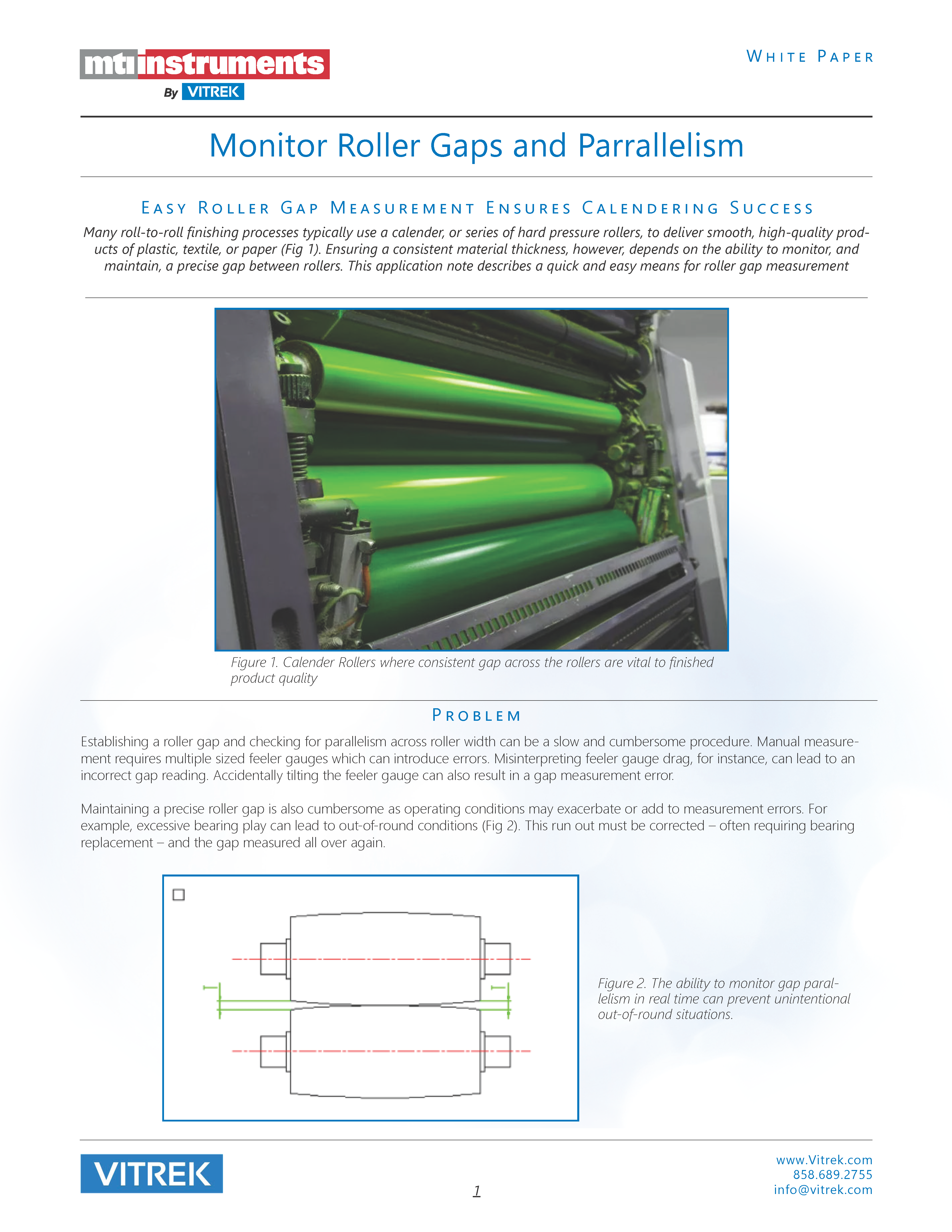
Easy Roller Gap Measurement Ensures Calendering Success Many roll-to-roll finishing processes typically use a calender, or series of hard pressure rollers, to deliver smooth, high-quality products of plastic, textile, or paper (Fig 1). Ensuring a consistent material thickness, however, depends on the ability to monitor, and maintain, a precise gap between rollers. This application note describes a quick and easy means for roller gap measurement Problem Establishing a roller gap and checking for parallelism across roller width can be a slow and cumbersome procedure. Manual measurement requires multiple sized feeler gauges which can introduce errors. Misinterpreting [...]
 A Comprehensive Guide to Non-Contact Sensors and Their Applications Gallery
A Comprehensive Guide to Non-Contact Sensors and Their Applications
Application Notes-MTI, Articles-MTI, Brand-MTI, Industry-Sensors, News-MTI-Metrology, Products-MTI-Capacitance, Products-MTI-Laser/Fiber Optic, Products-MTI-Semiconductor/Metrology, Whitepapers-MTI, Z-REPUB, z1
A Comprehensive Guide to Non-Contact Sensors and Their Applications
Sensors, both contact and non-contact, are crucial devices that allow the monitoring, detection, and reaction to conditions in an environment or within a process or piece of equipment. While myriad types of sensors exist and are designed to monitor varying conditions, all of them can be characterized as being one of two types — contact sensors and non-contact sensors. We’ll focus on the latter, diving into different technologies, types, and applications of non-contact sensor technology; but first, let’s explore what differentiates contact and non-contact sensors. Contact vs. Non-Contact Sensors: What’s the Difference? Measuring, monitoring, or detecting a particular condition [...]
 Aircraft Vibration Analysis and Measurement Techniques Gallery
Aircraft Vibration Analysis and Measurement Techniques
Brand-MTI, Industry-Aerospace, Industry-Compliance Testing, Industry-Government/Military, Industry-Manufacturing, Industry: Transportation, Knowledge Center-MTI, News-MTI-PBS, Whitepapers-MTI, Z-REPUB, z1
Aircraft Vibration Analysis and Measurement Techniques
Aircraft engine vibration is a critical indicator of engine health and overall flight safety. While some level of vibration in aircraft is expected during normal operations, excessive or abnormal vibrations often signal underlying mechanical issues that demand immediate attention. With modern jet engines becoming more complex, real-time vibration monitoring and precise balancing tools are essential for both aircraft maintenance teams and aviation diagnostics specialists. Aircraft vibration measurement tools detect and quantify these issues, enabling maintenance teams to take corrective actions before minor imbalances escalate into major faults. Types of Aircraft Vibrations There are two main categories of aircraft vibrations: [...]






Capacitive Displacement Sensors: Working Principle & Precision Measurement Applications
Capacitive Displacement Sensors: Working Principle & Precision Measurement Applications Capacitive displacement sensors are precision non-contact measurement devices that utilize capacitance changes to determine position, distance, and thickness with exceptional accuracy. These capacitive distance sensors offer superior performance in applications requiring high-resolution measurements, making them essential tools across manufacturing, automation, and research industries. How Capacitive Displacement Sensors Work Capacitive Sensor Working Principle Capacitive displacement sensors operate on the fundamental principle of measuring capacitance variations between two conductive surfaces. The sensor probe acts as one plate of a parallel plate capacitor, while the [...]