Important Standard Update: IEC 60950-1 was officially withdrawn in December 2020 and replaced by IEC 62368-1 (Audio/video, information and communication technology equipment – Safety requirements). Products certified under IEC 60950-1 remain valid through their lifecycle, but new designs should target IEC 62368-1. This guide covers IEC 60950-1 for legacy compliance, transition planning, and ongoing product maintenance.
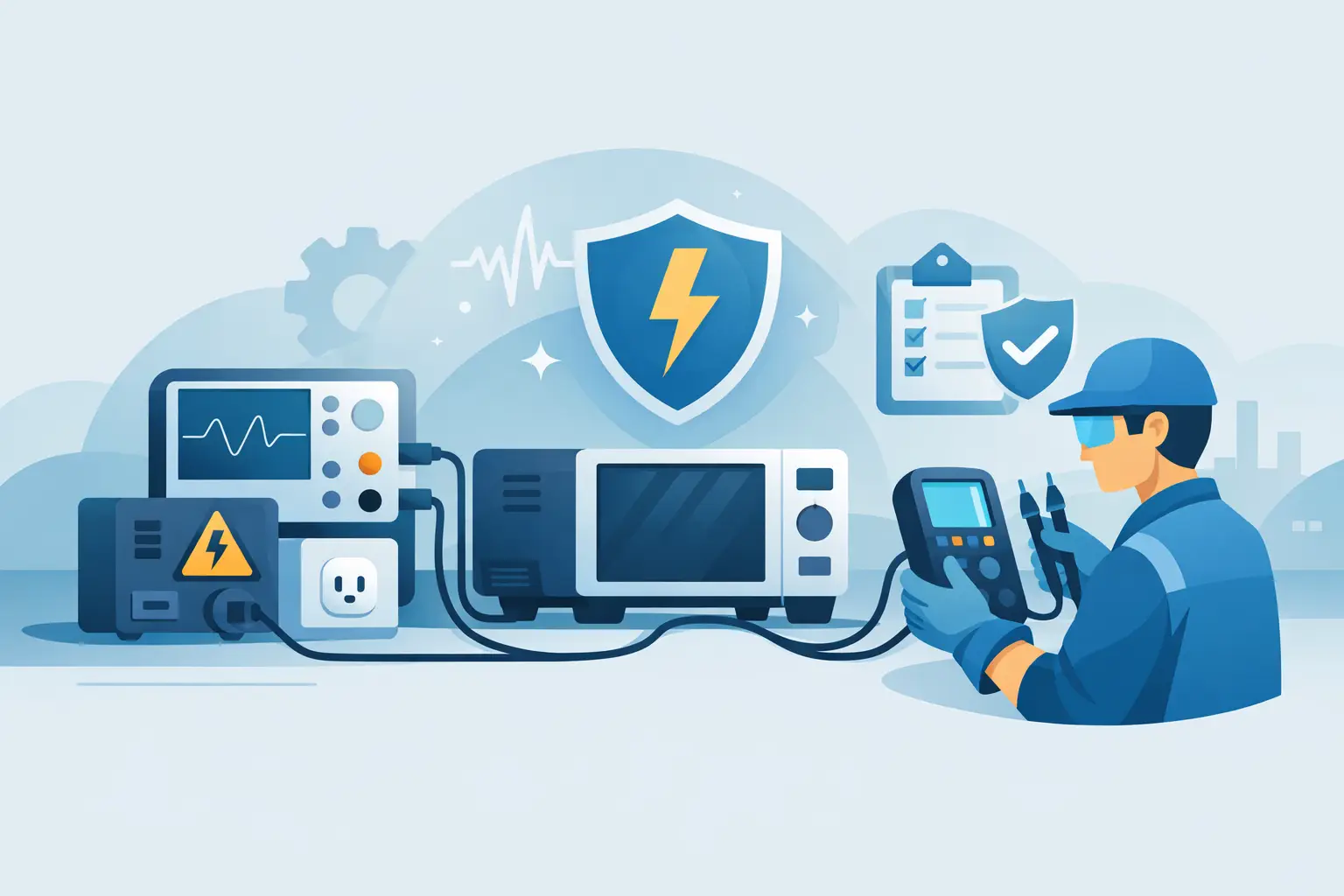
Electrical safety failures in IT and telecommunications equipment can trigger data center outages and life-threatening incidents involving field technicians. IEC 60950, the international safety standard for IT and telecom equipment, mandates dielectric withstand testing commonly called hipot testing (high potential testing) or hi-pot testing — to prevent these failures before products reach the field.
This guide covers everything you need for IEC 60950 hipot test compliance: standard scope, AC and DC hipot test voltage requirements and formulas, acceptable leakage current limits, test procedures, UL hipot test requirements, and the Vitrek instruments that deliver the precision and repeatability safety-critical testing demands.

What Is Hipot Testing? Definition and Purpose
Hipot testing (short for high potential testing, also written as hi-pot test or high-pot test) is a dielectric withstand test that applies a voltage significantly higher than normal operating voltage across a product’s insulation system. The test verifies that insulation can safely isolate live circuits from accessible surfaces, chassis, and other conductors — preventing electric shock under normal and fault conditions.
A hipot test monitors the leakage current that flows through insulation during the voltage application. If leakage current exceeds the defined limit — or if insulation breaks down entirely — the unit fails. A passing unit demonstrates the insulation is sound, correctly applied, and free from manufacturing defects such as pinholes, contamination, or mechanical damage.
Why is hipot testing required?
- Insulation can degrade due to manufacturing defects, aging, environmental stress, or improper design
- Degraded insulation can energize previously safe surfaces at dangerous voltages
- Regulatory certification bodies worldwide require documented hipot test results as proof of compliance
- A single field failure due to insulation breakdown carries severe liability, recall, and reputational consequences.
What Is IEC 60950? Scope and Global Adoption
IEC 60950-1, “Information Technology Equipment – Safety – Part 1: General Requirements,” is the world’s most widely adopted safety standard for IT and telecommunications equipment. Published by the International Electrotechnical Commission (IEC), it governs computers, servers, networking infrastructure, printers, telecommunications switching equipment, base stations, UPS systems, and power distribution units.
Regulatory bodies including TÜV (Europe), UL (North America), and equivalent organizations across Asia-Pacific recognize IEC 60950-1 compliance as satisfying their own national requirements. This global recognition allows manufacturers to achieve market access across multiple geographies through a single certification process — reducing time-to-market and certification cost.
IEC 60950-1 specifically addresses:
- Electric shock protection — through insulation requirements and hipot testing
- Fire prevention — through component ratings and thermal testing
- Toxic and hazardous materials — through material restrictions
The standard acknowledges IT equipment’s unique risk profile: it is handled by non-technical users, operates continuously in uncontrolled environments, and may be subject to unpredictable modifications or interconnections.
Why Hipot Testing Is Required Under IEC 60950: The Critical Role of Dielectric Withstand Testing
Hipot testing validates the integrity of insulation systems that prevent current flow between live circuits and accessible surfaces under normal operating conditions. Insulation can degrade due to manufacturing defects, aging, environmental stress, and design inadequacies.
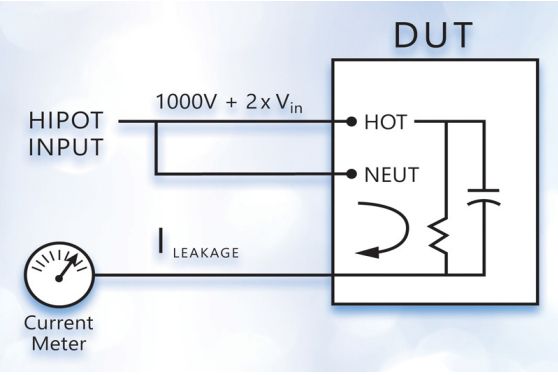
When insulation degrades, it may energize previously safe surfaces at dangerous voltage levels, jeopardizing user safety.
Insulation Categories and Risk Levels
| Insulation Type | Description | Risk on Failure |
|---|---|---|
| Functional Insulation | Minimum needed for circuit operation; no shock protection | Immediate shock hazard |
| Basic Insulation | Single protection layer | Immediate shock hazard |
| Supplementary Insulation | Additional backup layer; must withstand 1.5 kV AC / 2.1 kV DC | User protected if basic fails |
| Double Insulation | Basic + supplementary combined; two independent barriers | User protected if basic fails |
| Reinforced Insulation | Single system providing equivalent protection to double insulation | High protection level |
Hipot Test Voltage and Conditions for IEC 60950: Understanding AC vs. DC Requirements
IEC 60950 establishes test requirements based on the working voltage of the test circuit and the type of insulation used. Working voltage is the highest RMS voltage across insulation during regular operation, including transients but excluding abnormal conditions.
AC Hipot Test
This utilizes alternating current (AC) to test the ability of insulation to withstand high voltage over a period. The AC’s reversing polarity stresses the insulation in both directions, making this test comprehensive.
Working Voltage Test Requirements
- For working voltages ≤ 50V, the required test voltage is =500V AC
- For 50V to 300V, the required test voltage is = 2 × working voltage + 1000V AC
- For > 300V, the test voltage is = 2 × working voltage + 1840V AC (maximum 3000V AC)
Why Choose AC Hipot Testing
- Regulatory Acceptance: It is a standard for safety compliance testing, and is preferred by safety regulatory bodies.
- No Ramp-Up/Discharge: It doesn’t require ramp-up voltage or discharge at the beginning or end of the testing.
- Real-World Simulation: Most IT equipment operates on AC power, making it more representative of actual operating conditions
AC Hipot Test Characteristics
- Frequency: 45-65 Hz (typically 50 or 60 Hz to match local power systems)
- Waveform: Sinusoidal with total harmonic distortion < 5%
- Accuracy: ±3% of specified test voltage
DC Hipot Test
This utilizes direct current, making it suitable for high capacitance components. DC Hipot testing demonstrates insulation quality through steady-state leakage current measurement.
Test Requirements
DC test voltage = 1.414 × corresponding AC test voltage, accounting for peak value relationships.
Why DC Hipot Testing
- It helps identify weaknesses in insulation materials, such as voids, cracks, moisture, and contamination.
- It is less susceptible to capacitive effects, which ensures its effectiveness in identifying inclusions in the insulation or mechanical damages.
- It can be used for a wide range of electrical equipment, including transformers, cables, generators, motors, and switchgears.
DC Hipot Test Characteristics
- Ripple Content: < 5% RMS for accurate leakage current measurement
- Polarity: DC Hipot tests usually apply either positive or negative voltage, but not both simultaneously.
- Voltage Stability: ±1% regulation during the test period
Test Duration, Leakage Current Limits, and Measurement Setup
Duration Requirements
IEC 60950 specifies precise timing requirements for Hipot tests. Insulation failure is often a time-dependent phenomenon. Adequate test duration ensures that marginal insulation, which might survive brief voltage exposure, will not fail during service.
- Standard Duration: 60 seconds for routine testing
- Production Testing: 1 second minimum when using 120% of the standard test voltage
- Rationale: The one-second production test at elevated voltage provides equivalent stress to the full 60-second test, enabling faster production line throughput while maintaining safety margins
Application Method
IEC 60950 recommends a controlled voltage rise to prevent damage from sudden voltage application.
- Ramp Rate: Voltage should increase gradually from zero to test level
- Maximum Ramp Rate: 500V/second to prevent overstressing sensitive components
- Initial Application: No flashover or breakdown should occur during voltage rise
- Steady State: Once test voltage is reached, maintain for the specified duration
Leakage Current Limits and Pass/Fail Criteria
IEC 60950 establishes leakage current limits based on insulation type and safety requirements for basic and supplementary insulation
- Maximum Allowable Leakage: 0.25 mA for AC tests, 0.1 mA for DC tests
- Measurement Method: RMS value for AC, average value for DC
- Safety Rationale: These limits ensure leakage current remains below levels that could cause harmful physiological effects
Double and Reinforced Insulation
- Stricter: May require lower leakage limits depending on application
- Enhanced Safety: Recognizes the critical role of these insulation types in shock protection
Best Practices for IEC 60950 Compliance: Ensuring Repeatable, Traceable Results
This requires a systematic means of aligning test procedures with clear actions that protect users, reduce liability, and support product quality.
Pre-test preparation includes:
- Visual inspection of equipment for defects
- Proper test point identification and connection integrity
- Confirmation that temperature, humidity, and EMI conditions meet requirements
- Verifying that procedures align with current standard revisions and customer requirements
Proper Test Configuration and Setup
Setting parameters like voltage levels, dwell time, ramp rate, and trip current helps maintain consistency across units. Deviation in setup can mask safety risks or result in false failures.
Key Steps for High Voltage Tests
- Use low-resistance, stable connections to prevent arcing or measurement errors.
- Use appropriate probes rated for test conditions.
- Verify continuity before applying voltage.
- Confirm proper isolation between test points and ground reference.
- Establish single-point ground reference for consistent measurements.
- Prevent ground loops that cause measurement errors.
- Ensure proper grounding of both the test equipment and device under test.
Discharge Handling and Safety Protocols
High-voltage testing stores significant energy in device capacitance requiring a safe discharge. After testing there remains a residual charge that can cause shock hazards and damage sensitive components if not fully discharged. Hence, a successful Hipot testing only ends when the stored energy is safely removed from the device under test (DUT).
Best Practices:
- Use test equipment with built-in discharge circuits.
- When automatic systems aren’t available, use proper manual discharge procedures with appropriate safety equipment.
- Verify complete energy dissipation before handling equipment.
- Consider all potential energy storage locations.
- Implement comprehensive lockout/tagout procedures.
- Use appropriate electrical safety equipment.
- Ensure operator high-voltage safety training, and maintain clear emergency response procedures.
Traceable Calibration and Documentation Management
This is non-negotiable for the IEC 60950 compliance. Instruments used in Hipot testing must be calibrated on a defined schedule.
Best Practices of Calibration Program
- Maintain annual calibration to NIST-traceable standards.
- Maintain complete calibration records, including calibration history and certificate.
- Clear out-of-tolerance protocols.
- Perform daily verification checks using certified reference standards and monitor instrument drift between calibrations.
- Take corrective actions to address calibration discrepancies.
Best Practices of Documentation
- Maintain detailed test procedures.
- Maintain complete test records including measured parameters and environmental conditions, non-conformance reports, and traceability matrices linking requirements to results.
- Implement document control, training records, audit trails, and continuous improvement processes based on experience and standard changes.
How Vitrek Testers Support IEC 60950
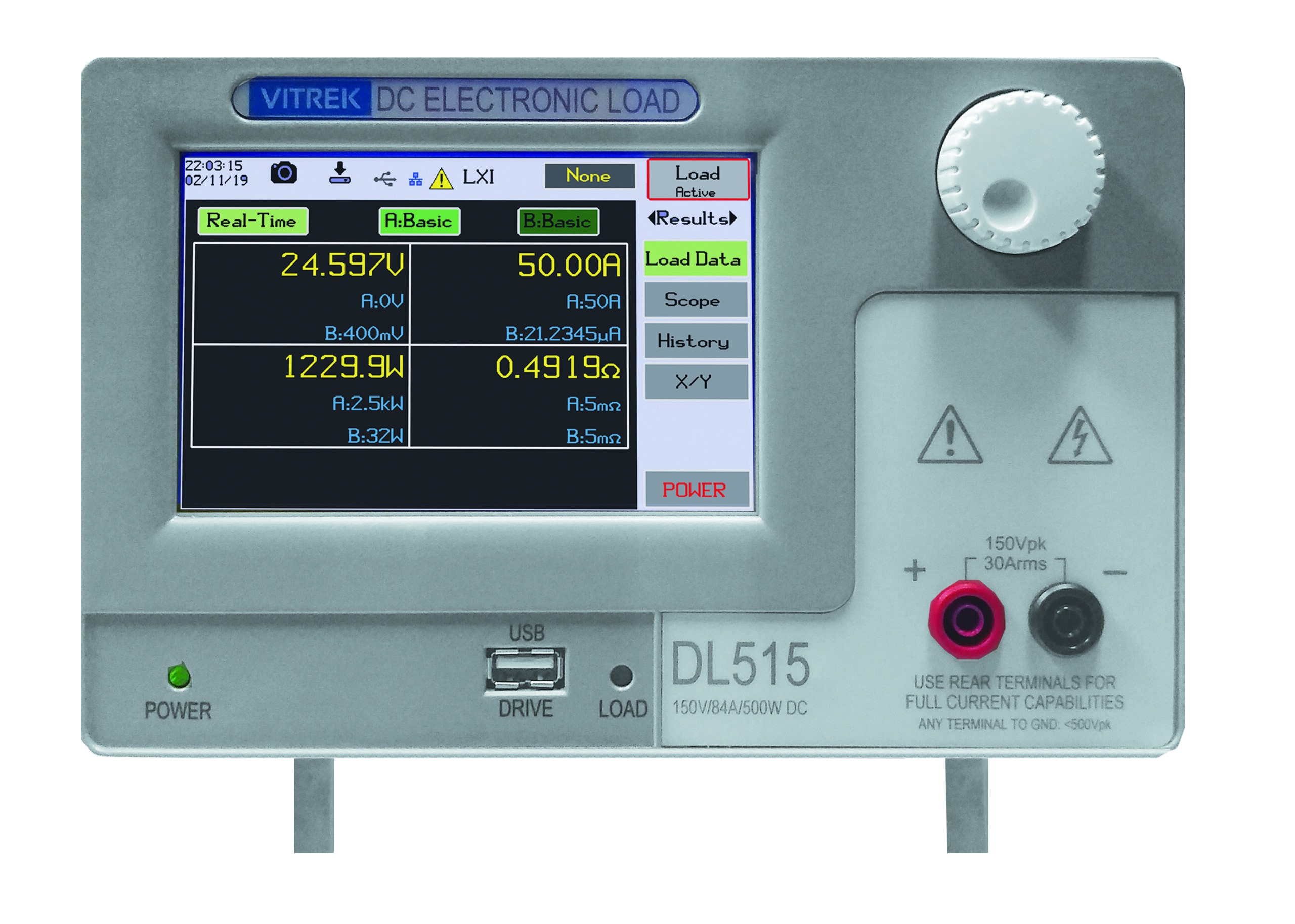
Vitrek’s electrical safety analyzers meet the demanding requirements of IEC 60950 compliance testing. They combine high-voltage generation, precision measurement, and comprehensive safety features in ruggedized platforms designed for both laboratory and production environments.
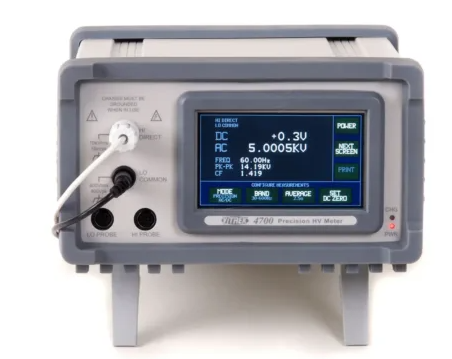
Vitrek 4700: This precision high voltage meter provides exceptional accuracy and versatility for applications that require repeatable high-voltage measurements.
- Voltage Range: 0-5000V AC/DC
- Current Range: 0.001-20 mA
- Special Features: Automated ramp/dwell timing, programmable pass/fail limits
- Applications: Ideal for standard IT equipment testing
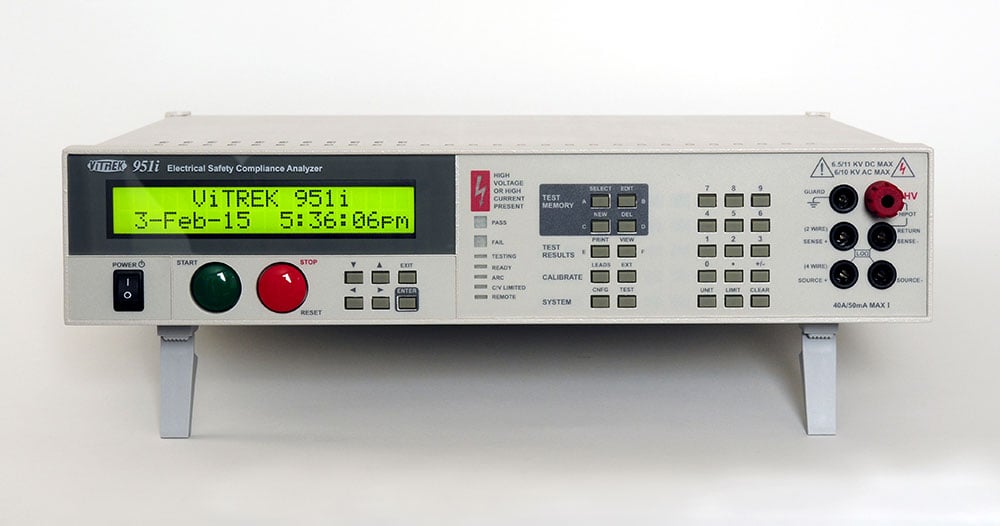
Vitrek 95X Series Hipot Testers: These robust solutions perform high-voltage testing, including Hipot tests. They are designed for a wide range of applications, making them ideal for manufacturers needing to meet all IEC 60950’s stringent requirements.
- Built-in Voltage Capabilities: 6.5KVDC, 11KVDC or 15KVDC and 6KVAC, 10KVAC or up to 30KV RMS AC with external option
- Operator Safety Features: GFI high-speed shutdown, SFI™ safety interlock, TLSS™ test lead safety sense, recessed start switch
- Power Output: 50mA DC, 100mA & 200mA AC for heavy-duty testing
- Test Speed: Ramp rates up to 50KV/second, test times as fast as 3ms
- Test Sequence Memory: Holds up to 100 tests with 100 steps, multiple interface options including Ethernet, RS232, and GPIB
Vitrek V7X Series Hipot Testers: Designed for safety and efficiency, theyd support multi-point testing and are ideal for industries requiring electrical safety compliance.
- 6 Functions Choose From: AC/DC Hipot, IR, Ground Bond, Continuity & Built-in Switching
- Source Current: 5KV AC/DC Hipot, 20mA max source current, 1-30A RMS Ground Bond
- Advanced Measurement: 100nA leakage current resolution, 450GΩ max insulation resistance
- Connectivity & Safety: USB, RS232, Digital I/O; built-in arc detection, safety shutdown, CE certified

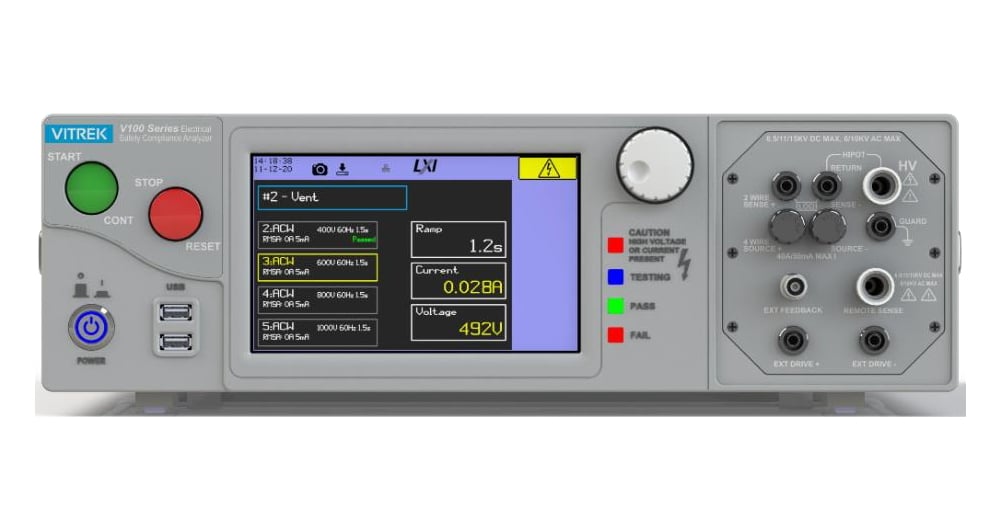
Vitrek V10X Series Hipot Testers: An automation-ready electrical safety testing platform combining a touchscreen workflow, advanced DSP measurement, and multi-test capability for high-voltage production and laboratory environments.
- 6 Test Functions: AC Hipot, DC Hipot, Insulation Resistance (IR), Ground Bond, 4-Wire Low-Resistance, and Built-in Switching
- High-Voltage Output: Up to 10 kVAC / 15 kVDC standard; expandable to 30 kVAC with external module; 50 mA DC, 100 mA and 200 mA AC options
- Precision Measurement: 100 pA leakage current resolution; phase angle analysis; configurable arc detection with sub-150 µs breakdown response
- Automation & Connectivity: SCPI-compliant LAN, USB, RS232, Digital I/O, optional GPIB; 100 test sequences with 1,000+ steps; built-in PDF and CSV export; direct control of up to 1,600 HV scanner channels
- Safety Features: GFI high-speed shutdown, SFI™ safety interlock, TLSS™ test lead safety sense; CE certified per EN 61010-1; made in the U.S.A.
Count on Vitrek for Safety and Reliability:
IEC 60950 compliance serves to ensure electrical safety in the IT and telecommunications industry. As equipment becomes more complex and power densities increase, the importance of thorough, accurate dielectric withstand testing grows.
Success requires understanding the standard’s requirements, the proper test procedures, and using instrumentation capable of delivering the precision and reliability that safety-critical applications demand. The consequences of inadequate testing extend far beyond regulatory non-compliance, potentially resulting in field failures and safety incidents.
Vitrek’s electrical safety analyzers provide advanced capabilities, proven reliability, and comprehensive automation– enabling confident IEC 60950 compliance. From precision voltage generation to advanced current measurement and automated test sequencing, these instruments deliver the performance required for demanding high-voltage testing.