Load cells are essential in modern engineering, providing accurate measurements of force, weight, and pressure across industries from manufacturing to aerospace. Engineers working with load cells face challenges like electromagnetic interference (EMI), temperature-induced drift, and bridge unbalance, which can affect measurement accuracy. Signal conditioning plays a crucial role in overcoming these obstacles by converting raw sensor outputs into clean, amplified signals for data acquisition systems. Load cells measure force, weight, and pressure by converting mechanical strain into electrical signals, typically in the millivolt range. Proper signal conditioning ensures linearity, repeatability, and precision across the measurement span. MTI Signal Generators by Vitrek assist in calibrating and verifying load cell signal conditioners, supporting system reliability and high accuracy measurements. This post covers fundamentals of load cell signal conditioning, core components, role of MTI signal generators, industry-wise applications, test setups, and engineering considerations for high-accuracy measurements in various applications.
Fundamentals of Load Cell Signal Conditioning
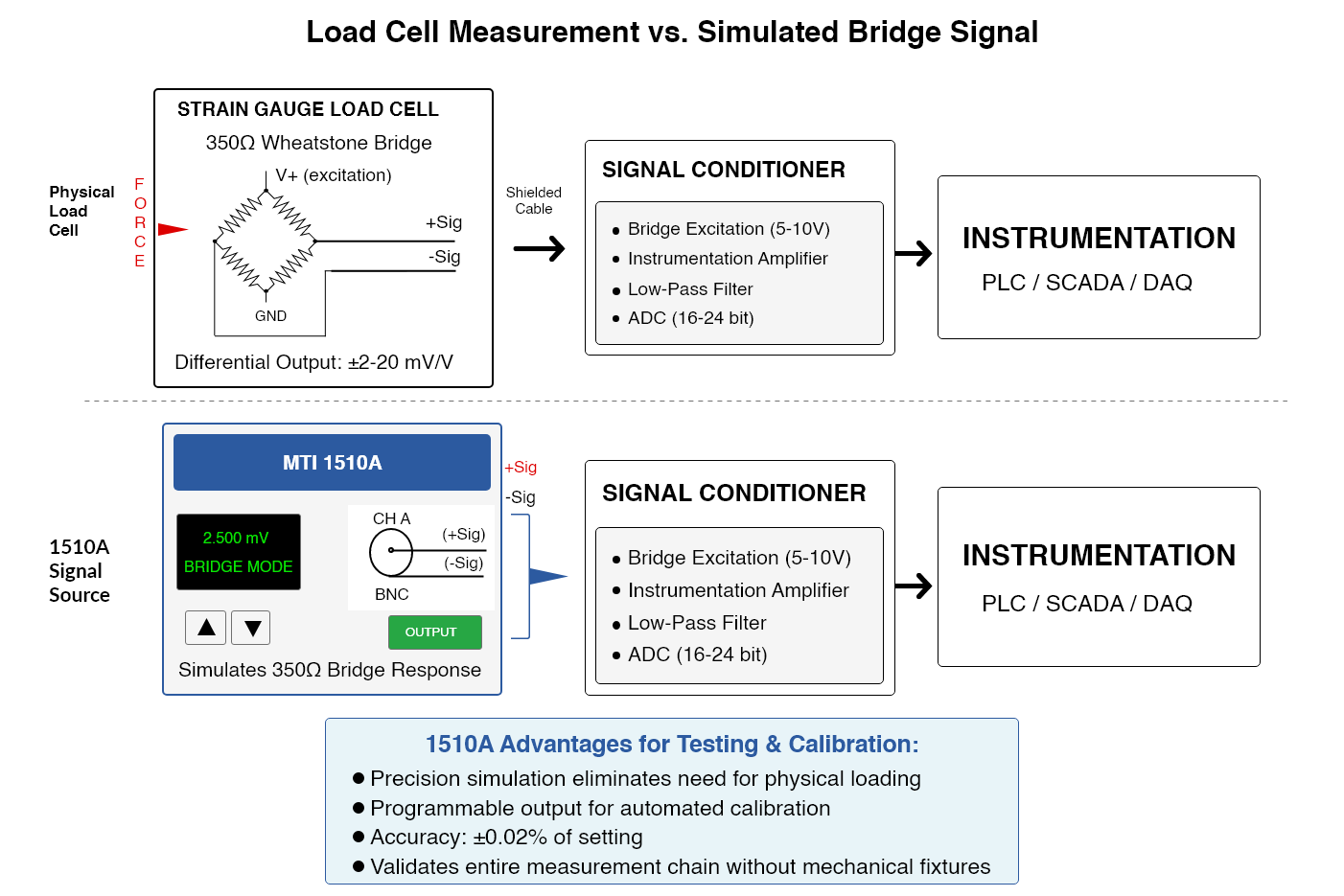
Load cells employ Wheatstone bridge circuits to generate low-level differential signals proportional to applied force. The bridge configuration converts resistance changes in strain gauges into voltage outputs, typically ranging from 1 to 3 millivolts per volt of excitation. Signal conditioning transforms these weak signals into usable measurements through four key functions.
- Excitation: It provides a stable voltage or current source that energizes the bridge circuit, maintaining consistent reference levels.
- Amplification: It boosts millivolt-range signals to levels suitable for analog-to-digital converters and data acquisition systems, typically in the 0-10V range.
- Filtering: This removes high-frequency noise and interference from power lines, motors, and switching equipment.
- Offset and linearity correction: It ensures accurate scaling across the measurement range, compensating for bridge imperfections and thermal effects that would otherwise introduce systematic errors.
Core Components of a Load Cell Signal Chain
The signal chain follows a clear path from sensor to display, with each component contributing to measurement quality and system performance.
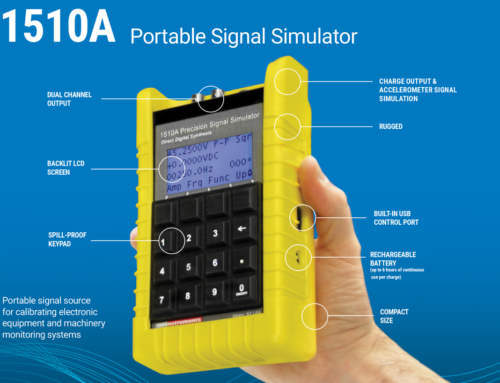
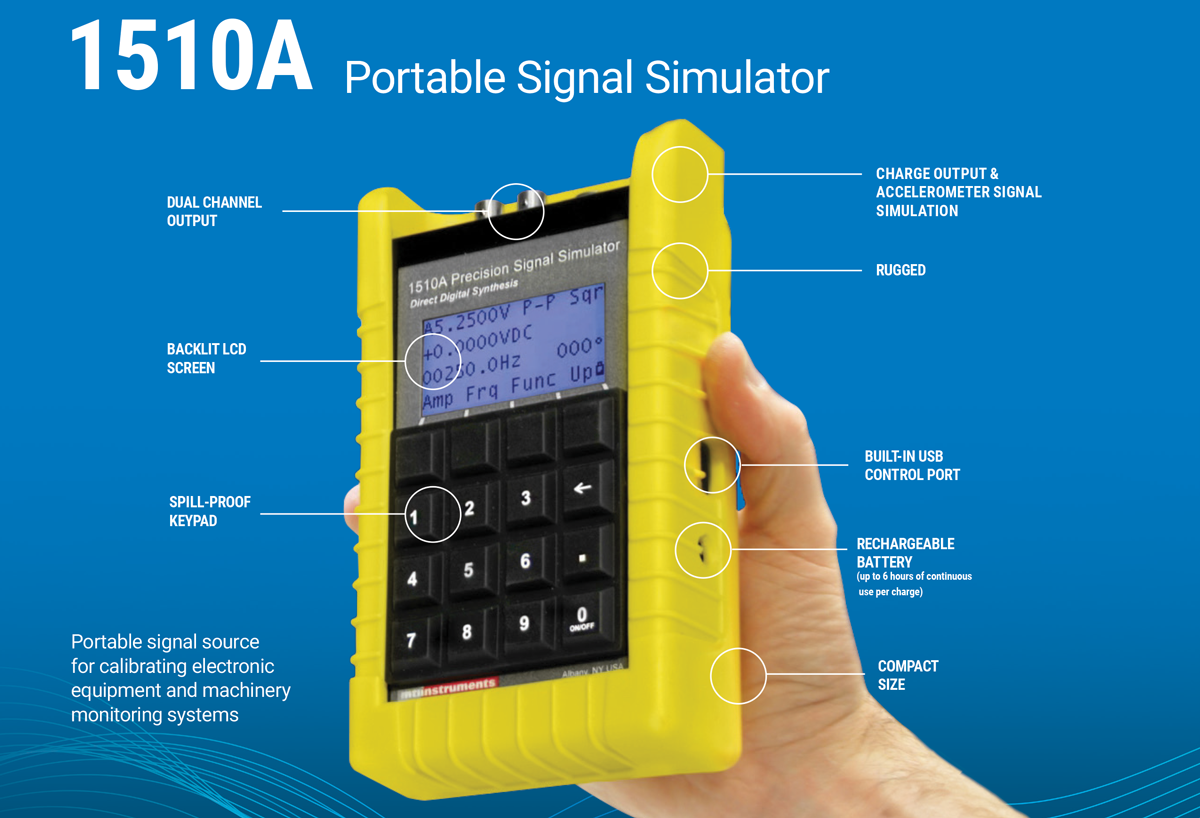
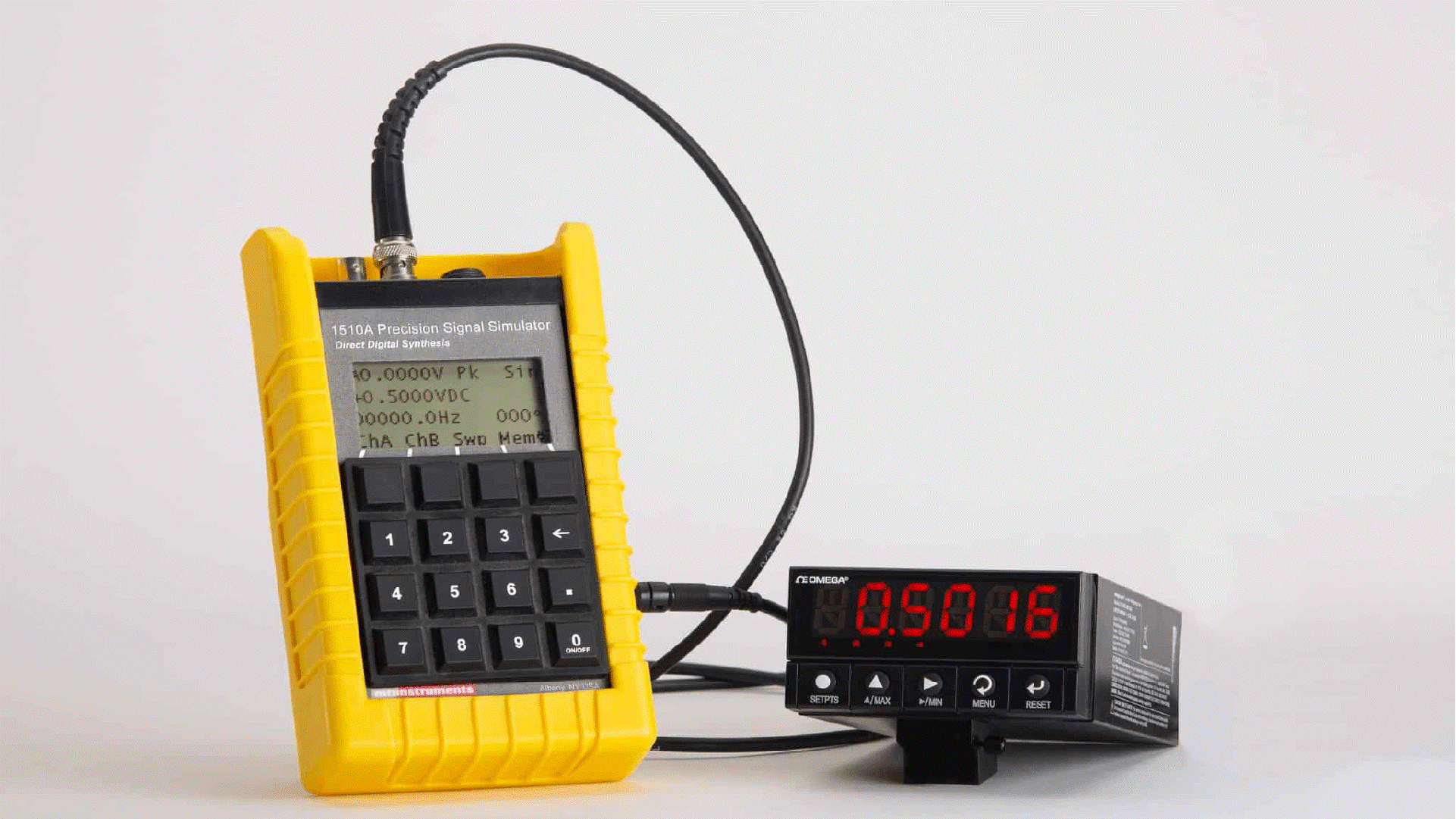
- Load Cell Sensor: The 1510A signal generator simulates microvolt-level bridge outputs using 24-bit closed-loop control, providing ±1 µV to ±99.999 mVDC with an accuracy of 0.05% ± 5 µV and resolution of 0.1 µV. This precision enables highly stable strain gauge simulation, ensuring reliable load cell signal conditioning across industrial environments.
- Load Cell Signal Conditioner: Load cell signal conditioners often include low-pass or band-pass filters and signal amplification electronics. This is where the 1510a provides unique value. It maintains 0.05% voltage accuracy from 10 mV to 10 V across 0.1 Hz to 100 kHz, with 0.005% frequency accuracy. This level of accuracy ensures amplifier stability and filter cut-off frequency location, allowing validation of signal conditioning systems with minimal distortion and exceptional gain consistency.
- Excitation Regulation Systems: Many load cell signal conditioners also provide a stable excitation voltage to the bridge circuit. The 1510A can output a stable DC excitation voltage up to ±9.9999 VDC with 0.05% ± 0.1 mV accuracy, ensuring negligible drift or ratiometric error. Its current-limited design and thermal compensation maintain consistent output for load cell excitation across varying temperature conditions.
- Calibration Traceability: Providing 0.05% signal accuracy and digital USB control, the 1510A enables precise calibration of monitoring and amplifier systems without physical loads. Its traceable and programmable signal output ensures consistent, verifiable standards for long-term load cell signal conditioning system performance.
Role of MTI Signal Generators in Load Cell Calibration and Verification
MTI’s signal generation solutions, including the MTI 1510A Signal Generator, provide precision tools for validating load cell instrumentation without mechanical loading requirements. These instruments simulate real-world load cell outputs by generating differential millivolt signals that replicate bridge behavior across the full measurement range.
Signal generators produce controlled voltage levels with accuracy exceeding typical load cell specifications, enabling verification of amplifier gain, linearity, and offset performance. The ability to sweep through voltage ranges allows engineers to test system response at multiple load points, systematically identifying nonlinearities and calibration errors. This approach eliminates the need for dead weights, hydraulic presses, or force calibration rigs during routine verification, while field calibration becomes practical without transporting heavy reference standards or disrupting production operation
Test Setup to Verify a Load Cell Measurement System
Systematic verification procedures ensure measurement system performance meets specifications before commissioning and throughout service life.
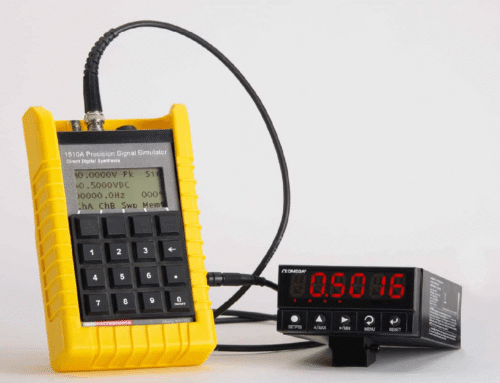
- Physical Configuration: Replace the physical load cell with an 1510A Signal Generator connected to signal conditioner terminals. The 1510A provides accurate signal simulation for load cell bridges (typically up to 100 mV output) while maintaining proper cable routing and shielding.
- Signal Level Programming: Set the generator to output equivalent mV/V levels spanning the measurement range at 0%, 25%, 50%, 75%, and 100% intervals,, including negative values for bidirectional measurement applications.
- System Response Observation: Observe system output for gain verification comparing displayed values against calculated expectations. Check zero reading stability for offset verification and monitor variability at fixed levels for noise assessment.
- Signal Chain Validation: Documented results confirm proper gain factors and acceptable noise performance before deployment. Comparison with previous calibration data reveals drift trends that may require corrective action in load cell signal conditioning systems.
- Troubleshooting Advantages: Faster validation cycles reduce calibration time from hours to minutes supporting preventive maintenance. Repeatable controlled conditions eliminate mechanical loading uncertainty, and systematic fault isolation identifies failing components.
Engineering Considerations for High-Accuracy Signal Conditioning
Proper implementation of signal conditioning systems requires attention to details that separate adequate performance from exceptional measurement quality.
- Cable Selection and Shielding: Twisted-pair construction with matched conductors minimizes magnetic coupling maintaining differential balance. Low-capacitance cables reduce high-frequency rolloff and single-point shield connections prevent ground loops in load cell signal conditioning.
- Grounding and Isolation Strategies: Careful ground management avoids circulating currents introducing offset voltages. Single-point grounding isolates chassis potential, while isolation amplifiers break ground paths in electrically noisy environments, such as those with welders or motors.
- Temperature Stability Management: Compensation strategies include matched resistor networks, integrated temperature sensors, and digital algorithms. Bridge completion resistors at sensor temperature minimize thermal drift and matching thermal time constants improves overall compensation.
- Bandwidth and Filtering Design: Low-pass filter corner frequencies set 10 times higher than maximum signal frequency match dynamic applications. Multi-pole filters improve noise rejection, and 60 Hz notch filters attenuate power line interference.
- Long-Term Stability Factors: Component aging in precision amplifiers requires periodic recalibration maintaining specifications over service years. Moisture ingress (which may degrade insulation resistance) and mechanical stress relaxation in load cells may cause shifts in linearity and zero-offset.
Take Control of Load Cell Accuracy with MTI Signal Generators
Signal conditioning is crucial for accurate load cell performance, converting weak sensor signals into dependable measurements for quality control, process monitoring, and safety. MTI Signal Generators allow engineers to validate instrumentation amplifiers and DAQ systems without mechanical load testing or production delays. These tools ensure long-term accuracy through traceable calibration and simplify diagnostics during troubleshooting.
Industry Applications of MTI Signal Generators
MTI Signal Generators serve critical roles across multiple industries where sensor validation ensures safety, quality, and operational efficiency.
- Cabling and Wiring Troubleshooting: Technicians inject known signals throughout signal chains to isolate cable faults and connection problems. Differential mode testing reveals unbalance, while shielding tests identify electromagnetic compatibility problems.
- Audio Signal Simulation: Audio equipment validation requires precise low-frequency signals replicating transducer outputs across the audible spectrum. Harmonic distortion and intermodulation testing characterize nonlinear behavior in amplifiers and processors.
- Vibration Signal Simulation for Accelerometers: Calibration sources mimic piezoelectric sensor outputs under dynamic conditions, validating integration circuits and verifying frequency response for detecting bearing faults and resonance issues.
- Machinery Speed Signal Simulation: Tachometer input validation occurs without rotating machinery to hazardous speeds. Pulse train generation replicates magnetic pickups and optical encoders while variable speed simulation tests acceleration responses.
- Low-Voltage Bridge Sensor Simulation: Pressure transducers, torque sensors, and displacement systems use bridge configurations requiring similar load cell signal conditioning approaches. Strain gauge simulation validates instrumentation for structural testing and load cell signal conditioning applications.
Visit MTI’s Signal Generator page for detailed specifications of the 1510A model. Contact Vitrek for demonstrations or customized solutions for your measurement challenges.