Introduction
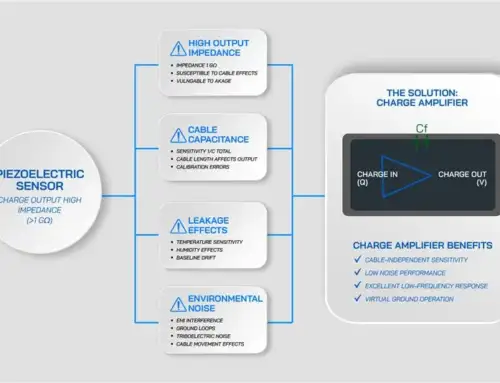
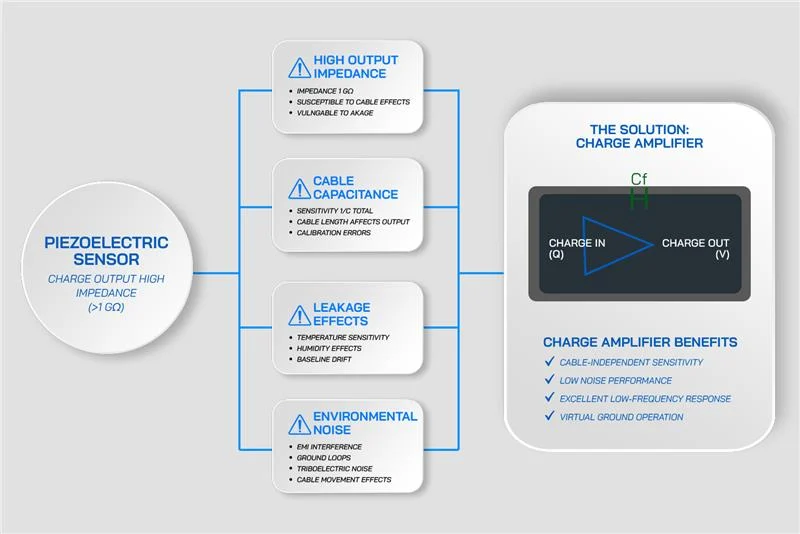
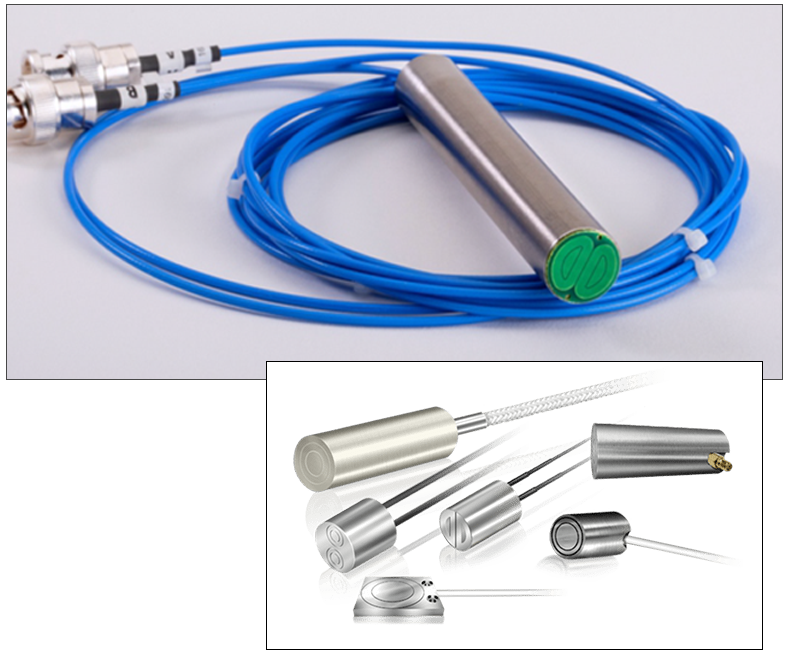
Many aerospace test programs rely on charge-output piezoelectric accelerometers, force sensors, and dynamic pressure transducers because of their wide frequency response, rugged construction, and ability to capture rapidly changing events. These sensors generate extremely small electrical charge signals—often measured in picocoulombs (pC)—that are susceptible to cable capacitance effects, electrical noise, leakage currents, and environmental influences that can compromise measurement accuracy.
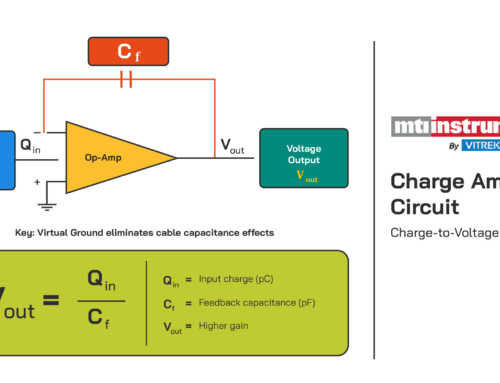
Charge amplifiers address these challenges by converting the sensor’s high-impedance charge output into a stable, low impedance voltage signal suitable for transmission, recording, and analysis. By making measurements largely independent of cable capacitance while maintaining low noise, stable gain, and excellent linearity, charge amplifiers help preserve signal integrity, improve measurement confidence, and ensure accurate data for aerospace qualification, certification, and
validation testing.
Challenge #1: Long Cable Runs
Aircraft structures, engine test cells, environmental chambers, and ground test facilities frequently require sensors to be installed far from instrumentation racks.
Without proper signal conditioning, cable capacitance can significantly alter measured amplitudes and introduce uncertainty into test results.
How Charge Amplifiers Solve It
The output of a charge amplifier is determined by a precision feedback capacitor rather than the cable capacitance between the sensor and instrument. Benefits include:
- Consistent sensitivity regardless of cable length
- Improved measurement repeatability
- Reduced installation variability
- Greater confidence during large-scale structural testing
For modal analysis, wing testing, fuselage validation, and propulsion development programs, the stability helps ensure measurements remain comparable across
channels and test configurations. In many test facilities, locating the charge amplifier closer to the sensor can further improve measurement quality by reducing the length of the high-impedance charge cable and minimizing opportunities for signal degradation before amplification occurs.
Rugged Signal Conditioning in Harsh Aerospace Environments
In many aerospace test programs, the best location for signal conditioning is often the most challenging environment in the test setup. Engine development, propulsion testing, structural qualification, and flight hardware validation frequently require sensors to be located significant distancesf rom data acquisition equipment. While traditional instrumentation is often installed in protected control rooms or equipment racks, placing the charge amplifier closer to the sensor can significantly improve measurement quality.
This approach reduces cable length between the piezoelectric sensor and charge amplifier, minimizing the opportunity for noise pickup, leakage effects, and signal degradation before charge conversion occurs. As a result, engineers can maximize signal integrity at the source while improving overall measurement confidence.
To support these demanding applications, aerospace test organizations often require charge amplifiers capable of operating in harsh environments that may include vibration, temperature extremes, moisture, and exposure to industrial test cell conditions. Rugged charge amplifier designs enable installation directly on engine test stands, thrust frames, and other locations near the sensor, helping preserve measurement quality while supporting reliable operation in challenging test environments.
Challenge #2: Detecting Small Signals in Noisy Environments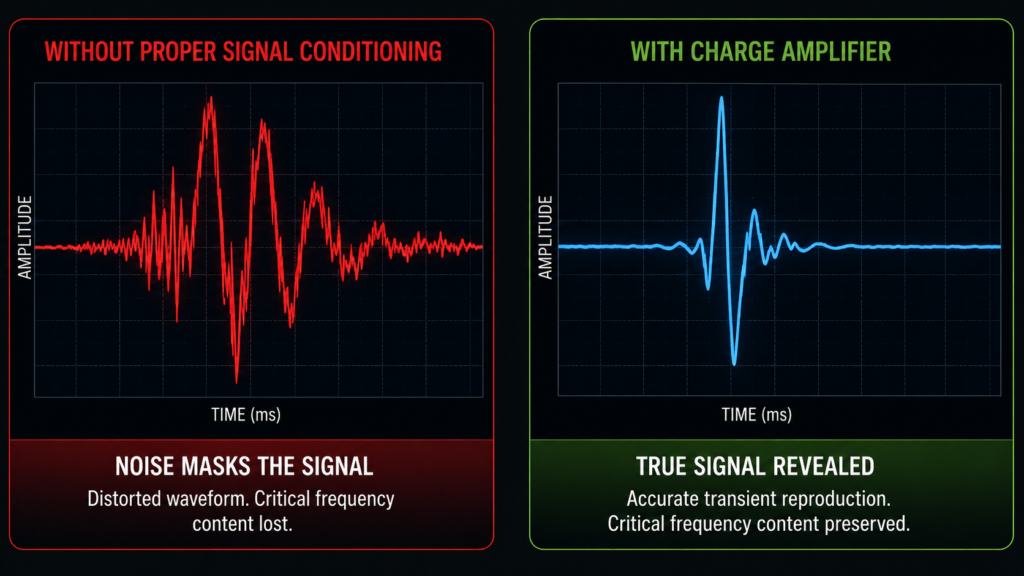
Aerospace and defense test environments contain numerous sources of electromagnetic interference, including variable frequency drives, high-current motors, hydraulic power units, power conversion equipment, RF systems, and environmental chambers.
These noise sources can interfere with sensor signals, masking low-level vibration signatures and dynamic pressure events that are critical for qualification, performance validation, and reliability testing.
How Charge Amplifiers Solve It
Modern charge amplifiers are designed to preserve weak sensor signals while minimizing the effects of electrical noise, leakage currents, and environmental influences. Through careful signal conditioning and stable charge-to-voltage conversion, they help maximize signal integrity throughout the measurement
chain.
Challenge #3: Capturing High-Frequency Dynamic Events
Many aerospace and defense measurements involve transient events that occur in milliseconds or even microseconds. Applications such as pyroshock testing, missile launch analysis, turbine blade vibration monitoring, combustion instability studies, structural impact testing, and flight control validation generate high-frequency signals that must be captured accurately to support engineering decisions.
If the signal conditioning system lacks sufficient bandwidth, these events can become distorted, attenuated, or lost altogether, masking critical frequency content and reducing confidence in test results. High-performance charge amplifiers help preserve the integrity of these measurements by providing wide bandwidth operation, flat amplitude response, minimal phase distortion, and accurate transient reproduction. By faithfully converting weak sensor outputs into stable voltage signals, charge amplifiers enable engineers to capture fast-changing events with greater accuracy and confidence, ensuring recorded waveforms accurately reflect real-world system behavior.
How Charge Amplifiers Solve It
High-quality charge amplifiers are engineered to maintain consistent gain, excellent linearity, low drift, and stable phase characteristics across multiple channels.
The result is improved correlation between channels and greater confidence in system-level measurements.
Challenge #4: Maintaining Channel-to-Channel Consistency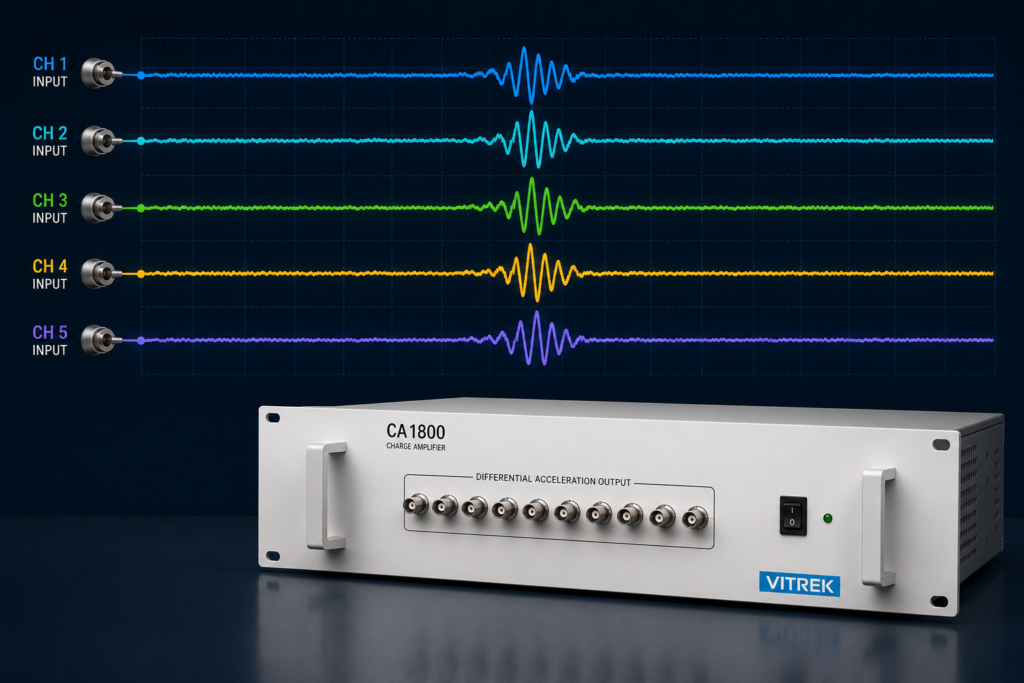
Many aerospace and defense test programs rely on large-scale data acquisition systems that may incorporate dozens or even hundreds of measurement channels operating simultaneously. These channels are often distributed across aircraft structures, propulsion systems, environmental test articles, or complex assemblies, where accurate comparison between sensors is critical to understanding overall system behavior. In these environments, even minor variations in amplifier gain, phase response, or signal conditioning characteristics can introduce measurement inconsistencies that affect the quality of the analysis.
Such discrepancies can significantly impact applications including modal analysis, structural correlation studies, vibration mapping, and digital twin validation efforts. When channels do not respond identically, engineers may observe apparent differences in amplitude or timing that are artifacts of the measurement system
rather than actual physical behavior. This can complicate efforts to identify resonant frequencies, validate simulation models, correlate test results with predicted
performance, and accurately characterize structural responses. Maintaining consistent signal conditioning across all channels is therefore essential for producing reliable, repeatable, and defensible test data in aerospace qualification and development programs.
The Value of Multi-Channel Signal Conditioning
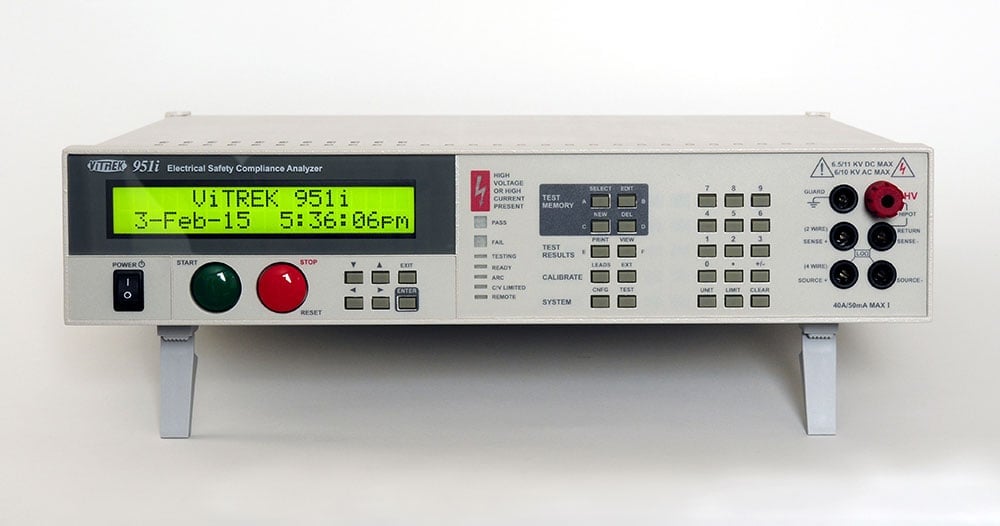
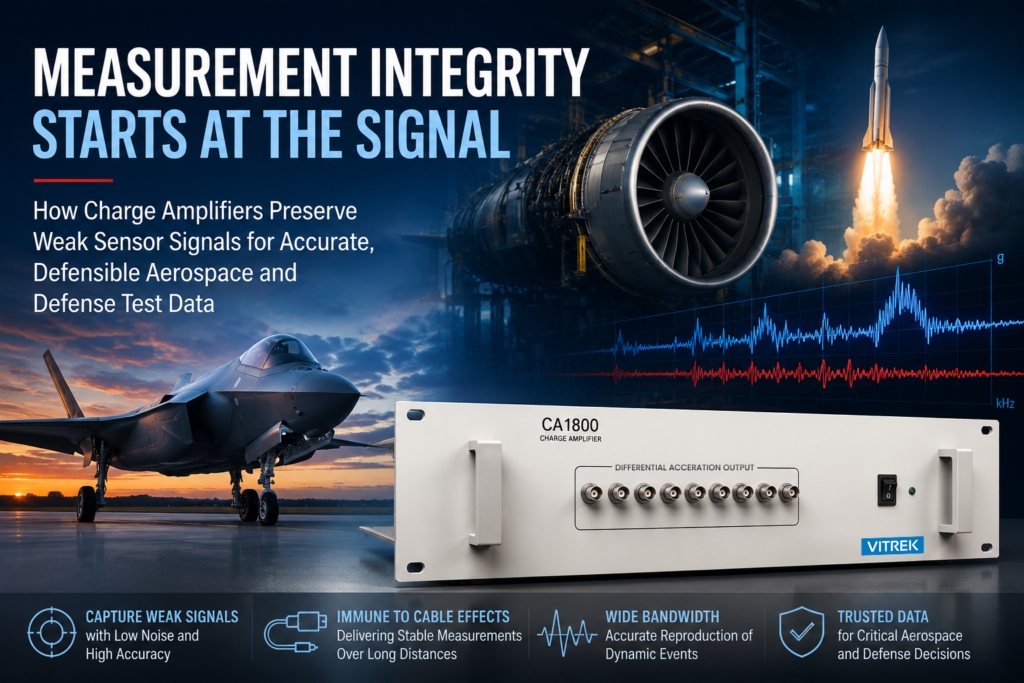
Modern aerospace test programs often require dozens or hundreds of sensors distributed across aircraft structures, engines, environmental test articles, and propulsion systems. Multi-channel charge amplifiers like the Vitrek CA1800 help ensure consistent signal conditioning across all measurement points,
improving channel-to-channel correlation, simplifying system setup, and reducing sources of measurement variability. For large-scale qualification and validation programs, maintaining consistent signal integrity across every channel is essential for producing reliable and defensible test results.
Why Charge Amplifer Selection Matters
Not all charge amplifiers are designed to meet the demanding requirements of aerospace and defense testing. Applications ranging from structural qualification and propulsion development to environmental testing and flight hardware validation require measurement systems capable of delivering accurate, repeatable, and traceable results under a wide range of operating conditions. Selecting the right charge amplifier can significantly impact the quality of the data collected and the confidence engineers place in the resulting analysis.
Noise Performance
Aerospace measurements often involve extremely low-level vibration, force, and dynamic pressure signals that can easily be obscured by electrical noise. The amplifier must provide low-noise performance to ensure critical signal information remains visible and measurable. Poor noise characteristics can mask
subtle events, reduce measurement resolution, and make it difficult to distinguish actual system behavior from background interference.
Gain Stability
Many qualification and development programs involve long-duration testing across varying environmental conditions. Changes in amplifier gain caused by temperature fluctuations, component drift, or aging can introduce measurement uncertainty and reduce repeatability. A high-quality charge amplifier should
maintain stable gain characteristics throughout the test, ensuring accurate and consistent measurements over time.
Dynamic Range
Aerospace systems often generate both low-level signals and large transient events within the same test. Engineers may need to capture subtle structural vibrations while recording significant shock or impact loads. The amplifier must provide sufficient dynamic range to measure both extremes without distortion, clipping, or saturation that could compromise critical data.
Frequency Response
Many aerospace events contain important information across a broad frequency spectrum. Turbine blade vibration, combustion instability, structural resonance, pyroshock events, and flight control transients require accurate amplitude and phase reproduction. Amplifiers with insufficient bandwidth may attenuate high-frequency content or introduce phase errors that affect analysis, correlation, and system modeling.
Calibration Traceability
Aerospace qualification and certification programs often require documented measurement traceability and verification. Engineers should consider whether amplifier performance can be calibrated, verified, and documented to support internal quality requirements and industry and military standards. Traceable calibration provides confidence that collected data remains accurate, repeatable, and defensible throughout the life of the test program.
By carefully evaluating these factors, engineers can select charge amplifiers that not only preserve signal integrity but also support the measurement confidence required for aerospace qualification, certification, and mission-critical system validation.
Conclusion
As aerospace platforms become more sophisticated, measurement uncertainty becomes increasingly costly. Charge amplifiers serve as a foundational element in the signal chain, ensuring that the data used for structural validation, propulsion development, environmental qualification, and flight hardware certification accurately reflects real-world performance.
By combining low-noise operation, cable capacitance immunity, wide bandwidth, stable gain characteristics, and repeatable measurement performance, modern charge amplifiers help transform weak sensor outputs into trusted engineering data capable of supporting critical qualification and mission-readiness decisions.